Source: IEA & Statistical Review of World Energy
The current oil supply and price crisis is producing two simultaneous and seemingly contradictory outcomes. On the one hand, it is accelerating investment in renewables, electrification, and energy diversification in advanced economies. On the other, it is reminding governments and industries that oil remains deeply embedded in the structure of modern economies and that rapid substitution is far more difficult than many transition scenarios assumed. The crisis is therefore not simply driving the World away from oil. It is simultaneously accelerating the structural shift towards renewables in advanced economies while reinforcing the systemic lock-in of oil in critical economic sectors in developing economies. Energy security and energy transition, once viewed as competing priorities, are merging into a single policy objective in mature energy-importing economies. The case of developing countries is more nuanced.
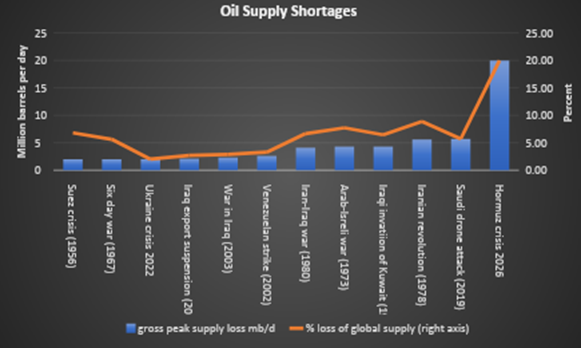
Recent disruptions linked to instability in the Gulf and the Strait of Hormuz that arrested the flow of over 20-25 percent of oil and natural gas supplies have pushed oil prices sharply higher, produced record profits estimated at US$916 billion globally for publicly listed oil and gas firms, increased inflation expectations, and weakened growth forecasts across major economies. This reflects the continuing macroeconomic centrality of oil. Despite decades of transition discourse, oil still underpins transportation, petrochemicals, aviation, shipping, agriculture, construction, mining, and military logistics. Oil remained the largest single source of energy, meeting 34 percent of total global demand in 2024, while global oil demand stayed above 103 mb/d (million barrels per day).
The global economy remains extraordinarily sensitive to disruptions in oil and gas supply because no other energy carrier currently matches oil’s combination of energy density, storability, transportability, and integration into existing infrastructure. Even highly electrified economies remain dependent on diesel-based freight, oil-derived aviation fuel, and oil-based petrochemical feedstocks. The US Federal Reserve’s 2026 financial stability report identified geopolitical oil shocks as one of the largest threats to global financial stability, while the IMF (International Monetary Fund) warned that sustained oil prices around US$125/barrel (bbl) could reduce global growth to nearly 2 percent while sharply increasing inflation. High fuel prices contributed nearly 7 percent to the consumer price index (CPI) in major economies between February and March 2026. The current global trade and food supply chains are still indexed to oil. The crisis has seen a sharp surge in "middle distillate" prices (diesel, jet fuel). The short-term effect of the oil and gas supply shocks is thus a renewed appreciation of oil’s strategic importance. In some regions, the crisis has perversely provided a lifeline to older fossil fuels such as coal. For instance, parts of Europe and many regions of Asia have temporarily ramped up coal production to shield households from astronomical gas price spikes that influence electricity tariffs.
Oil import bills have increased for economies like India, potentially widening its current account deficit to 2-2.5 percent of GDP. Standard models show that a 25 percent oil price increase can reduce GDP by 0.5 percent, and that Asia's oil burden could hit 6.3 percent of regional GDP at US$120/bbl. Global merchandise trade is expected to slow sharply from 4.7 percent growth in 2025 to 1.5–2.5 percent in 2026. Energy shocks are pushing up prices and increasing the cost of living. Investors are pulling back from developing countries, weakening currencies and raising borrowing costs. 3.4 billion people live in countries already spending more on debt than on health or education.
In oil-importing developing countries like India, the evidence suggests oil shocks mainly hurt growth through short-run macro channels rather than permanent structural damage, which is exactly why policymakers are pushing diversification and energy-security buffers. For energy-importing developing countries, the crisis is thus not replacing oil’s economic importance but quantifying its cost.
For developing nations in Asia and Africa, the priority is energy addition. The crisis has fuelled a pragmatic reassessment, with major industry voices calling for an "energy addition" approach—scaling up both conventional and low-carbon energy systems in parallel to manage risk and meet demand. They need to power growing economies and lift citizens out of poverty, expanding all available energy sources, including oil and coal. For major fossil fuel producers outside West Asia, the crisis is a reminder of oil's enduring value. The crisis has therefore reinforced the strategic value of oil security. Governments are once again emphasising strategic petroleum reserves, diversified crude suppliers, refinery resilience, and maritime security. The IEA (International Energy Agency) itself, despite being one of the strongest advocates of clean energy transition, recently stressed that “oil supply security” remains high on the global policy agenda and released strategic reserves to stabilise markets during the present disruptions. For producers, high prices mean record revenues, which fund national budgets and sovereign wealth funds.
Historically, high oil prices have been among the strongest catalysts for energy transition. The oil shocks of the 1970s stimulated nuclear power, fuel efficiency standards, public transport expansion, and North Sea oil development. Similarly, the current crisis is strengthening the economic attractiveness of EVs, renewable electricity, battery storage, heat pumps, and alternative fuels in affluent economies.
The single most powerful structural headwind for oil is the unstoppable rise of EVs (electric vehicles). In 2025, global EV sales surged by over 20 percent to over 20 million units. This technological shift has a compounding effect, permanently destroying demand for transport fuel year after year. The structural shift from internal combustion engines to EVs, especially in China, is permanently dampening the link between oil prices and passenger mobility. The country’s oil demand growth slowed sharply from 8.7 percent in 2023 to only 0.8 percent in 2024 due to rapid EV adoption, high-speed rail expansion, and increased use of natural gas trucks. In advanced economies overall, oil demand remains below pre-pandemic levels because efficiency gains and electrification are offsetting economic growth.
Peer-reviewed research supports the price-to-transition link directionally. A study on China's energy mix found that a 1 percent increase in oil prices results in a 0.16 percent increase in renewable energy consumption, modest per-unit, but significant at scale. A 30-country panel study found significant asymmetric impacts. Oil-exporting countries demonstrate a strong, positive long-run response to volatility, with price uncertainty acting as a catalyst for economic diversification and sustainable investment in renewables as a strategic risk management tool. The sectoral composition of that investment is telling. Solar energy remains the largest single recipient of clean energy funds, attracting US$450 billion, nearly double the amount five years ago. Investments in electricity, including generation, grids, and storage, are now expected to be 50 percent higher than those for oil, gas, and coal combined. Ten years ago, fossil fuel investments exceeded spending on electricity infrastructure by 30 percent. That structural inversion is arguably the most important energy statistic of the decade. In 2025, global energy transition investment hit a record US$2.3 trillion, with clean energy supply. According to the IEA, total global energy investment was about US$3.3 trillion, with roughly US$2.2 trillion going to clean energy and about US$1.1 trillion to fossil fuels. For a second consecutive year, clean energy spending in 2025 outpaced fossil fuel investment, with the gap widening to over US$100 billion from US$85 billion in 2024. Fossil fuel supply investment fell for the first time since 2020, declining US$9 billion year-on-year.
According to the IEA, oil demand growth was already decelerating well before the crisis, growing by just 0.7 percent in 2025, with demand in advanced economies continuing a structural decline. Global oil demand is forecast to rise only 2.5 mb/d from 2024 to 2030, reaching a plateau around 105.5 mb/d, with a small decline expected in 2030. EVs are set to displace 5.4 mb/d of global oil demand by the end of the decade. In power, renewables added a record 585 GW in 2024 and accounted for over 90 percent of new global power capacity, while low-carbon sources reached 40.9 percent of global electricity generation.
Modern economies are less oil-intensive than they were in the 1970s. Global oil intensity has fallen dramatically since the 1970s. In 1970, the world used about 0.12 tons of oil equivalent (toe) per unit of GDP, while by 2022 this had dropped to around 0.05 toe per unit of GDP, less than half that in the 1970s. The US is a net exporter of oil now, unlike the 1970s when it was a net importer.
Oil crises do not automatically destroy oil demand, but they do change capital allocation. Several recent analyses suggest high oil prices can discourage conventional fuel use and strengthen the economic case for renewable investment over time, even if the effect is uneven across countries and often delayed. That is why the current shock is being described by many energy-transition analysts as a security crisis as much as a climate one. Countries want insulation from geopolitics, shipping chokepoints, and imported fuel volatility.
The World economy is showing that it can grow while using less oil. The clean-energy response is now large enough to be economically meaningful. The most powerful argument for acceleration is that energy security has now replaced climate anxiety as the dominant political driver of renewables policy, a far more durable political force.
The crisis has triggered a dual response that reflects a world of divergent priorities and capabilities. The broader economic lesson is that oil crises tend to strengthen both transition policies and fossil fuel realism simultaneously. It is a geopolitical rupture with structural implications, and it is producing sharply divergent outcomes depending on whether the country is affluent, less affluent, energy importing or energy exporting.
For advanced, import-dependent economies, the crisis is acting as a powerful accelerator of the energy transition and is acting as proof of concept for their energy independence strategies, further doubling down on renewables, electrification, and diversification away from unstable regions. For energy-poor developing nations, it's a trap that makes transition harder, not easier.
Strategic Reserves
India’s strategic petroleum reserve can last 74 days to meet the demand arising out of any global turbulence. For any country like India, which is growing at a phenomenal pace, there must be a very viable and secure reserve, so that it is not in a vulnerable situation in the case of global turbulence. India has several refineries both in the West coast as well as the East. Taking advantage of low crude oil prices in April/May 2020, Strategic Petroleum Reserves (SPR) were filled to full capacity, leading to notional savings of approximately INR50 billion (US$0.53 bn). The weighted average procurement cost of crude oil filled in SPRs from Government Budgetary Support is still half of the currently prevailing crude oil prices.
Demand
According to the World Oil Outlook 2025, India is projected to be the largest contributor to global oil demand growth till 2050. As per OPEC’s flagship long-term outlook, India alone is expected to add 8.2 million barrels per day (bpd) of oil demand by 2050, with growth “driven primarily by transportation, petrochemicals and industrial activity.” The outlook projects India as the “largest and most stable contributor” to global primary energy demand growth. India’s total primary energy demand is expected to almost double from around 22 million barrels of oil equivalent (mboe) per day in 2024 to about 43.6 mboe per day by 2050. As per the outlook, demographic and economic trends would consolidate India’s central role in future energy demand. India’s urbanisation rate is projected to rise from 37 percent to 53 percent by 2050, while the country’s passenger car fleet is expected to expand from around 50 million in 2024 to more than 240 million by 2050.
LPG
Bharat Petroleum Corporation Ltd (BPCL) has launched Bharatgas Lite, an innovative LPG (liquefied petroleum gas) cylinder made from advanced composite materials, aimed at providing safer, lighter, and more user-friendly cooking energy solutions for households in Goa. Bharatgas Lite, branded as “Naye Bharat Ka Naya Cylinder,” is over 50 percent lighter than traditional mild steel cylinders, facilitating easier handling, transportation, and installation. Its translucent design allows users to see LPG levels clearly, assisting in refill planning and preventing unexpected runouts. Additionally, the rust-free construction fosters a clean kitchen environment and eliminates corrosion issues typically linked to steel cylinders. Its explosion-resistant features provide enhanced safety under extreme conditions, reflecting BPCL’s commitment to innovation and improved safety standards in the domestic LPG market. Bharatgas Lite improves safety by minimising leakage risks and damage, featuring enhanced handling and a modern design suitable for contemporary kitchens. The cylinder is available for new domestic non-subsidised LPG connections and through a cylinder swapping scheme for existing customers, with an incremental deposit of INR300 for exchanges. New customers can directly opt for Bharatgas Lite with a security deposit of INR2,500.
India’s energy infrastructure offers potential investment opportunities worth up US$500 bn in the South Asian nation’s quest to become independent in production of energy. India is building energy infrastructure to meet demand, looking towards affordable refining and transport options. The South Asian nation aims to become the world’s No. 1 in refining capacity. India is currently the third largest energy consumer and importer of crude. It aims to boost to US$100 bn the opportunities on offer in oil exploration, in the effort to lift the area under exploration to 1 million square kilometre (386,000 square miles).
Imports
Indian refiners are avoiding Russian oil purchases for delivery in April and are expected to stay away from such trades for longer, a move that could help New Delhi seal a trade pact with Washington. The US (United States) and India moved closer to a trade pact, announcing a framework for a deal they hope to conclude by March that would lower tariffs and deepen economic cooperation. Indian Oil Corporation (IOC), BPCL and Reliance Industries Ltd (RIL), are not accepting offers from traders for Russian oil loading in March and April. These refiners, however, had already scheduled some deliveries of Russian oil in March. Most other refiners have stopped buying Russian crude. Indian refiners may change their plan and place orders for Russian oil only if advised by the government. Indian refiners have been buying more oil from Middle Eastern, African and South American countries as they scale back Russian oil purchases.
BPCL, one of India’s leading refiners, and Trafigura, a market leader in the global commodities industry, announced a new crude oil supply agreement signed. Under the agreement, Trafigura has been awarded a tender to supply Iraqi Basrah and Oman crude oil to BPCL on term basis. Delivery will begin in April 2026. This marks the first agreement of its kind for BPCL for imports of Basrah crude, representing a strategic milestone in the company's procurement approach and strengthening India’s energy security framework.
As India seeks to diversify their avenues for oil import, BPCL, would enhance their term contract to procure crude oil from Brazil’s Petrobras, according to the government. The latest deal would have the Indian state-owned refiner procuring 12 million barrels of Brazilian crude from the state-owned entity for US$780 million (mn) in the upcoming financial year. IOC also maintains a commercial agreement with the Brazilian state-owned oil entity for procurement of crude oil. Other than the Bharat Petroleum-Petrobras deal, state-owned upstream major Oil India (OIL) along with their Navaratna subsidiary Numaligarh Refinery would be inking a memorandum of understanding (MoU) with French major TotalEnergies for LNG sourcing.
India’s Mangalore Refinery and Petrochemicals Ltd (MRPL) is exploring purchases of Venezuelan oil as it halts imports of Russian oil to comply with Western sanction. The refiner, which operates a 500,000 barrel per day (bpd) refinery in the southern state of Karnataka, exports about 40 percent of its refined fuel output. Higher margins on refined fuel exports are offsetting the loss of Russian oil. The refiner meets about 40 percent of its crude needs through purchases from the Middle East, in addition to sourcing from spot markets and processing domestic oil. MRPL is actively considering purchases of Venezuelan oil if commercial terms, including freight rates, are favourable. India refiners are considering buying Venezuelan oil. To boost its profits, MRPL has turned its focus to direct retail sales instead of selling refined fuels to other refiners. The company plans to expand its retail fuel network to 500 outlets within three years from 200 and aims to operate 1,000 fuel stations within five years.
Exports
IOC expects its annual diesel exports to rise sharply to up to 5 million metric tonnes (mt) from 2027 as it expands refining capacity. IOC is raising its annual refining capacity to 98 mt in a year and a half from 80 mt currently. The company operates nearly 41,000 retail fuel stations in India, but IOC’s retail network would be expanded to more than 44,000 over the next two years.
India stopped exporting diesel to the European Union (EU) due to the European Union’s ban on fuel derived from Russian crude and instead sent a record amount to West Africa, while Turkey’s diesel exports to the EU slowed in recent months. The developments highlight that the EU policy, aimed at punishing Russia over its 2022 full-scale invasion of Ukraine, is prompting a further reordering of intercontinental oil flows, forcing India’s oil refineries to seek new markets and disrupting Turkey's lucrative trade in supplying fuel to the EU. Russian crude made up 30 percent of India’s seaborne crude imports in 2025, while it represented 48 percent for Turkey’s seaborne crude imports last year. India has not sent any diesel to the EU so far in January, having exported a monthly average of 137,000 bpd in 2025, making it the third biggest diesel exporter to the bloc. In India, RIL has been the biggest fuel exporter to the EU in recent years, while Turkey’s Star oil refinery, owned by Azerbaijan state-owned Socar, was the biggest Turkish exporter. India’s diesel exports to West Africa were on track to reach an all-time high in December at around 155,000 bpd, which showed January exports were on pace to reach 84,000 bpd.
Production
Asian Energy Services has discovered oil at the onshore Mevad field in Gujarat following the drilling and testing of a new well with expected peak production of about 125-130 barrels of oil per day (bopd). The well NM-01 was drilled to a total depth of 1,650 metres, encountering three hydrocarbon-bearing sand intervals—Mandhali, Sobhasan and Kalol. The zones are being evaluated sequentially. The well is currently producing about 100 bopd in the testing phase from Sobhasan sand, with data indicating potential production rates of 125-130 bopd.
The partnership between Oil and Natural Gas Corporation Ltd (ONGC) and global major BP has led to a crude oil output increase of over 3,500-4,000 bpd to date from Mumbai High, bringing the total production to 126,000 bpd from the block. For ONGC’s Krishna Godavari (KG) block, oil production has stabilised at around 27,000 bpd, compared to the peak production estimates of 45,000 bpd earlier. The company has onboarded a subject matter expert to boost production from ONGC’s KG-98/2 block. Crude oil output from ONGC’s KG-98/2 block has been sliding since production commenced in January 2024. The firm’s crude output from the block was around 35,000 bpd in 2024, declining currently to 26,500 bpd.
IOC’s overseas joint venture (JV) with Bharat PetroResources, a wholly owned subsidiary of BPCL, has made a new oil discovery in Abu Dhabi’s Onshore Block 1. The block is operated through Urja Bharat Pte Ltd (UBPL), a 50:50 venture between IOCL and Bharat PetroResources. UBPL won the concession in Abu Dhabi’s 2019 bid round. Testing of the exploratory well XN79-02S resulted in a flow of light crude oil, marking the first oil find in the Habshan reservoir within the concession area. The discovery will now be appraised and assessed for potential development. The latest find comes after UBPL’s first discovery in the same block in early 2024, when oil was struck in the "unconventional Shilaif play" at the XN-76 well.
World
According to Citi bank, oil prices may stay elevated due to rising geopolitical risks, US restrictions on Russian oil purchases and continued Chinese buying, even as markets entered the year expecting a large oversupply. Citi noted that Kazakhstan production outages, severe cold weather in the US, geopolitical tensions in the Middle East and tightening US restrictions on Russian oil purchases helped keep prices above US$60 a barrel. As per Citi potential for Iran getting attacked has escalated the geopolitical premium of oil prices by potentially US$3 to US$4 a barrel, adding that any further ratcheting up of tensions would lift the premium higher. It highlighted that Chinese buying may help explain oil’s unexpected price strength, noting continued inventory-driven imports. Citi estimated apparent crude stock builds averaged around 0.7 million bpd in 2025.
Oil prices gained further ground as supply concerns lingered after a winter storm disrupted US crude output and exports, while Middle East tensions lent additional support. US producers lost up to 2 million bpd or roughly 15 percent of national output over the weekend, analysts and traders estimated, as the storm strained energy infrastructure and power grids. Crude and liquefied natural gas (LNG) exports from US Gulf Coast ports tumbled to zero, ship tracking service Vortexa said.
According to the International Energy Agency (IEA), global oil market will be in deep surplus in the first quarter of 2026, as so far excess supplies have offset the geopolitical risk of disruption. The IEA, which advises industrialised countries, in its oil report projected global oil supply would exceed demand by 4.25 million bpd in the first quarter. A surplus of that size would be about 4 percent of world demand and is larger than other predictions. Oil prices have risen about 6 percent since the start of the year, as concerns about geopolitics and possible oil market disruption drove buying. The IEA said it is too early to assess the full implications of all the latest geopolitical developments on the oil market, but said the US blockade on Venezuelan oil shipments had lowered exports by 580,000 bpd from December to early January.
Africa & Middle East/ OPEC
Organization of the Petroleum Exporting Countries (OPEC)’s oil output fell in January due to lower supply from Nigeria and Libya, a survey found, which offset increases in members including Venezuela after the US capture of Nicolas Maduro and the ending of an oil blockade. The OPEC pumped 28.34 million bpd in January, down 60,000 bpd from December's total, the survey showed, with Nigeria posting the largest decline. OPEC+, comprising OPEC and allies including Russia, in January began a first-quarter pause of its monthly output increases amid concerns of a supply glut. Under an agreement by eight OPEC+ members covering January output, the five of them that are OPEC members - Algeria, Iraq, Kuwait, Saudi Arabia and the UAE - were to keep output unchanged before the effect of compensation cuts totaling 130,000 bpd for Iraq and the UAE. The survey showed that they increased output by 60,000 bpd month on month, but total output remained below their targets. Nigeria had OPEC's largest output decline, and Libyan supply also fell as bad weather impacted loadings, the survey found.
Chevron and TotalEnergies are among the oil majors snapping up offshore blocks in West and Southern Africa as compelling geology, regulatory reforms, and the need to restock spur a hunt for the next Brazil. Companies are restocking their oil and gas assets given prospects for fossil fuel demand to stay higher for longer than predicted just a few years ago. With growth in US shale topping out, other regions are drawing fresh attention, including West and South Africa, with Shell, for example, returning to offshore Angola after a 20-year absence. Of the oil and gas discovered since 2020, some 11 percent, or about 8.7 billion barrels of oil equivalent (boe), has been found along West Africa, most of it oil, African upstream regional research director for S&P Global Commodity Insights Justin Cochrane said.
Oilfield services provider SLB said it has been awarded a US$1.5 bn contract over five years by Kuwait Oil Company for the development of the Mutriba field in the country. Oil producers in the Middle East, Africa and Asia are seeking to boost inventories, which is driving exploration and drilling activity in the region and with it demand for oilfield services.
The head of the Syrian Petroleum Company, Youssef Qeblawi, said that oil major Shell had asked to withdraw from the al-Omar oilfield and transfer its share to Syria’s state-owned operators but that US (United States) companies were interested in the country’s energy sector. The al-Omar oilfield, Syria’s largest, came under government control at the weekend after a lightning offensive against Kurdish forces who had held the site for nearly a decade and used it as a military base. Qeblawi said the field had operated as a joint venture between the Syrian Petroleum Company and Shell. The London-listed oil major had suspended all of its activities in Syria, including exploration and production activities, in December 2011 after the outbreak of Syria’s war and European Union sanctions on Syria’s oil sector.
Russia/Central Asia
Russian oil production dipped around 0.7 percent last year to 9.129 million bpd, OPEC (Organization of the Petroleum Exporting Countries) data showed. Russia has managed to keep broadly steady its oil output, which together with natural gas accounts for around a quarter of federal budget tax proceeds, despite drone attacks by Ukraine on energy infrastructure and lower crude prices. Russia is a member of the OPEC+ group of leading oil producers which decided to keep its output steady. Oil prices fell more than 18 percent in 2025 - their steepest yearly drop since 2020 - amid growing oversupply concerns. Russian oil production in December declined by 73,000 bpd to 9.304 million bpd, according to OPEC. In its report, OPEC said Kazakhstan’s oil output last month dropped by 237,000 bpd to 1.522 million bpd.
Russian Deputy Prime Minister Alexander Novak said that there is currently a balance on the global oil market, while demand will be gradually rising in March and April, when asked about the OPEC+ group’s plans on its production policy. OPEC+ agreed to keep its oil output unchanged for March at a meeting. Novak didn’t directly say what the group’s steps could be starting from April.
North & South America
US oil major Chevron is pushing Iraq to improve returns on the giant West Qurna 2 oil field as a condition for buying the project from Russia’s Lukoil. Iraq nationalised the oilfield after the US imposed sanctions on Lukoil to put pressure on Russia to end its war in Ukraine. The sanctions made it difficult for Lukoil to operate its international operations including West Qurna, which is one of the world’s largest oilfields, accounting for about 0.5 percent of global oil supply and nearly 10 percent of Iraq’s output. A deal for Chevron in West Qurna 2 would mark a further push into Iraq for the US oil major after it agreed to develop several fields in the country as part of an international expansion since completing a deal to acquire US oil producer Hess for US$53 bn in 2025. Iraq, the world's seventh-largest oil producer, has improved the terms of its oil contracts in deals signed with global oil majors in the past two years as it seeks to attract investment and increase output.
US shale production could fall by as much as 400,000 barrels of oil per day in 2026 if OPEC countries try to increase market share and oil prices fall to as low as US$40 a barrel, according to Rystad Energy CEO (chief executive officer) Jarand Rystad. US shale production could remain flat if prices stay close to US$60 a barrel, but that will require OPEC countries to hold production at present levels, Rystad said. The US Energy Information Administration (EIA) said last year that it expected American shale oil production to reach around 9.7 million bpd in 2025.
US Energy Secretary Chris Wright told oil company executives that Venezuela’s output can rise 30 percent from its current level of 900,000 bpd in the short- to medium-term. US President Donald Trump wants US oil executives to invest US$100 bn to fix Venezuela’s dilapidated oil industry and increase output, a key objective for Washington after US forces seized Venezuela’s leader Nicolas Maduro in a raid. Years of under-investment and sanctions have seen Venezuela’s oil output plummet. It pumped 3.5 million bpd in the 1970s when it accounted for 7 percent of global supply, but represents just 1 percent of world output. An increase of 300,000 bpd would have little impact on the global market, one person at the meeting said. Global oil supply was 106 million bpd in 2025.
President Donald Trump has lavished the US oil industry with favourable policies since returning to the White House, but his twin demands for cheap oil and “energy dominance” are increasingly colliding with companies’ bottom lines. Over the past year, the Republican president has rolled out numerous pro‑fossil fuel measures and offered strong support for US oil firms abroad, a sharp departure from his Democratic predecessor Joe Biden’s focus on combating climate change. The price drop, and expectations of a future global supply glut, pushed US drillers to scale back operations, with the domestic oil rig count falling 15 percent over the past year, according to energy service provider Baker Hughes. That pullback is set to slow the pace of US output growth this year and next.
Asia Pacific
Australia’s Woodside Energy flagged a lower production outlook for 2026, tempering stronger-than-expected fourth-quarter (Q4) revenue that was underpinned by resilient output despite weaker oil and gas prices. Output reached a record 198.8 million barrels of oil equivalent, exceeding guidance on the back of strong operating performance across key assets, including Sangomar, Shenzi and Pluto LNG.
EU & UK
The European Commission proposed a sweeping ban on any services that support Russia’s seaborne crude oil exports, going far beyond previous piecemeal EU sanctions in its effort to stunt Moscow's key source of income for its war on Ukraine. Russia exports over a third of its oil in Western tankers - mostly from Greece, Cyprus and Malta - with the help of Western shipping services. The ban would end that practice, which mostly supplies India and China, and render obsolete a price cap on purchases of Russian crude oil that the Group of Seven Western powers have tried to enforce with mixed success.
Andhra Pradesh CM reviews fuel shortage as 421 petrol bunks shut amid panic buying
27 April: Andhra Pradesh Chief Minister (CM) N Chandrababu Naidu reviewed the fuel shortage situation following panic buying that led to the temporary closure of 421 petrol bunks. Out of 4510 fuel outlets in the state, the shutdowns were due to supply constraints triggered by a sharp surge in demand for petrol and diesel. Fuel supply has increased by nearly 10 percent compared to earlier levels, but panic buying led to heavy rush at several outlets. Under normal conditions, daily sales are around 6330 kilolitres of petrol and 9048 kilolitres of diesel. Sales rose to 10345 kilolitres of petrol and 14156 kilolitres of diesel. With demand increasing by over 50 percent, stocks at fuel stations are depleting quickly, resulting in long queues. The situation is being affected by bulk purchases in the aquaculture sector, where fuel is often stored in drums.
RIL navigates oil market volatility with diverse sourcing, ops shifts
26 April: India’s largest private refiner Reliance Industries Ltd (RIL) relied on diversified crude sourcing and operational agility to navigate a volatile energy market during the last quarter of FY26, marked by geopolitical disruptions and sharp cost swings. After the Iran war disrupted oil and gas flows from Gulf countries, RIL, which operates the world’s largest oil refining complex at Jamnagar in Gujarat -- tapped non-Persian Gulf suppliers to replace barrels lost due to the conflict, according to the company.
India resorts to LPG spot buying to bridge West Asia supply gap
25 April: With energy supplies still tight amid the West Asia conflict, India is securing LPG (liquefied petroleum gas) cargo through spot purchases to meet demand for cooking gas cylinders among households as well as commercial establishments. Oil marketing companies (OMCs) have tied up with the US to bridge the supply shortfall. Besides long-term contracts with the country, OMCs have added spot cargoes in the last few weeks, which are likely to reach India in June and July. When asked, Sujata Sharma, joint secretary in the petroleum and natural gas ministry, said India was importing nearly 60 percent of its LPG requirement before the war broke out in West Asia. According to the ministry, against a daily LPG requirement of approximately 80,000 tonnes, India has raised domestic output by nearly 20 percent to about 46,000 tonnes.
Over 50k LPG holders in Bilaspur may face cylinder supply disruptions for KYC non-compliance
23 April: Approximately 50,865 LPG (liquefied petroleum gas) holders in Bilaspur, Himachal Pradesh, may face disruptions in their LPG cylinder supply if they do not complete the KYC process for their connections immediately. District Controller of the Department of Food, Civil Supplies, and Consumer Affairs, Bilaspur, Brijendra Pathania, informed that in accordance with directives from the Ministry of Petroleum and Natural Gas, E-KYC has been made mandatory for all active gas connections. Connections for which E-KYC remains incomplete may be blocked from booking or obtaining refills after the stipulated deadline. The deadline will expire in one week, he said.
India’s Adani Total Gas posts quarterly profit rise on demand boost
27 April: India’s Adani Total Gas reported a rise in fourth‑quarter profit, supported by higher compressed natural gas demand and steady growth in household piped natural gas connections, which lifted overall volumes. The company, a joint venture of the Adani Group and French oil major TotalEnergies SE, said its consolidated net profit rose about 9 percent to INR1.68 billion (US$17.84 million) in the three months ended 31 March. CNG sales volumes, which account for over half of total sales, rose 17 percent during the quarter, driven by sustained demand from the transport segment and a rise in outlets. Piped natural gas, Adani Total’s second-biggest segment, logged a 5 percent increase in sales volumes at 91 million standard cubic meter of gas per day. India in March ordered faster approvals for new gas pipelines, deeming permissions granted if authorities fail to respond, helping lift household piped gas additions to about 580,000 that month from roughly 342,300 a year earlier, government data showed. Natural gas sourcing costs for Adani Total Gas rose 17.8 percent, contributing to an 18 percent rise in its total expenses to 1INR4.92 billion. Total revenue from operations rose 16.5 percent to INR16.95 billion.
Gadkari backs proposal to shift INR122 bn synthetic natural gas project HQ to Nagpur
25 April: A renewed push to locate the headquarters of a proposed INR122.15 billion synthetic natural gas (SNG) project in Nagpur has gathered momentum, with Union Minister Nitin Gadkari urging top officials of Coal India Ltd (CIL) and Bharat Petroleum Corporation Ltd (BPCL) to consider the move. The proposal, led by the Association for Industrial Development (AID), seeks to relocate the project’s administrative base from Mumbai to Nagpur, arguing that proximity to the plant site and regional balance make a compelling case. AID president Ashish Kale recently submitted a representation outlining these factors, prompting Gadkari’s intervention. The SNG project, based on coal gasification technology, is planned at Majri in Bhadravati tehsil of Chandrapur district. Conceived as a joint venture between the two public sector companies, the project is expected to generate employment for around 3,000 skilled and semi-skilled workers, adding to the region’s industrial base.
Coal India plans 10-year roadmap to slash 243 MT coal imports
26 April: Coal India Ltd (CIL) is planning a comprehensive 10-year roadmap to slash the current 243 million tonnes (MT) coal import volume through ramped-up domestic production, coal quality upgrades, and logistics cost parity. The proposed roadmap targeting coal import cuts includes a detailed forensic audit of imports, backed by sector-specific policies and phased shift strategies to boost local supply. It will include the National Washery & Logistics Grid to streamline coal washing and transport, addressing key bottlenecks in the supply chain.
New Era Cleantech plans to make coal-based urea at Chandrapur plant
25 April: New Era Cleantech Solutions Pvt Ltd, which held a ground-breaking for its coal gasification plant at Chandrapur, has drawn plans to make coal gas-based urea at the site on priority basis. The company, which had plans to make ammonia out of coal, wants to build the urea plant in the first phase itself. The plant is estimated to produce about 3,850 tonnes per day of urea. This is equivalent to 1.27 million metric tonnes per annum (MMTPA) based on gasification of 1.3 MMTPA of coal. If this works out, it would become the first-ever private sector coal-to-urea plant in the country. The company has written a letter to the ministry of coal seeking a clear policy framework for the coal-to-urea projects in the country, financial incentives and the viability gap funding.
Bharat Coking Coal announces scheme to encourage higher coal offtake, cut costs for power consumers
23 April: Coal India Ltd subsidiary Bharat Coking Coal Ltd (BCCL) announced a scheme to encourage higher coal offtake and reduce costs for power consumers for buying coal during the April-June period of the current financial year. The move aims at encouraging power companies to buy more coal, speed up transport, and cut their costs. It will improve coal supply, ensure steady electricity, and support India’s self-reliance goal amid global energy issues. The scheme will apply to all eligible power sector consumers covered under the fuel supply pact, including those under the flexi-linkage scheme.
Hindustan Power Receives MoEF Clearance for Proposed 2×800 MW
28 April: Hindustan Power, one of India’s leading integrated power producers, has received environmental clearance from the Ministry of Environment, Forest and Climate Change (MoEF) for its proposed 2×800 MW (megawatt) transitional power project at Anuppur in Madhya Pradesh. The approval marks a significant milestone for the execution of the second phase for the company’s Anuppur power plant. Post this nod, the transitional energy power project will proceed to the next stage, which includes detailed engineering and execution planning, subject to applicable approvals. Hindustan Power had commissioned the first phase of the project - aggregating to 1,200 MW - between 2015 and 2016. The project has since played an important role in boosting the region’s power infrastructure with long-term capacity creation.
India’s power demand crosses record 256 GW as mercury levels rise across India
26 April: India’s peak power demand hit an all-time high of 256.11 GW (gigawatt) due to an intensifying heat wave, which increased the use of cooling devices such as air conditioners and desert coolers, according to the power ministry data. The peak power demand eclipsed the previous record of 252.07 GW, hit just a day earlier, 24 April. According to the data, peak power demand set a new high of 256.11 GW, and it was fully met. Experts stated that peak power demand is inching towards the ministry’s estimate of 270 GW for this summer season, as mercury levels have begun to rise. The country’s peak power demand has risen with temperatures in April. The highest electricity supply on 22 April was 239.70 GW which rose to 240.12 GW on 23 April 2026. In the first fortnight of this month, the peak power demand met, or the highest supply of electricity in a day, remained lower than the 235.32 GW recorded in April 2025. Experts are of the view that demand and consumption of electricity may further rise due to more intense heat waves, with more frequent use of air conditioners, air coolers, and other appliances by domestic and commercial consumers to beat rising mercury levels in the country. Last summer, the peak power demand was 242.77 GW, recorded in June, 2025, but stayed below the government's estimate of 277 GW. In May 2024, the peak power demand was 250 GW, a record at the time and exceeding the previous all-time peak of 243.27 GW set in September 2023.
No unannounced load shedding in Kerala, outages due to overload: Electricity Minister
25 April: Kerala Electricity Minister K Krishnankutty said there was no unannounced load shedding in the state, attributing recent power interruptions to temporary overload caused by high consumption. Clarifying concerns raised from various parts of the state, the minister said the disruptions are not deliberate but occur when demand peaks, particularly between 10 pm and 11 pm.
UPERC slaps notice on UPPCL over delay in restoring power to prepaid smart meter users
24 April: The Uttar Pradesh Electricity Regulatory Commission (UPERC) has issued a show-cause notice to UP Power Corporation Ltd (UPPCL), seeking an explanation as to why a penalty of INR1 lakh per day should not be imposed for failure to restore electricity supply to prepaid smart meter consumers within the stipulated time frame. In its notice issued, UPERC said that UPPCL has acknowledged non-compliance with regulation 16.11.1 of the UPERC’s standards of performance regulations, 2019, which mandates restoration of power supply within two hours of recharge in the case of prepaid meters. The commission noted that as many as 1.93 lakh prepaid smart meter consumers were affected by delays beyond the prescribed two-hour limit. The notice refers to data submitted by UPPCL on 17 April, in response to an earlier notice from the commission. The data covered prepaid smart meter reconnections across 16 different dates between 13 March and 10 April. During the period, electricity supply to over 40.27 lakh prepaid consumer households was disrupted due to negative balance in their accounts. The commission has directed UPPCL to submit its reply within 15 days of receipt of the notice. Failure to provide a satisfactory explanation could result in financial penalties and further regulatory action.
Power demand in Nagpur surges to 821 MW, strains infrastructure
24 April: Nagpur has recorded a peak power demand of 821 MW (megawatt), the highest so far this season, as rising temperatures and increased use of cooling appliances push electricity consumption upward. The surge has come nearly a month earlier than last year’s peak, indicating an early onset of summer-driven demand pressure on the city’s power network. The sharp increase in demand has placed significant stress on the local power infrastructure, leading to frequent tripping and short-duration outages across several areas. Utilities have attributed the disruptions to load pressure on feeders and transformers, as consumption rises during both daytime and late evening hours. Maharashtra State Electricity Distribution Company Ltd (MSEDCL) said pre-monsoon maintenance work is underway to stabilise the grid, including upgrades to feeders, transformers and distribution lines. However, delays in infrastructure upgrades have limited immediate relief, even as investments worth around INR12 billion are being undertaken to strengthen the network.
Indian court pauses stricter power grid penalties for renewable firms
28 April: A court in the southern Indian state of Karnataka has temporarily blocked new, tougher penalties for solar and wind power producers for deviating from scheduled grid supply after industry bodies challenged the rules. India, on 32 March, increased penalties for wind and solar generators for deviating from their supply pledges to the power grid. Until the next hearing, renewable energy companies can continue using the older system for paying charges when their power generation differs from the schedule given to grid operators, the court order showed. The case was filed by the National Solar Energy Federation of India, which argued that new rules issued by the Central Electricity Regulatory Commission (CERC) were introduced without proper public consultation. Solar and wind power output depends on weather conditions and cannot always be controlled, the petitioners said, unlike coal or gas-based power plants. The federal government and power regulator have been asked to respond by 10 June. India aims to build 500 gigawatt (GW) of renewable energy capacity by 2030. Industry groups had previously said stricter regulations could lead to revenue loss and limit investor interest in India’s clean energy sector.
Greater Noida plans INR800 mn biogas plant at Astauli dumpsite
27 April: Greater Noida Industrial Development Authority (GNIDA) is set to establish a 300 tonne per day (TPD) compressed biogas plant at Astauli dumpsite, around 20 kilometre (km) from Pari Chowk, in a major push for waste management and reduction of legacy garbage in the city. The authority has issued a request for proposal for the project, which is estimated to cost INR800 million. GNIDA will issue a request for proposal (RFP) in a few days. The project aims to process municipal solid waste and convert it into compressed biogas, a clean and sustainable fuel alternative. The proposed plant is expected to substantially ease the burden on the Astauli landfill by handling both fresh waste and legacy waste through biomining and scientific disposal methods.
NPCIL advances Kudankulam Unit 3, completes key reactor flushing stage
27 April: Nuclear Power Corporation of India Ltd (NPCIL) has achieved a key milestone in the development of Kudankulam Nuclear Power Plant’s Unit 3, successfully completing the reactor flushing process. This step is critical in preparing the reactor systems for subsequent stages of commissioning, ensuring that all piping and components are free from impurities before operations begin. Reactor flushing is an essential pre-commissioning activity that helps maintain system integrity and operational safety by removing debris and contaminants from the primary circuit. The completion of this process indicates steady progress in Unit 3’s construction and brings the project closer to fuel loading and eventual power generation. Kudankulam Units 3 and 4 are part of India’s broader nuclear expansion programme aimed at increasing low-carbon baseload power capacity. Progress at Unit 3 reflects continued momentum in the country’s nuclear pipeline, with NPCIL focusing on meeting timelines while adhering to stringent safety and quality standards.
NTPC exploring two nuclear power units of 1.4 GW in Bihar’s Banka
26 April: As part of its energy diversification plan, NTPC Ltd is looking to set up two nuclear units of 700 megawatt (MW) each in the Banka district of Bihar, which could entail an investment of around INR250 billion. At present, NTPC conducting a feasibility study for two 700 MW nuclear units in the district, located around 250 km from Patna. According to industry estimates, a 1 gigawatt (GW) nuclear plant requires an investment of INR150-200 billion and typically takes at least three years from concept to commissioning.
Odisha tops rooftop solar scheme in India
24 April: Odisha has recorded the highest achievement in the country under the utility-led aggregation scheme, a rooftop solar initiative under the PM Surya Ghar-Muft Bijli Yojana (PMSG-MBY), reflecting its implementation strategy and risingconsumer participation in renewable energy adoption. The achievement was highlighted during the 29th board meeting of power distribution companies responsible for electricity supply in different parts of Odisha. Odisha has made encouraging progress under both rooftop solar schemes. A total of 55,888 installations have been completed under PMSG-MBY, while the ULA scheme has added 29,000 more, taking the total number of rooftop solar systems installed in the state to 84,888. Odisha targets to cover three lakh households under the scheme. Odisha has achieved 83,979 installations, showing steady progress.
India weighs petitions on mandate for domestic solar cells
23 April: India’s clean energy ministry said it was examining petitions from both solar manufacturers and developers of clean energy over a mandate to use only domestically made solar cells in power projects from June. A severe shortage of solar cells looms as new rules from June mandate the use of domestically made cells in solar panels. Such mandatory use would drive up prices of solar panels and delay projects, manufacturers have warned the ministry. India’s domestic cell manufacturing capacity of about 25.6 gigawatt (GW) falls short of annual demand of roughly 50 GW, with imports from China supplying more than 90 percent, the industry said. India’s tighter local sourcing rules are part of a push to build domestic clean energy supply chains and meet a net-zero emissions target by 2070.
India needs 10 GW annual wind capacity addition over next decade to meet net zero goal: Joshi
22 April: India must add nearly 10 GW (gigawatt) of wind capacity annually over the next decade to reach the nation’s larger goal of a net-zero economy, Union New & Renewable Energy Minister Pralhad Joshi said. The Minister said India’s wind energy potential is vast and still largely untapped.
Rajasthan ranks third in rooftop solar adoption, driven by policy push
22 April: Rajasthan has emerged as the third-largest state in India in terms of rooftop solar installations, driven by rapid adoption and policy support. The state is witnessing a steady rise in consumers shifting to solar energy, with nearly 675–700 new users adopting rooftop systems every day. According to the state energy department, Rajasthan has installed 2,45,317 rooftop solar units across residential, commercial, and industrial segments, taking total installed capacity to around 2,090 MW (megawatt). The surge in installations has led to 1,43,965 consumers reducing their electricity bills to zero, reflecting the economic viability of rooftop solar adoption. The state currently ranks behind Gujarat and Maharashtra, which lead the country with rooftop solar capacities of 6,882 MW and 5,442 MW respectively. The state government expects installations to continue rising, with rooftop solar adoption projected to cross one lakh new units in the first half of the current year, supported by policy incentives and growing consumer awareness.
Saudi Arabia may lower June oil prices to Asia from record levels
28 April: Saudi Arabia might cut its official June crude selling prices (OSP) to Asia from record levels as spot premiums eased and as demand cooled after weeks of supply disruption from the US (United States)-Israeli war on Iran, according to a survey of industry sources. The June OSP for flagship Arab Light crude might slide to a premium of US$7.50 to US$14.50 a barrel above the average Dubai and Oman quotes, the survey said, US$5 to US$12 a barrel lower than the OSP for May. The wide range of forecasts reflects lingering uncertainty among Asian buyers whose crude supply and price expectations have varied after the war disrupted their supplies. In China, the top buyer of Saudi crude, refiners have been squeezed by weak margins as rising feedstock costs outpaced fuel price hikes while Beijing has curbed refined fuel exports. Chinese refiners planned to buy just 20 million barrels of crude, the lowest volume on record, from Saudi Arabia in May after the seller hiked its price to a record high. Saudi Aramco has been using the Red Sea port of Yanbu to export Arab Light crude after the war restricted shipping through the Strait of Hormuz.
UAE exit weakens OPEC+ power over oil market but group to stay together
28 April: OPEC (Organization of the Petroleum Exporting Countries) and its allies will lose some of their power over the oil market when the United Arab Emirates (UAE) leaves the group on 1 May, but the rest of the producer alliance is likely to stick together and continue to coordinate on oil supply policy, OPEC+ delegates and analysts said. The UAE will become the largest oil producer to depart OPEC, a heavy blow to the organization and its de facto leader Saudi Arabia. Abu Dhabi pumped around 3.4 million barrels per day (bpd) or about 3 percent of the world’s crude supply before the US (United States)-Israeli war on Iran forced it and other Middle East Gulf producers to curb shipments and shut down some production. Once outside OPEC, the UAE will join the ranks of independent oil producers that pump at will, such as the US and Brazil.
Uganda to offer new oil exploration licensing round in 2026/27 financial year
28 April: Uganda will offer a new oil exploration licensing round next financial year, its minister for energy and mineral development Ruth Nankabirwa said. The East African country, which expects to start commercial crude production later this year, is keen to expand its resource base through potential new discoveries. She said that Uganda would offer its third petroleum exploration licensing round in the financial year that starts in July. Uganda’s last licensing round, in which five blocks were on offer, was launched in 2019 and concluded in 2023. The country’s existing reserves, estimated at about 6.5 billion barrels, are all in the Albertine Graben, which straddles Uganda’s border with the Democratic Republic of Congo. The energy ministry says only 40 percent of that region has been explored so far. The government is doing preliminary exploration surveys in two new basins, Moroto-Kadam and Kyoga, located in the country’s north and northeast, respectively.
Italy’s Eni signs agreement to relaunch heavy oil project in Venezuela
28 April: Italy’s energy producer Eni signed an agreement with Venezuela’s oil ministry and oil company PDVSA to relaunch a heavy crude project in the Orinoco Belt, the company said. PDVSA’s key partners have been signing preliminary agreements to confirm interest or expand their oil and gas projects as the government progresses in a broad review of all contracts in the industry as part on an oil reform. PDVSA and Eni, which has presence in the country since 1998, are partners in the Junin 5 project in the Orinoco, which holds some 35 billion barrels of certified oil in place, and in the Petrosucre project, where they produce crude in shallow waters. In 2025, Eni’s production in Venezuela was 64,000 barrels of oil equivalent per day, it said.
Diesel, jet fuel exports from northeast Asia to recover in May
27 April: Northeast Asian spot diesel and jet fuel exports are set to show a recovery in May as refiners capitalise on record margins and improving crude oil supply, traders said. Data showed refiners in South Korea and Taiwan have sold more diesel and jet fuel cargoes loading in May than April although the volume remained below pre-Iran war levels. Refining margins in Asia soared to all-time highs of about US$60 a barrel. The rise in exports has helped ease record spot premiums of both diesel and jet fuel in the Asia Pacific which strained countries as the conflict cut most of the region's oil supply through the Strait of Hormuz. South Korea’s SK Energy, GS Caltex, S-Oil and Hyundai Oilbank sold a total of more than 10 diesel cargoes loading next month, more than twice April’s volume, data showed.
Russian diesel cargoes rerouted from Brazil as global prices surge
27 April: Two tankers carrying Russian ultra-low sulphur diesel (ULSD) were diverted mid-voyage from Brazil to alternative destinations, traders and LSEG data showed. Both were loaded in March at the Russian Baltic port of Primorsk and made almost half of the trip to Brazil before the cargo buyers were switched as traders seized on a spike in global prices due to the Iran war, traders said. Brazil is a major diesel producer, but depends on imports to meet domestic demand, which makes up 20–30 percent of its total fuel consumption. Russian diesel exports to Brazil are not prohibited under current sanctions. Russia has emerged as the dominant diesel supplier to Brazil since March 2023, rapidly displacing US volumes after the European Union’s ban on Russian oil products took effect.
Indonesia to import 150 mn barrels of crude oil from Russia this year: Deputy Energy Minister
24 April: Indonesia will import 150 million barrels of crude oil from Russia this year, Deputy Energy Minister Yuliot Tanjung said. The Southeast Asian country secured supplies of crude oil and liquefied petroleum gas (LPG) from Russia amid energy shortages following the Middle East war. Yuliot said the import volume of LPG from Russia has yet to be decided. Indonesia is seeking to secure crude oil and LPG from other countries including the United States, Yuliot said.
Mexico to send 1 mn barrels of crude oil to Japan: President
23 April: Mexico will send one million barrels of crude oil to Japan, President Claudia Sheinbaum said, noting that up to 1.4 million barrels per day (bpd) of Mexico’s total output is used for domestic refineries and the remainder is exported. Sheinbaum and Japan’s Prime Minister Sanae Takaichi agreed to enhance their cooperation on energy matters as the Iran war disrupts global supply. Takaichi had requested cooperation in building a favorable environment for Japanese companies operating in Mexico as both leaders agreed to strengthen trade relations. Mexico exports between 400,000 and 500,000 bpd.
Sierra Leone signs US$225 mn offshore oil agreement with Nigeria’s Marginal Energy
23 April: Sierra Leone said it had signed a petroleum licence agreement with Nigeria‑based Marginal Energy Ltd, granting the company offshore exploration and production rights as the government seeks to revive interest in its under‑explored upstream sector. The licence, signed through the Petroleum Directorate of Sierra Leone (PDSL), covers offshore blocks G‑145, G‑146, G‑147, G‑160 and G‑161, spanning about 6,800 square kilometres. Marginal Energy, a Nigerian independent, has committed to a seismic and drilling programme with exploration spending expected to exceed US$225 million. Under the agreement, the state will hold a 10 percent carried interest in oil projects and 5 percent in gas during exploration and development, with an option to acquire an additional participating interest on a paid basis of up to 9 percent once production begins.
S&P Global cuts 2026 oil demand forecast by 700k bpd due to Iran war
23 April: S&P Global Energy has reduced its global oil demand forecast for 2026 by 700,000 barrels per day (bpd) as the US (United States)-Iran war disrupts energy supplies from the Middle East and hits demand in the second quarter, consultant Ethan Ng said. Global oil demand growth expected to shrink to 400,000 bpd versus pre-war forecast of 1.1 million bpd. Oil demand to fall sharply in the Middle East and Asia in Q2. About 178 refineries accounting for around 40 percent of the world’s refining capacity are affected by the closure of the Strait of Hormuz. Physical Dated Brent prices are capped by a huge drawdown of strategic petroleum reserves by countries such as Japan and South Korea to manage fuel shortages.
Druzhba oil flows to Slovakia and Hungary after Ukraine war standoff
23 April: Slovakia and Hungary said they began receiving crude oil through the Druzhba pipeline after a months-long outage that had blocked European Union aid to Ukraine. The Druzhba pipeline became one of the most politically charged pieces of infrastructure in Europe after the halt in Russian oil deliveries to Hungary and Slovakia in January which Ukraine blamed on a Russian air strike. Oil through the Ukrainian section of the pipeline started flowing, prompting Hungary to lift its veto on a €90 billion (US$105.4 billion) EU loan urgently needed by Ukraine. Slovakia confirmed early that oil had reached it and Hungary’s oil group MOL confirmed that it had begun receiving crude oil through the pipeline. Slovakia said it expected to receive 119,000 tonnes of oil through the pipeline by the end of April.
Gulf oil output likely to rebound within months after Hormuz reopening: Goldman
23 April: Gulf oil production, sharply curtailed by the Iran conflict, is likely to mostly recover within a few months after the Strait of Hormuz fully reopens, but could take significantly longer, Goldman Sachs said. The bank estimated about 14.5 million barrels per day (bpd) of Gulf crude output – around 57 percent of pre‑war supply – was offline in April, largely due to precautionary shutdowns and stock management rather than physical damage to oilfields. The Strait of Hormuz handles about a fifth of global oil flows under normal conditions, so prolonged disruption has significant implications for global energy markets. Goldman said that a safe and sustained reopening of the strait in the absence of renewed attacks on oil infrastructure would allow production to return relatively quickly, supported by spare capacity in Saudi Arabia and the United Arab Emirates (UAE). However, any recovery will be constrained by logistics and well performance. Available empty tanker capacity in the Gulf has dropped by about 130 million barrels, or 50 percent, limiting how quickly producers can move oil once exports resume, the bank said. An average of forecasts from external agencies suggests Gulf producers could recover about 70 percent of lost output within three months and around 88 percent within six months, Goldman said, while cautioning that a prolonged closure raises the risk of lasting damage to supply.
UAE’s ADNOC to invest tens of billions to build US gas business
28 April: UAE (United Arab Emirates)’s Abu Dhabi National Oil Company (ADNOC) is planning to invest tens of billions of dollars to build a natural gas business in the United States (US). The company is reviewing 29 potential deals aimed at creating a vertically integrated global gas business. The strategy is to diversify ADNOC’s overseas investment arm XRG’s commodity exposure by operating across the entire gas value chain. XRG is weighing options to create a business that would meet rising global demand for liquefied natural gas (LNG) and the growing US (United States) demand to power data centres.
Japan’s JERA secures adequate LNG stocks through July despite Iran crisis
27 April: JERA, Japan’s biggest power generator, has secured adequate liquefied natural gas (LNG) inventories through July to cover Middle East supply disruptions caused by the US (United States)-Israeli war with Iran. JERA handles about 35 million metric tonnes annually of imports and trading, of which roughly 27 million tons are used domestically. About 5 percent of its Japan-bound shipments pass through the Strait of Hormuz, where the conflict has disrupted shipping. In February, JERA signed a 27-year deal with QatarEnergy for 3 million tonnes per annum (mtpa) from the North Field South expansion project starting in 2028.
Camuzzi, Vitol sign MoU for Argentina’s US$3.9 bn LNG del Plata project
27 April: Camuzzi Gas Inversora and Vitol signed a memorandum of understanding (MoU) for Argentina’s LNG del Plata project, the Argentine firm said, with Vitol potentially acquiring up to 100 percent of production and evaluating an equity investment. The project, currently wholly owned by Camuzzi, is located at the Port of La Plata in Buenos Aires province and will require an investment of US$3.9 billion over the next 20 years.
Eni-Repsol JV seeking to increase gas output at Venezuela’s Cardon IV
27 April: Spain’s Repsol and Italy’s Eni are seeking to increase production at Venezuela’s Cardon IV gas field to 645 million cubic feet per day, the project manager Gonzalo Antonio Carrillo said. The field currently produces about 580 million cubic feet per day, Carrillo said. Venezuela’s vice minister for gas Cindy Rondon said the country needed to speed up repairs to gas infrastructure.
Canada greenlights Enbridge gas pipeline expansion in test of Carney approval process
24 April: Canada has approved a C$4 billion (US$2.93 billion) expansion of Enbridge’s Westcoast natural gas pipeline system in British Columbia, the first major pipeline project to get the go-ahead under Prime Minister Mark Carney. Enbridge has been developing its Sunrise Expansion project, which will add 300 million cubic feet per day of natural gas capacity in B.C., since 2022, and applied for federal regulatory approval two years ago. Enbridge will build Sunrise to meet rising B.C. natural gas demand, including from LNG projects such as Woodfibre, which is under construction on the Pacific coast and of which Enbridge owns 30 percent. Enbridge’s Westcoast natural gas pipeline system stretches 2,900 kilometres (1,802 miles) from northeast British Columbia to the Canada-US (United States) border, with a current capacity of 3.6 billion cubic feet of natural gas per day. The expansion will involve constructing new pipeline segments along the existing system, additional gas compression capacity and upgrades and changes to existing facilities. Construction is scheduled to begin in July, with a targeted in-service date in late 2028.
Pakistan LNG seeks three spot cargoes in first tender since December 2023
23 April: Pakistan LNG Ltd has issued its first spot tender for liquefied natural gas (LNG) since December 2023 amid supply shortfalls triggered by the US (United States)-Israeli war with Iran. The company is seeking bids from international suppliers for three LNG cargoes of around 140,000 cubic metres each for delivery on 27-30 April, and on 1-7 and 8-14 May at Port Qasim in Karachi. Pakistan Federal Minister of Energy Awais Leghari said the LNG tender was aimed at meeting rising power demand and to cut reliance on costlier diesel and furnace oil. Pakistan is not sure when it will get more cargoes from Qatar, Leghari said. Pakistan has not received any LNG cargoes loaded after the Middle East war began on 28 February and Iran shut off almost all shipping through the Strait of Hormuz, which connects the Gulf to the Indian Ocean. Qatar depends on access through the strait to move its energy output. It supplied the bulk of the 6.64 million metric tonnes of LNG Pakistan imported last year, according to Kpler data. Islamabad cancelled 21 LNG cargoes for 2026–27 under a long-term deal with Eni, expecting slower demand growth and increased power supply from solar energy. Pakistan remains exposed to supply shocks, however, and LNG is still needed to meet peak summer demand and limit outages.
European Union not on track to fill gas storage 90 percent before winter
23 April: European Union (EU) countries are set to fall short of the bloc’s requirement to fill gas storage to 90 percent of capacity before next winter, because of the Iran war’s disruption to global fuel markets, the European energy regulators' agency ACER said. Countries should be able to reach a lower 80 percent filling level - a flexibility the EU rules allow in difficult market conditions, ACER said. But it said that hitting this level “will likely come at a premium cost” and be vulnerable to supply disruptions. Filling storage to 90 percent would require the EU to increase its LNG imports by 13 percent compared with 2025, ACER said. That will be difficult given tight global supplies. The Iran war has upended global gas markets by effectively closing the Strait of Hormuz, which usually transits around 20 percent of the world’s liquefied natural gas (LNG). While most of the EU’s gas imports come from outside the Middle East - from Norway and the US (United States) - the disruption to global supplies has forced European buyers to compete with those in Asia for flexible LNG cargoes, and increased European gas prices by around 40 percent. Europe’s current reserves of stored gas are unusually low, after a cold winter. The current high prices are deterring companies from buying gas for storage. EU gas storage is currently 31 percent full, the lowest level for this time of year since 2022, when Russia slashed gas supplies to Europe, Gas Infrastructure Europe data showed. Gas from storage typically covers up to a third of EU gas demand in winter. The European Commission has urged governments to start refilling gas storage as soon as possible, and said it will step in to coordinate countries' efforts to avoid them rushing to buy gas at the same time and causing new price spikes.
Anglo American has at least three suitors for Australian coal business
23 April: Anglo American has at least three potential buyers for its Australian steelmaking coal business after its unsuccessful deal with Peabody Energy for the assets. Australian miner Stanmore Resources, Japan’s Mitsubishi Corporation and Indonesia-based PT Buma Internasional Grup, are among the bidders for the coal assets. Peabody withdrew its US$3.78 billion bid for Anglo American’s Australian coking coal assets in August, and the London-listed miner initiated an arbitration against the US (United States)-based coal miner. The assets up for sale include mines in Queensland’s Bowen Basin, the world’s top steelmaking coal region, and are part of Anglo’s wider plans to divest its non-core assets.
Nigeria’s commercial capital Lagos bets on local power as grid falters
28 April: Lagos is betting that Nigeria’s chronic electricity shortages can be addressed outside the national grid, scaling up state-backed power generation and distribution after securing 400 megawatt (MW) of new supply, Lagos Commissioner for Energy and Mineral Resources Biodun Ogunleye said. Africa’s largest city is pressing ahead under reforms that allow sub-national governments to regulate power as Nigeria’s grid struggles. At least 22 other states are also setting up electricity markets to reduce reliance on the centralised system in Abuja, according to the power regulator data. Nigeria’s grid delivers about 3,000 MW on a good day, far short of estimated demand of more than 30,000 MW, according to government power plans, forcing businesses and households to rely on diesel generators. Lagos activated its electricity regulatory regime in June 2025 and transferred oversight of intrastate electricity matters from the Nigerian Electricity Regulatory Commission (NERC) to the Lagos State Electricity Regulatory Commission. By the end of the year, it had assumed full regulatory control of its electricity market, becoming the first Nigerian state to do so. In a circular last year, NERC said state regulators would oversee intrastate electricity matters, while it would retain responsibility for interstate electricity transactions, national grid operations and industry standards. Lagos has signed power purchase agreements with Fenchurch Power, Mainland Power and Viathan Engineering Limited to supply up to 400 MW to public facilities over three years. Analysts said state-level power markets could improve reliability but would not remove constraints including gas supply, foreign exchange exposure, affordability, transmission bottlenecks and weak technical capacity.
European grid operators seek better control of voltage surges in wake of Iberian blackout
28 April: Power grid operators in the European Union (EU) want policymakers to regulate all new power plants to help control voltage swings and avoid the kind of blackouts that affected Spain’s power system a year ago, the chair of Europe’s power grid operators' association said. A string of probes has found a voltage surge was the likely cause of the outage that plunged large parts of Spain and Portugal into darkness for up to 16 hours on 28 April 2025. Not all power plants can control voltage dynamically, which is key to keeping a grid stable. Traditionally, gas-fired and other conventional power plants are able to control voltage, while solar plants may need to be equipped to do that. European grid operators have urged changes to a set of rules for so-called connection network codes that establish requirements for power generators - both conventional and renewables - and other parts of power systems across Europe. The revised rules would ensure that when there's a swing in voltage all new power generators can react dynamically. After the blackout, Spain updated its rules establishing power grid voltage control obligations for power plants to expand the role played by renewable plants.
Edison International posts steady profit growth on rising electricity rates
28 April: Edison International beat expectations for first-quarter profit, as the utility benefited from higher electricity rates. United States (US) power companies are seeking higher customer electricity rates, driven by surging demand from AI-focused data centers, increased domestic manufacturing and extreme weather events including wildfires. US power consumption hit a record high in 2025 and is projected to keep climbing through 2027, according to the EIA (Energy Information Administration), driven largely by AI and crypto data centers, along with growing electrification of homes, businesses, and transportation.
Argentina receives three bids for its stake in power transport firm Transener
28 April: Argentina’s privatization of majority power transport firm Transener is nearing its final stage, Economy Minister Luis Caputo said, having received three bids from firms for its stake. Transener is the South American nation’s main high voltage power transmission company, with the government looking to sell off its 51 percent stake. Libertarian President Javier Milei has promised to privatize a number of state firms in his administration, including legacy carrier Aerolineas Argentinas.
Ashoka Buildcon wins INR6 bn Angola electricity distribution project
24 April: Ashoka Buildcon Ltd said it has received a Letter of Contract Acceptance from the Ministry of Energy and Water, Republic of Angola, for an electricity infrastructure project. The contract, valued at US$72.36 million (INR6 billion), pertains to the ‘Electricity Sector Improvement and Access Project’ and involves the design, supply, installation and commissioning of rehabilitation works for distribution networks in Luanda City. The project will be executed over a period of 24 months, the company said.
France eyes steps to speed up data centre grid connections
23 April: France could allow large data centre projects to temporarily connect to underground cable systems as part of an overhaul of its grid connection system, as it tries to cut development times and attract investment, the energy ministry said. France, like much of Europe, has struggled in recent years with long and cumbersome electricity connection queues as data centre operators race to plug into the grid and get to market. The bottlenecks have encouraged so-called "ghost projects", where companies secure grid slots for developments that may never be built, crowding out rivals and, in some cases, allowing slots to be traded under a first-come, first-served system. As a short-term fix, the government is considering allowing some large projects to connect to the underground cable network, alongside broader reforms to the current queuing system, the ministry said in its electrification plan. The temporary underground connection option could be available by the end of the month and would provide power to several very large projects, helping them meet tight time-to-market deadlines. A deeper overhaul of the grid queue will take longer. Energy regulator CRE is running a consultation, with a decision expected by the end of the year, the ministry said. The regulator aims to boost France’s appeal to investors by cutting connection costs and delays, which in some European countries can stretch to a decade because of clogged queues.
South Africa’s Eskom, South32 collaborate on renewable power for Hillside aluminium smelter
28 April: South Africa’s power utility Eskom and South32 are working on a renewable electricity plan for the Australian firm’s Hillside aluminium smelter, to take effect from 2031, the two companies said. The 720,000 metric tonnes per year Hillside plant, located on South Africa’s east coast, is the biggest aluminium smelter in the southern hemisphere and has a 10-year deal with Eskom for discounted power costs ending in 2031. South Africa grants power‑intensive smelters discounted electricity tariffs because the plants, which support tens of thousands of jobs, would likely close if forced to pay standard rates in a country with high, coal‑based generation costs. High electricity costs, which have risen roughly tenfold since 2008, have forced dozens of plants to shut. South32 placed its Mozal aluminium smelter in Mozambique on care and maintenance on 15 March, after failing to secure sufficient and affordable power supply for the plant.
US to end more offshore wind leases in exchange for fossil fuel investments
27 April: President Donald Trump’s administration said that it had reached a deal to end two more United States (US) offshore wind leases in exchange for US$885 million in pledged investments in domestic fossil fuels. The projects, one in the Atlantic and one in the Pacific, are managed by Ocean Winds, a joint venture between France’s ENGIE and Portugal’s EDP Renewables. Engie said that it was in talks with the administration about a possible refund for its offshore wind leases. It had paused three projects in development and booked impairments.
Nations meet to discuss fossil fuel exit as Iran war drives up prices
27 April: Around 60 governments, including Brazil, Germany, Canada and Nigeria, will hold the first international meeting to discuss phasing out fossil fuels, as the Iran war upends global oil and gas markets and sends prices soaring. The gathering of ministers and officials in Santa Marta, Colombia, which starts, will focus on practical steps to shift economies away from fossil fuels, rather than setting new global targets of the kind agreed at UN (United Nations) climate summits. Talks will address how to create investment conditions for industries to switch from gas to electricity, and how to reform fossil fuel subsidies. The meeting brings together a coalition of willing nations, with the world’s top two polluters - China and the US (United States) - notably absent. Saudi Arabia and other major Middle Eastern oil and gas producers are not attending. The meeting reflects frustration among some governments at slow progress in annual UN climate talks, where nearly 200 countries must agree decisions by consensus. Countries agreed to transition away from fossil fuels at the COP28 climate summit in 2023. But subsequent COP meetings have done little to advance that pledge, with countries including Saudi Arabia blocking recent proposals targeting fossil fuels.
Canada, Alberta close in on carbon price agreement
27 April: Canada and Alberta are expected to strike a deal in the next two weeks that will increase the price on carbon for the province’s industrial emitters, but a broader agreement to tackle oil sands greenhouse gases and green-light a new crude oil export pipeline remains elusive. Canada’s federal government and its main oil-producing province have been in talks since November, when both parties agreed to work together to boost investment in energy production. Experts said a carbon pricing deal is necessary first to make the economics of the Pathways project work. Pathways, first proposed by the companies in 2022, would be one of the world’s largest such projects, with the potential to significantly reduce emissions from the oil sands, Canada’s largest source of greenhouse gases.
China acquired capacity to build 50 nuclear power reactors simultaneously
25 April: China can build up to 50 nuclear reactors simultaneously, the country’s atomic authority has said as Beijing gears up to rapidly expand the nuclear power sector to reduce dependence on fossil fuels amid the US (United States)-Iran war. China has the ability to run dozens of nuclear projects concurrently spanning the full project life cycle — from design to construction — according to a latest report released this week by the country’s Nuclear Energy Association.
French oil major TotalEnergies approves Kazakh renewable project despite disputes
24 April: French oil major TotalEnergies approved a US$1.2 billion investment in a 1 gigawatt (GW) wind farm in Kazakhstan, pressing ahead despite ongoing legal disputes in the country. The final investment decision on the Mirny project comes as TotalEnergies contests a US$4.6 billion environmental fine and a multibillion-dollar cost dispute linked to the giant Kashagan offshore oilfield in the Caspian Sea, which it operates in a consortium with several other majors. The project will be folded into a 50/50 Asian renewables partnership TotalEnergies is forming with Emirati firm Masdar, allowing it to share its investment costs. About 75 percent of the project is externally financed and it is expected to reach full capacity in 2029. TotalEnergies is expanding its 31 GW renewables portfolio, already the largest among oil majors, and is targeting 100 GW of gross installed capacity by 2030. Part of that growth will come from supplying renewable systems to oil and gas clients, including a flagship multi-energy project in Iraq combining seawater desalination, solar power and flared gas recovery.
British International Investment launches US$1.4 bn Asia climate investment push
23 April: British International Investment (BII) launched a 1.1 billion-pound (US$1.48 billion) climate finance initiative, aiming to draw private capital into clean energy projects across India and Southeast Asia, where coal is still dominant in power generation. The five-year programme, called British Climate Partners, will invest in developing Asian economies alongside private investors in equity platforms and mezzanine financing to scale renewable and low-carbon projects, BII said. Asia accounted for about three-quarters of global coal demand in 2024, underscoring the challenge in cutting emissions in fast-growing economies, BII said.
Brazil to start tests for diesel blend containing 20 percent biofuel in May
23 April: Brazilian researchers at the Maua Institute of Technology will begin tests to investigate the viability of raising the blend of biodiesel in diesel to 20 percent in May, Renato Romio, manager of the institute’s vehicles division, said. Brazil is a powerhouse producer of biofuels from raw materials soy and sugarcane, with current mandated blends of 15 percent biodiesel in diesel and 30 percent ethanol in gasoline. Global energy disruption caused by the US (United States)-Israeli war with Iran since February has led to calls in the South American country to raise those mandated blends and reduce reliance on fossil fuels and imported energy sources.
US sets preliminary antidumping duties on solar imports from India, Indonesia and Laos
23 April: The United States (US) Commerce Department announced preliminary antidumping duties on solar cells and panels imported from India, Indonesia and Laos, the latest in a string of tariffs imposed over a decade on solar imports from Asia. With the decision, federal trade officials sided with domestic solar factory owners in finding that companies operating in the three countries dumped cheap goods in the US market. The three nations last year accounted for US$4.5 billion in US solar imports, about two-thirds of the total, according to government trade data. The Commerce Department said it would announce a final decision on or around 13 July for solar cells from India and Indonesia, and a decision for imports from Laos on or around 9 September.
Australia’s Queensland invests in biodiesel to cut reliance on fuel imports
22 April: The government of Australia’s Queensland state said it would invest A$25 million (US$18 million) in a renewable diesel project, casting the decision as the first step towards reducing its reliance on imported fuel. Australia has been grappling with high fuel prices and the threat of shortages since the US (United States)-Israeli war on Iran curtailed the flow of oil from the Middle East. The Queensland government said it was investing in production at the Lytton refinery in Brisbane, operated by fuel producer Ampol. The project will turn waste, vegetable oils and animal fats into 20 million litres of renewable diesel a year starting from 2028, it said. It said that it had more money to invest, biofuels were one of its priorities and hundreds of millions of litres could be produced by early next decade.
Africa, Southeast Asia drive China solar panel exports to record in March
22 April: China’s solar panel exports soared to a record in March, China customs and industry data showed, as Southeast Asia and Africa stockpiled ahead of expected price increases and fallout from the Iran war boosted demand. Panel exports surged 42.2 percent to 1.75 million metric tonnes in March, equivalent to 13.3 percent of volumes in all of 2025. The shipments were valued at US$3.61 billion, up 67 percent from a year earlier and 125 percent from February, Chinese customs data showed. Countries in Southeast Asia and Africa rushed to import panels ahead of expected price increases due to an end to China’s export tax refunds on 1 April, with the surge amplified by disruption to energy supplies due to the US (United States)-Israel war on Iran, analysts said. Investors are betting on renewable energy stocks in China, the dominant maker of solar gear, on expectations that the war will boost global demand for renewables. S&P in February had projected China’s 2026 solar exports to remain flat-to-slightly down versus 2025 because of weaker global demand before the Iran war. Import duties on Chinese panels in countries including India and the US have blunted demand there, shifting flows to markets such as Southeast Asia and Africa. Imports by the Philippines, which is targeting faster solar additions through 2030, nearly quadrupled from a year earlier to 109,513 tonnes valued at US$228 million.
Ukraine’s reliance on nuclear power increases during war
22 April: Since Russia’s 2022 invasion, nuclear power has become the backbone of Ukraine’s energy system. After repeated airstrikes on thermal generation, it was nuclear stations that began carrying Ukraine’s baseload demand. At the start of the war, Ukraine operated four nuclear power plants with a combined 15 power units. But the largest of them - the Zaporizhzhia nuclear station, which is the biggest in Europe - was occupied in 2022 and shut down several months later. Nuclear firm Energoatom said that even before the war, nuclear generation accounted for more than half of Ukraine’s electricity production. During the war, the company said, its share had risen to about 70 percent of total generation - not as the result of an expansion of the nuclear sector, but because of the destruction of other generating capacity. Earlier this year that nuclear generation covered up to 80 percent of local consumption.
Hormuz Blockade
India's strategic oil reserves, designed to provide cover for about 9.5 days of supplies during disruptions or price shocks, are currently sitting at only two-thirds capacity, the government said. India, the world’s third-largest energy consumer and heavily dependent on imports for about 88 percent of its crude oil needs, has built strategic underground storage facilities with a total capacity of 5.33 million tonnes (MT) across three locations -- Visakhapatnam in Andhra Pradesh, and Mangaluru and Padur in Karnataka -- to store crude oil used for producing fuels such as petrol and diesel. Indian Strategic Petroleum Reserve Ltd (ISPRL) is the special purpose vehicle that established Strategic Petroleum Reserves (SPR) facilities with a total capacity of 5.33 MT of crude oil at three locations, which can act as a buffer for short-term supply shocks. The stockpile has been in focus since the breakout of war in the Middle East snapped the supply of crude oil, natural gas and LPG (liquefied petroleum gas) from the Gulf countries to India. India spent US$110 billion in the first 11 months of the current fiscal year on importing about 226 MT (or 88.7 percent of oil needs).
The Telangana Bharat Petroleum Dealers Association (TBPDA) clarified that people should not believe false news about fuel shortage in Telangana. It said that people were unnecessarily queuing at fuel filling stations due to fake propaganda. The association’s state general secretary Surabhi Sharath Kumar said that the supply was not disrupted in Telangana. People were engaging in panic buying following the West Asia conflict. Oil companies were relentlessly trying to ensure sufficient supply of both petrol and diesel across the state, he stated. He requested the customers not to trust fake news and rumours spread on social media platforms. The association said that certain companies stopped credit facilities to traders, while customers were buying more fuel than required resulting in inconvenience to motorists and a crisis-like situation.
Mangalore Refinery and Petrochemicals Ltd (MRPL) declared force majeure on all gasoline export cargoes amid the Middle East conflict that has upended crude oil flows from the Gulf, traders said. The traders, who deal with the company and said they received a notice from them, said MRPL invoked force majeure, a legal term which allows a company to invoke circumstances outside of their control to not fulfil a contract, for its gasoline exports for March and April. The refiner, which operates a 500,000 barrel per day (bpd) refinery in the southern state of Karnataka, exports about 40 percent of its refined fuel output.
India holds about 100 million barrels of commercial crude oil stocks - in storage tanks, underground strategic reserves and on ships voyaging towards the country - which could cover roughly 40-45 days of its requirement if flows through the Strait of Hormuz are disrupted, according to Kpler. India imports about 88 percent of the crude oil it needs - the raw material for fuels such as petrol and diesel - with more than 50 percent supplied by Middle Eastern countries and transiting the narrow Strait of Hormuz, flows from which have been disrupted amid the Iran crisis.
Retail petrol and diesel prices in India are unlikely to be raised in the near term despite the recent surge in global crude oil. International crude prices jumped nearly 9 percent after US (United States) and Israeli military strikes on Iran and retaliatory attacks by Tehran, fuelling concerns over supply disruptions and higher fuel costs. Brent crude, the global benchmark, climbed close to US$80 per barrel, while US-traded crude rose 8.6 percent to US$72.79 from about US$67. India imports roughly 88 percent of its crude requirement, which is processed into fuels such as petrol and diesel, meaning sustained increases in global prices typically translate into a higher import bill. The three state-run fuel retailers — Indian Oil Corporation (IOC), Bharat Petroleum Corporation Ltd (BPCL) and Hindustan Petroleum Corporation Ltd (HPCL) — together reported a profit of INR237.43 billion in the December quarter alone this financial year. The geopolitical flare-up has also renewed concerns around the Strait of Hormuz, a critical chokepoint through which nearly half of India’s oil imports pass. After the latest attacks, Iran warned shipping away from the strait and insurers reportedly withdrew coverage, effectively halting tanker movements. Amid the escalating tensions, Union Petroleum and Natural Gas Minister Hardeep Singh Puri reviewed the supply situation of crude oil, LPG and other petroleum products with senior officials and public sector companies.
The government has mandated the sale of petrol blended with up to 20 percent ethanol and a minimum Research Octane Number (RON) of 95 from 1 April, according to a notification issued by the Ministry of Petroleum and Natural Gas (MoPNG). The decision comes against the backdrop of the recent controversy over ethanol blending amid claims that blending ethanol — an agricultural by-product derived from sugar processing and feedstocks such as rice and maize — impacts vehicle efficiency and mileage. The government may, in special circumstances, permit oil marketing companies (OMCs) to sell ethanol-blended petrol meeting the RON specifications prescribed by the BIS, for a specified period and in designated regions. The government had introduced the ethanol blending programme, which targeted 20 percent ethanol blending in petrol, to reduce reliance on fossil fuels and cut down on energy imports. The country imports around 90 percent of its crude oil requirements and 50 percent of natural gas needs.
Indian coastal authorities reportedly “seized three US-sanctioned tanker ships linked to Iran”. The vessel seizures follow the improvement in India-US relations with Washington announcing recently that it would cut import tariffs on Indian goods to 18 percent from 50 percent. Indian coastal authorities said that they had intercepted the three vessels about 100 nautical miles west of Mumbai after detecting suspicious activity involving a tanker in India’s exclusive economic zone.
LPG
Amid growing concerns over LPG supply disruption triggered by the US-Iran conflict, UP (Uttar Pradesh) government has approved the release of over INR1.93 billion for providing free LPG cylinders to beneficiaries under the Pradhan Mantri Ujjwala Yojana (PMUY). The approval, issued by the food and civil supplies department on 25 March, will facilitate the second phase of free LPG refills to eligible beneficiaries in the 2025-26 fiscal. UP has around 18 million PMUY beneficiaries—the highest in the country. PMUY provides free LPG connections to women from below-poverty-line households. Though the oil industry has been maintaining that LPG availability in the state remains stable and adequate, government appears to be taking a proactive approach to prevent distress among vulnerable sections. Analysts said that the step carries a strong electoral resonance as cooking fuel is a daily necessity and has a direct bearing on household budgets, eventually connecting with the women.
Production
Oil and Natural Gas Corporation (ONGC)’s net profit, on a standalone basis, increased 1.6 percent on a year-over-year (YoY) in the December-end quarter basis notwithstanding a lower oil price regime which led to lower crude price realisations. On a standalone basis, ONGC’s net profit increased 1.6 percent YoY tov INR83.72 billion in the third quarter of the ongoing financial year. Whereas, crude price realisation, from nominated fields, declined about 15.1 percent YoY to US$61.63 per barrel during the reported quarter. Further, price of gas produced from nominated fields increased about 1.4 percent to US$6.59 per million metric British thermal units (mmBtu).
Imports
India’s recalibration of crude oil imports marks a structural shift from opportunistic discount buying to disciplined geopolitical risk management, according to analytics firm GlobalData. With oil accounting for roughly a quarter of India’s primary energy consumption and import dependence at about 87 percent, the country is prioritising compliance resilience, supply diversification and stronger US energy linkages as part of a more strategic energy security doctrine, the firm said. India, the world’s third-largest oil consumer, is projected by the International Energy Agency (IEA) to see demand rise from 5.5 million barrels per day (bpd) in 2024 to 8 million bpd by 2035. Import dependence could increase to 92 percent by 2035 despite ongoing domestic exploration, widening exposure to external supply shocks.
India’s imports of crude oil from Russia stood at 1.1 million bpd in January 2026, marking the lowest in more than three years, as US sanctions forced domestic refiners to scale back purchases from Moscow. The International Energy Agency (IEA) said that Russian supply declined last month, by a sizeable 350,000 bpd, as key buyers faced increased pressure from Washington and broader EU sanctions.
India’s Bharat Petroleum Corporation Ltd (BPCL) and HPCL Mittal Energy (HMEL) secure Venezuelan crude amid strategic shift in India’s oil import mix, signalling reduced dependence on Russian barrels and broader supply diversification. BPCL has made its inaugural purchase of crude oil from Venezuela, while private refiner HMEL has resumed Venezuelan crude procurement after a two-year hiatus. Both companies acquired one million barrels each of Venezuela’s heavy Merey crude grade through transactions arranged by global commodities trader Vitol. The cargoes are expected to be co-loaded on a very large crude carrier to optimise freight costs, boosting India’s total Venezuelan imports to at least six million barrels through April 2026. The strategic move comes as Indian refiners adjust their crude supply mix, reportedly reducing purchases of Russian oil — a shift that has coincided with efforts by New Delhi to secure an interim trade agreement with the US. HMEL last imported Venezuelan crude in February 2024 before the recent resumption. BPCL plans to discharge part of its Venezuelan shipment at Kochi port in Kerala for its 310,000 bpd refinery and at Sikka port in Gujarat for its 156,000 bpd Bina facility. HMEL is expected to route its share via Mundra port in Gujarat for processing at its 226,000 bpd Bathinda refinery. While BPCL and HMEL declined to comment, traders say India’s broader interest in Venezuelan grades reflects the allure of discounted heavy crude options and a pragmatic response to evolving global energy geopolitics. Leading Indian refiners including Reliance Industries Ltd (RIL) and Indian Oil Corporation (IOC) have previously sourced Venezuelan crude at cuts to global benchmarks.
Pricing
India has slashed excise duties on petrol and diesel to protect consumers and curb a potential spike in inflation, while imposing windfall taxes on aviation fuel and diesel exports, amid volatile global oil markets due to the Iran war. Global oil prices have surged past US$100 per barrel after the near closure of the Strait of Hormuz, which serves as a conduit for 40 percent of India’s crude oil imports, since the US and Israel first struck Iran on 28 February. In a government order, India’s finance ministry reduced the special excise duty on petrol to INR3 (US$0.0318) per litre from INR13. It cut the duty on diesel to zero from INR10 per litre. India will lose INR70 billion (US$739 million) a fortnight from the excise cuts, although it will recover part of this - INR15 billion - through separate export taxes on some fuel products, Central Board of Indirect Taxes and Customs chairman Vivek Chaturvedi said. The tax cuts ease the burden for oil marketing companies. While fuel prices in India are technically deregulated, state-run oil companies, which control 90 percent of the retail network, do not always raise prices when crude climbs. The government said that at current crude rates, the combined daily under-recoveries being absorbed by oil firms stand at INR24 billion. The diesel export tax was set at INR21.5 a litre, along with a INR29.5 a litre tax on aviation fuel exports, the order said. Between April 2025 and January 2026, India exported 14 million metric tonnes of gasoline and 23.6 million tonnes of gasoil. Most refiners have stopped exporting fuels. Finance Minister Nirmala Sitharaman said the government will ensure there is no shortage of petrol, diesel and jet fuel. It will support oil marketing companies so that citizens are spared price hikes and ensure that jet fuel prices do not rise, she said. India, the world's third-biggest oil importer and consumer, relies heavily on overseas supplies. The petroleum ministry said it will raise the allocation of liquefied petroleum gas (LPG) to commercial and industrial users by 20 percent, taking total supply to 70 percent of pre-crisis levels. India consumed 33.15 million tonnes of cooking gas last year, with imports covering about 60 percent of demand. About 90 percent of those imports came from the Middle East.
Global
World oil demand will rise more slowly than expected this year, the International Energy Agency (IEA) said, while warning the global market still faces a sizeable surplus despite outages that cut supply in January. In its oil report, the agency projected that global supply would exceed demand by 3.73 million bpd in 2026, broadly unchanged from last month. A surplus of that scale would equal almost 4 percent of world demand and is larger than other forecasts. World oil demand is set to rise by 850,000 bpd this year, the IEA said, down 80,000 bpd from last month's forecast and well below projection from producer group OPEC (Organization of the Petroleum Exporting Countries). OPEC+ has, however, paused its output hikes for the first quarter of 2026. Eight members will meet on 1 March when they are expected to decide whether to resume the hikes in April. Global oil supply plunged by 1.2 million bpd in January to 106.6 million bpd after the outages in Kazakhstan and elsewhere, the IEA said. With supply cut at the start of the year, the agency trimmed its projection for 2026 supply growth to 2.4 million bpd from 2.5 million bpd. OPEC+ pumped 43.3 million bpd of crude in January, down 160,000 bpd from December, the IEA said.
Oil prices slid about 2 percent after paring deeper losses earlier in the trading session, as Iran reviewed a US proposal to end the war that has disrupted global energy flows from the Persian Gulf. Brent futures fell US$2.27, or 2.2 percent, to settle at US$102.22 a barrel, while US West Texas Intermediate crude futures fell US$2.03, or 2.2 percent, to settle at US$90.32. Earlier in the session, Brent futures were down by as much as 7 percent.
The premium currently built into the crude oil price over tensions between the US and Iran fluctuates according to the daily headlines, but there is an underlying assumption that everything will turn out fine. Global benchmark Brent futures jumped 4.4 percent to close at US$70.35 a barrel, the highest finish since 30 January. The increase was largely driven by news reports that Iran and Russia will conduct navy drills in the Sea of Oman and the northern Indian Ocean, just days after Iran’s Revolutionary Guards conducted exercises in the Strait of Hormuz. But the premium is also small enough to reflect that the market believes there won’t really be any disruption to crude supplies through the Strait of Hormuz, through which about 20 percent of global daily volumes transit. That belief is grounded in past experience, where conflict in the Middle East has rarely led to sustained or major supply interruptions. The logic is that even if you are shooting missiles and bombing each other, it is in everybody’s interests that the crude keeps flowing.
Goldman Sachs raised its Brent and West Texas Intermediate (WTI) crude forecasts for the fourth quarter(Q4) of 2026 by US$6 to US$60 and US$56 respectively, citing lower OECD (Organisation for Economic Cooperation and Development) stocks, even as it continued to assume no Iran-related supply disruption and maintained its view of a surplus this year. For the year, it expects Brent to average US$64 a barrel, up from US$56 previously, and WTI to average US$60, up from US$52. Oil prices fell about 1 percent as the US and Iran prepared for a third round of nuclear talks, easing fears of an escalating conflict. Brent crude futures were trading around US$71 a barrel, while US WTI crude futures were at US$65.75 a barrel. Goldman said its US$60 Brent price forecast reflected a gradual fading of a US$6 risk premium estimate assuming that geopolitical tensions ease and a US$5 decline in the fair value price on rising stocks in the OECD. The bank maintained its 2026 surplus forecast of 2.3 million bpd, assuming no major supply disruption and no Russia-Ukraine peace. The bank said its 2026 surplus reflects offsetting 0.2 million bpd downgrades to supply and demand on slightly softer growth in Asia. The bank downgraded its 2026 supply outlook for Kazakhstan, Venezuela, Iran, and Iraq due to realized production misses, while it upgraded supply expectations for the Americas and in core OPEC (Organization of the Petroleum Exporting Countries) countries with spare capacity. The bank said it expects OPEC+ to begin gradually increasing production in the second quarter of 2026, given that OECD inventories have not built up. Goldman, however, expects downside risks of US$5 for Brent and US$8 for WTI for the fourth quarter of 2026 if potential sanctions relief for Iran or Russia accelerates landed stock builds and unlocks higher supply in the longer term. It expects Brent and WTI to average US$65 and US$61, respectively, in 2027 and to rise to US$70 and US$66 by December 2027 on the back of solid demand and slowing supply growth.
China
One of the least talked about dynamics of the global crude oil market is the role China plays in setting a floor and a ceiling for prices. The world’s largest crude importer has quietly built a track record of buying excess oil to build inventories when its refiners and government deem prices to be cheap, and conversely pull back on imports when prices rise too high, or too rapidly. Because the shifts in imports happen with a lag of several months, given the time between when a cargo is arranged and delivered, it is not immediately obvious to analysts and reporters covering the crude market. However, there are some early signs that China is shifting its imports to favour more competitively priced crudes, while also trimming imports from April onwards. China is often seen as a buyer of last resort for West African crudes, and the high discounts on offer show that there is limited appetite for extra cargoes. Higher freight rates are making it more expensive to land West African crudes in China, especially since Middle East producers have been lowering their prices in recent months. China has responded by buying more Saudi crude as well as other similar grades from Gulf producers.
Chinese smaller independent refiners are expected to cut crude processing rates in April following a sharp rally in sanctioned oil prices and still weak fuel demand in the country, traders and analysts said. The so-called teapot refiners had benefited in recent months from cheap stocks of Russian and Iranian crude, but temporary US waivers allowing purchases of Russian and Iranian oil stranded at sea for 30 days have driven prices for those barrels sharply higher as buyers, especially Indian refiners, rush to secure supply.
China’s crude oil imports surged 15.8 percent in the first two months of 2026 from a year earlier, as refiners maintained high throughput and increased stockpiling. China releases combined import data for January and February to smooth out the impact of the week-long Lunar New Year holiday, which fell in the second half of February this year. Imports in January and February totalled 96.93 million metric tonnes, or about 11.99 million bpd, according to the General Administration of Customs.
Rest of Asia Pacific
Asia’s imports of crude oil are on track to hit a record high in February as the recent strong run continues, but the mix of suppliers is starting to shift in response to geopolitical dynamics. The world’s top-importing region is expected to see seaborne arrivals of 28.51 million bpd in February, the highest total on a daily basis in records compiled by commodity analysts Kpler. The strong February imports come on the heels of robust arrivals of 27.48 million bpd in December and 26.22 million bpd in January, according to Kpler data.
South Korea will introduce a policy allowing oil refiners to swap crude supply from its national reserve, the industry ministry said. The policy enables refiners to borrow crude oil from the national reserve and return the same volume once crude shipments secured abroad arrive, the ministry said. The ministry said authorities expect no disruption to supplies of crude oil in the country before June. South Korea’s local refiners have secured more than 20 million barrels of crude, which will be delivered by the end of June.
The government of the Malaysian state of Sarawak said that it has filed a petition to the country’s highest court to challenge three federal laws governing petroleum, part of a broader effort to seek more control over its natural resources. In 2024, Sarawak set up its own firm, known as Petros, to procure, distribute, supply and sell all natural gas produced in the state, putting it in conflict with Petronas, the energy firm owned by the national government. Sarawak state authorities are seeking to determine the validity and applicability of the Petroleum Development Act of 1974, the Continental Shelf Act of 1966, and the Petroleum Mining Act of 1966. The move comes in response to an application filed by Petronas in January, seeking clarity about the legal and regulatory framework governing its operations in Sarawak. Settling these constitutional issues will provide clarity on the regulatory framework for the oil and gas industry in Sarawak and for investors in the upstream and downstream businesses of the industry.
Japan will release about 80 million barrels of oil from its strategic reserves, equivalent to 45 days of supply, to mitigate global disruptions caused by the Middle East war. Japan is dependent on the Middle East for around 95 percent of its oil supplies and gets around 90 percent of its oil shipments via the Strait of Hormuz, which Iran effectively controls. Shipments via the Strait have been virtually blocked amid the US-Israeli war on Iran. After Japan’s decision, the IEA (International Energy Agency) recommended the release of 400 million barrels of oil, unanimously agreed to by 32 member countries and the largest such move in the agency’s history, to try to restrain soaring crude prices from the Iran crisis. To avoid disruption to gasoline and other petroleum product supplies, Japan will tap its reserves in coordination with the G7 and the IEA but will begin releasing its part from 16 March, Prime Minister (PM) Sanae Takaichi said.
Bangladesh has begun receiving diesel from suppliers including China and India, with officials saying the country has enough fuel to cover about one month of demand, with arrangements under way for another month, after the US-Israeli war on Iran disrupted shipments, including to the massive garments industry. The South Asian nation of 175 million people, which relies on imports for roughly 95 percent of its energy needs, has imposed fuel rationing for vehicles, restrictions on diesel sales and closed universities as the war on Iran causes severe disruption to Middle East oil exports. Some garment makers in Bangladesh, the world’s second-largest clothing exporter after China, have already complained they do not have enough diesel to run their back-up generators when public utilities cut power supplies. Bangladesh Petroleum Corporation (BPC) is receiving around 60,000 metric tonnes of diesel from three traders, with a further 90,000 metric tonnes scheduled to arrive later this month. A 27,000 metric tonnes diesel cargo from PetroChina arrived at Chittagong port, while a cargo of 28,000 metric tonnes from Vitol is waiting at the port’s outer anchorage, BPC said. Bangladesh normally needs about 380,000 metric tonnes of diesel each month. Bangladesh imports around 1.4 million metric tonnes of crude oil a year for its refineries under long-term contracts with Saudi Aramco and Abu Dhabi National Oil Company (ADNOC). However, supplies from Saudi Aramco and ADNOC could be affected because their crude shipments to Bangladesh must pass through the Strait of Hormuz. One Aramco cargo of about 100,000 tonnes has already been delayed in the Gulf due to the ongoing crisis. Severe gas shortages have already forced Bangladesh to halt operations at four of its five fertiliser factories, redirecting available gas to power plants.
Thailand will consider lowering its oil tax to help alleviate the impact of rising energy prices caused by the war in the Middle East, the finance ministry said. Reducing the oil excise tax will lower retail prices, the ministry said. The tax cut plan was approved by a special cabinet meeting after the government had stopped capping oil prices, leading to a jump in diesel prices by 6 baht (US$0.1830). The state planning agency earlier said every one baht rise in diesel prices would cut economic growth by 0.02 percentage points. The Oil Fund, which stabilises fuel prices, is in a deficit of 38 billion baht (US$1.16 billion), Energy Minister Auttapol Rerkpiboon said.
Middle East & Africa
Nigerian National Petroleum Company (NNPC) is allocating seven May cargoes for Dangote oil refinery, up from five in previous months, after the spike in fuel prices caused by the Iran war. Fuel prices in Nigeria have reached record highs and the country’s Dangote refinery has previously said the company could source only about five crude cargoes a month locally, far short of the 13–15 it requires, forcing it to import the rest at prices dictated by the impact of war in the Middle East. An increase in crude allocations to the 650,000 barrel per day (bpd) refinery, Africa’s largest, could also curb volumes of Nigerian crude available for export at a time when the Iran war has drastically cut supply from the Middle East, forcing buyers to hunt far and wide for available cargoes. NNPC cargoes are cheaper for the refinery because of lower shipping costs. Dangote recently had to pay premiums as high as US$18 a barrel over the Brent crude benchmark to secure cargoes from the international market. Dangote has raised gasoline supplies to Nigeria’s domestic market this month, meeting the needs of a little more than two thirds of Nigeria’s daily requirements of 60 million litres.
UAE (United Arab Emirates) oil producer Abu Dhabi is set to export more of its flagship Murban crude in April, adding to signs that top exporters in the Middle East are stepping up supplies just as concern grows that any US strike on Iran may disrupt flows from the region. US President Donald Trump has said he is considering a strike on Iran to pressure it to agree a deal to curb its nuclear programme. The US has assembled a large military force in the Middle East in recent weeks. Partners in Murban crude producer ADNOC (Abu Dhabi National Oil Company) Onshore, which include BP, TotalEnergies, China National Petroleum Corporation, Inpex, Zhenhua Oil and South Korea’s GS Energy, are entitled to about 40 percent of production of the grade at about 2 million bpd. The move by the UAE comes as Saudi Arabia is increasing its oil production and exports as part of the top OPEC producer's contingency plan in case any US strike on Iran disrupts supplies.
OPEC and OPEC+
Libya’s National Oil Corporation said that oil production had fully resumed at the Sharara and El Feel oilfields after completing maintenance on a crude export pipeline linking Sharara to storage tanks at the Zawiya refinery. Orders were given to resume operations at Libya’s El Feel oilfield after a suspension on 17 March. The field has been in shutdown since the state oil company National Oil Corporation used its pipeline to transport crude from the Sharara field after its pipeline was damaged by fire. The interior ministry said that security authorities recovered two exploded projectiles from a damaged crude oil pipeline of Sharara oilfield.
Deputy Prime Minister (PM) Alexander Novak said Russia’s oil exports reached 238 million metric tonnes in 2025 with around 80 percent of the volumes dispatched to China and India. This is broadly on par with 240 million tonnes (MT), or 4.8 million bpd, Russia exported in 2024. Russia had to divert oil exports from Europe, which used to be its main market for commodity supplies, due to destruction of economic and political ties with the West following the start of the military conflict in Ukraine in 2022. Novak said Russian oil exports to Europe last year was only 25 MT, down from 175 MT Russia exported to the region before the Western sanctions over Ukraine. Russia has faced challenges in exporting its oil due the Western sanctions and has had to offer a lower price for its oil in comparison to international benchmarks to attract demand. Russia’s flagship Urals oil blend was being sold from its Baltic ports at the deepest discounts for around three years compared to the global benchmark Brent crude. Novak said Russia seeks to narrow that gap to around US$10 per barrel.
Russian oil producers could be forced to sharply cut output in coming months as tightening pressure from US President Donald Trump and European powers restricts the country’s exports and its storage fills up, a development that would further dent the Kremlin’s war chest. Russian crude exports have remained broadly stable in recent years despite sweeping Western sanctions and a sharp reduction in energy purchases by Europe. Moscow successfully redirected most of its seaborne crude to China, India and Turkey, often relying on a “shadow fleet” of ageing, uninsured tankers to circumvent restrictions while offering steep discounts. Demand has been hit by a European Union ban on imports of fuels refined from Russian crude that came into force. Russian seaborne crude exports fell to 3.4 million bpd in January from 3.8 million bpd in December, and are currently tracking around 2.8 million bpd in February, according to analytics firm Kpler.
Iraq could nearly double its output from the West Qurna 2 oilfield to 800,000 bpd as Chevron enters exclusive talks to take over operations from Russia’s Lukoil, Iraq’s Oil Minister Hayan Abdel-Ghani said. Iraq has been seeking to increase oil and gas production, with oil majors vying to expand operations after scaling back during years of political instability. Ghani said that output could rise to between 750,000 and 800,000 bpd after Chevron takes over operations at the field. The U.S. company has secured exclusive negotiations to take over the project. Iraq, the second-largest producer within the OPEC+ group comprising the Organization of the Petroleum Exporting Countries (OPEC) and allies including Russia, plans to raise oil production capacity to more than 6 million bpd by 2029. Iraq’s output has grown to more than 4 million bpd in 2025 from about 2.5 million bpd before the US invasion in 2003. The country has failed to reach ambitious targets of up to 12 million bpd promised after the war but has frequently produced in excess of its agreed OPEC+ quota. The deal would expand Chevron’s footprint by giving it control of one of the world’s largest oilfields, which accounts for nearly 10 percent of Iraq’s production and about 0.5 percent of global supply.
Kuwait has begun cutting production at some oil fields after running out of room to store its bottled-up crude. The country, which is a founding member of the Organization of the Petroleum Exporting Countries (OPEC) is discussing limiting its production and refining capacity further, to just what it needs to cover domestic consumption.
Saudi oil giant Aramco has begun cutting output at two of its oilfields, after the vital Strait of Hormuz was choked by the US-Israeli war on Iran and subsequent attacks on the waterway. The reductions by the world’s top oil exporter underscore the severe logistical bottlenecks in the region since the US and Israel began attacking Iran on 28 February and Tehran responded by launching hundreds of missiles and drones, including at Gulf countries hosting US military facilities. Several of Saudi Arabia’s neighbours have also cut production as shipping in the oil transit chokepoint, carrying roughly a fifth of global oil and liquefied natural gas flows, has ground to a near halt. Kuwait Petroleum Corporation has reduced oil output and declared force majeure on shipments, while Qatar halted liquefied natural gas (LNG) production at its massive Ras Laffan export hub following drone strikes and also declared force majeure. Oil production from Iraq’s main southern fields has dropped by about 70 percent as storage limits are reached, the United Arab Emirates' ADNOC is reducing offshore output and Bahrain’s Bapco Energies declared force majeure.
Some oil-loading operations have been suspended in the United Arab Emirates' Fujairah emirate, a major bunkering hub and crude export terminal, after a drone attack and fire. The suspension comes hours after the U.S. attacked military targets on Iran’s Kharg Island oil export terminal and Iran's Revolutionary Guards (IRGC) responded by saying that US interests in the UAE - including ports, docks and military locations - were legitimate targets. Fujairah, outside the Strait of Hormuz, is the outlet for about 1 million barrels per day of the UAE’s Murban crude oil - a volume equal to about 1 percent of world demand. The International Energy Agency said that the world was facing its biggest ever oil supply crisis due to the effective closing of the Strait of Hormuz, a channel along the Iranian coast, since the US and Israel began airstrikes on Iran on 28 February, with the UAE among producers forced to cut oil output.
Europe and UK
Norwegian oil and gas investments are expected to decline this year and next as many field developments are completed while fewer new projects begin, the industry survey showed. Norway produces about 2 percent of global oil and meets about 30 percent of Europe’s gas needs, after becoming its largest pipeline gas supplier following Russia's invasion of Ukraine in 2022.
Norway’s Equinor and its partners have discovered oil near the Snorre field in the North Sea and plan a "rapid and cost effective" development of the new reserves, the state-controlled operator said. Preliminary estimates put the size of the discovery, known as "Omega South Alfa," at between 25 million and 89 million barrels of recoverable oil equivalent, Norway’s Offshore Directorate (NOD) said. Companies in Norway are seeking to extend the life of ageing oil and gas fields by exploring for nearby reserves that can be linked to existing platforms. Norway meets around 20 percent of Europe’s oil demand and 30 percent of its natural gas demand, according to Equinor.
Hungary and Slovakia have asked Croatia to help them secure Russian oil and Hungarian company MOL initiated the release of strategic crude reserves after disruption to flows via Ukraine that the two countries have blamed on Kyiv. Kyiv’s foreign ministry said a Russian attack on a Ukrainian pipeline was responsible for the halt in flows to Eastern Europe since 27 January. Slovak Prime Minister Robert Fico accused Ukraine of delaying the restart of a pipeline in order to pressure Hungary to drop its opposition to Ukraine’s future membership of the European Union. Hungarian Foreign Minister Peter Szijarto said Hungary and Slovakia had asked Croatia to permit Russian oil flows via the Adria pipeline instead. The Adria oil pipeline runs from the Croatian port of Omisalj to oil refineries in Croatia and others in southern and central Europe. Hungary’s oil company MOL said that it contacted the Hungarian government to initiate the release of strategic crude oil reserves to maintain security of supply in the region. To make up for the shortfall, MOL said it has started supplying its refineries with seaborne crude oil. The first shipments are expected to arrive at the port of Omisalj in Croatia in early March. After that, it will take a further 5-12 days for the crude oil to reach its refineries. Hungary and Slovakia both hold exemptions to EU (European Union) sanctions on Russian piped oil.
Spain supports the International Energy Agency (IEA)’s proposal to undertake the largest release of oil reserves in its history to mitigate soaring crude prices caused by the US-Israel war with Iran, Spanish Energy Minister Sara Aagesen said. The proposal is the largest in IEA history, more than double the level proposed during Ukraine war, the Minister said.
Portugal proposed a temporary subsidy of €10 cents per litre on diesel for key sectors such as agriculture and transport to ease fuel cost increases due to the Iran war. The subsidies could cost up to €450 million (US$519 million) over three months, but will only apply if diesel prices remain more than 10 cents above the average for the first week of March, when the war in Iran intensified, the government said. The subsidies, which will run from 1 April to 30 June and still need parliamentary approval, will support sectors such as agriculture, forestry, fishing, public transport and taxis, and will be capped at a fixed diesel consumption limit per vehicle.
North and South America
The US extended a deadline for the fourth time for companies to negotiate with Russia’s Lukoil about buying its foreign assets after Washington imposed sanctions on the energy company last year. The US Office of Foreign Assets Control extended the deadline this time by a month to 1 May for companies interested in buying the foreign assets that are worth about US$22 billion.
Venezuela’s oil exports fell 6.5 percent in February from a month earlier to some 737,000 bpd as more shipments to the US and Europe could not fully offset the loss of what had been the OPEC (Organization of the Petroleum Exporting Countries) country’s main market, China, according to vessel monitoring data and documents from state company PDVSA. Washington has controlled the South American nation’s oil exports since early January, when US forces captured Venezuelan President Nicolas Maduro. Trading houses Trafigura and Vitol and US producer Chevron are exporting the lion’s share of Venezuela’s barrels under US authorizations. Crude and fuel exports from Venezuela fell 6.5 percent in February as larger shipments to the US and Europe were not enough to offset the loss of the Chinese market, which used to be the main destination of the OPEC country’s oil. Venezuela’s direct exports to the US rose 32 percent to about 375,000 bpd, while shipments to Europe increased ninefold to 158,000 bpd, with Spain’s Repsol leading purchases in that region. Venezuela’s oil exports averaged 847,000 bpd last year, with China taking three quarters of the total. US President Donald Trump has said the Asian country can buy Venezuelan oil but at fair market prices. Venezuela’s imports of naphtha both for diluting its extra heavy oil and for producing gasoline rose to 105,000 bpd, from 32,000 bpd the previous month, the shipping data showed.
This is a weekly publication of the Observer Research Foundation (ORF). It covers current national and international information on energy categorised systematically to add value. The year 2025 is the twenty-second continuous year of publication of the newsletter. The newsletter is registered with the Registrar of News Paper for India under No. DELENG / 2004 / 13485.
Disclaimer: Information in this newsletter is for educational purposes only and has been compiled, adapted and edited from reliable sources. ORF does not accept any liability for errors therein. News material belongs to respective owners and is provided here for wider dissemination only. Opinions are those of the authors (ORF Energy Team).
Publisher: Baljit Kapoor
Editorial Adviser: Lydia Powell
Editor: Akhilesh Sati
Content Development: Vinod Kumar
The views expressed above belong to the author(s). ORF research and analyses now available on Telegram! Click here to access our curated content — blogs, longforms and interviews.



 PREV
PREV