Building resilient coastal futures requires reimagining urbanisation through the alignment of ecology, infrastructure, governance, and community livelihoods

This piece is part of the series 'Governing the Oceans: Rethinking Access and Equity'
Sea-level rise, once considered a gradual risk, is now impacting infrastructure, lives, and livelihoods. With mean sea levels projected to rise by more than 1 metre by 2100, the immediate dangers posed by sea-level rise, when combined with extreme rainfall, cyclones, and tidal surges, threaten the very foundations of coastal cities worldwide.
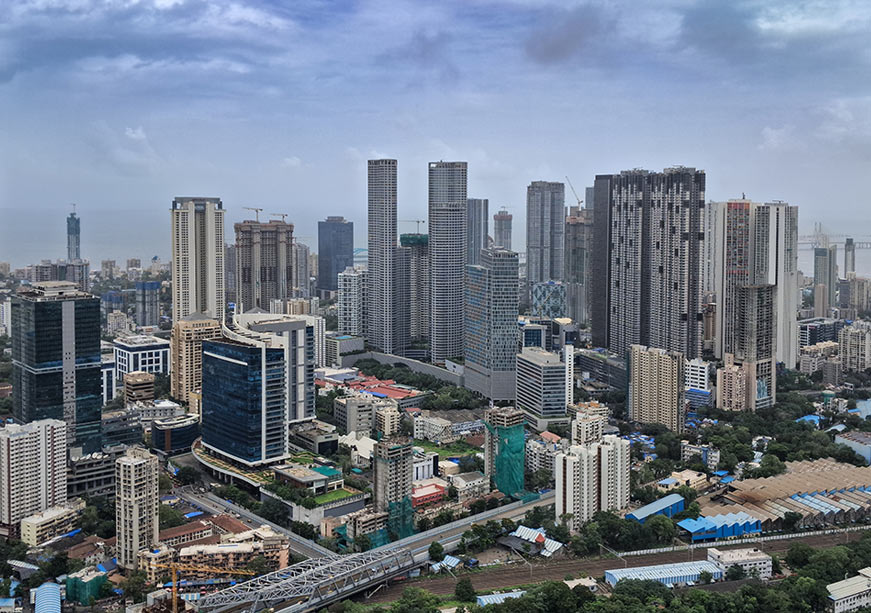
Sea-level rise, interacting with intensifying cyclones and storm surges, is already reshaping India’s coastal cities, as evident in recurrent floods in Mumbai disrupting transport and real estate markets, saline intrusion in Chennai undermining water security, and cyclone-induced damage along the Odisha coast eroding livelihoods and fisheries. These events destabilise infrastructure, local economies, and resilience pathways. While this is a global phenomenon, India’s coastal cities, as in most across the Global South, face these risks without the institutional capacity and financial resources available to many developed economies, reflecting the gaps in urban governance and climate financing.
Marine sectors, such as fisheries, port-led trade, tourism, offshore energy, and related services, anchor India’s blue economy.
For India, therefore, the challenge is much more than addressing climate change. It requires reimagining the structural, developmental, and economic models of coastal cities to promote resilience, inclusivity, and equitable economic growth. Marine sectors, such as fisheries, port-led trade, tourism, offshore energy, and related services, anchor India’s blue economy. However, they will deliver genuine economic gains only if governance frameworks align institutions and ensure coherent implementation, thereby enabling the equitable distribution of value among communities and stakeholders.
India’s over 11,000 km coastline hosts some of its most significant economic hubs. India supports nearly 4 million fishers. Millions more are engaged in processing, logistics, tourism, and informal coastal services. Fisheries contribute 1 percent to the national GDP and considerably more to local economies. Additionally, maritime routes account for ~95 percent of India’s trade volume, highlighting the significance of coastal systems to its sustained economic growth.
Yet coastal cities are at the forefront of the climate crisis, intensified by dense populations and limited adaptive capacity. Cities, such as Surat, Mumbai, Navi Mumbai, Kochi, Chennai, and Kolkata, are at high risk of inundation by mid-century. Mumbai’s vulnerability stems from its low elevation, land reclamation, and expansion; Chennai’s from the loss of wetlands, and Kolkata’s from the combined pressure of sea-level rise and subsidence in the Ganges-Brahmaputra delta. Kochi is experiencing frequent tidal flooding and saline intrusion, while Surat’s location at the confluence of riverine and coastal ecosystems results in frequent flooding.
Kochi is experiencing frequent tidal flooding and saline intrusion, while Surat’s location at the confluence of riverine and coastal ecosystems results in frequent flooding.
Frequent disruptions to ports, fisheries, and coastal infrastructure are impacting employment, supply chains, and local economies. A recent World Bank report pegged current losses from urban flooding at ~US$4 billion annually, projected to rise to US$5 billion by 2030, and between US$14-30 billion by 2070 if the current trends of urbanisation persist. This trend reflects deeper structural flaws: fragmented governance, unscientific land-use regimes, and poor infrastructure planning, underscoring the urgency of reimagining coastal urbanisation through an integrated, inclusive blue economy model.
Overfishing, pollution, and warming seas have depleted nearshore stocks, leading to declining catch, damaged assets, and instability for small-scale fishers. Fast-growing capital-intensive sectors, such as ports, coastal infrastructure, real estate, and industrial corridors, have further stressed coastal resources and raised land value beyond the means of local communities. Consequently, the blue economy gains remain unevenly shared, with vulnerable coastal populations shouldering disproportionate climate, ecological, and economic risks.
Despite the blue economy’s expansion, coastal entrepreneurship remains underdeveloped. Small-scale fisheries and marine services face barriers in accessing formal finance, technology, and markets. Regulatory complexity and licensing regimes further constrain participation in ocean-based sectors. Conversely, global experience shows that enabling blue entrepreneurship can generate employment, support livelihoods, and foster innovation across marine sectors. Without such support, India’s blue economy risks becoming increasingly capital-intensive, limiting local communities’ participation in higher-value economic activities.
Urban expansion has degraded mangroves, wetlands, and floodplains, the natural sponges absorbing runoffs and reducing storm impacts. Though India has recorded impressive growth in mangrove cover, urban regions continue to face widespread erosion. For example, Chennai has lost 85 percent of its wetlands, while Mumbai (71 percent) and Kolkata (36 percent) have seen extensive encroachment into ecological buffers.
Global experience shows that enabling blue entrepreneurship can generate employment, support livelihoods, and foster innovation across marine sectors. Without such support, India’s blue economy risks becoming increasingly capital-intensive, limiting local communities’ participation in higher-value economic activities.
Regulatory frameworks such as the Coastal Regulation Zone (CRZ) Notification exist but are unevenly enforced. Consequently, illegal construction has proliferated in coastal zones, and informal settlements, driven by housing shortages, have sprouted mainly in high-risk areas.
Infrastructure constraints exacerbate these vulnerabilities. Projections estimate that India will need US$840 billion in urban infrastructure investment by 2036, much of it for climate-resilient infrastructure. Yet, municipal governance remains financially weak and fragmented.
Fishing communities, such as the Kolis of Mumbai, have an inherited understanding of tidal patterns, seasonal variations, and the significance of mangroves and creeks. Similarly, Kerala’s traditional fishers are well-versed in coastal currents and erosion patterns. However, they are largely excluded from decision-making processes that directly affect their lives and livelihoods. Conversely, Odisha’s cyclone preparedness, driven by coastal community engagement, has strengthened resilience, underscoring how addressing policy and governance flaws can provide safeguards despite the brewing climate crisis.
Globally, integrating such knowledge into formal governance is gaining prominence. New Zealand’s policy integrates traditional Māori coastal management practices. Canada’s indigenous marine stewardship programmes combine traditional knowledge and scientific monitoring. The Netherlands has adopted participatory approaches in the Room for the River programme. Similarly, China’s sponge city interventions involve local communities as equal stakeholders.
Odisha’s cyclone preparedness, driven by coastal community engagement, has strengthened resilience, underscoring how addressing policy and governance flaws can provide safeguards despite the brewing climate crisis.
Addressing rising seas thus requires a fundamental rethinking of coastal urbanism. New coastal urbanism must:
To balance climate risk and economic opportunity, India must urgently align infrastructure, ecology, governance, and livelihoods in a coordinated, actionable response strategy. Such alignment will ensure that blue economy benefits are fairly distributed and that policies bridge rather than widen existing disparities. At the same time, governance systems must evolve to match the scale of risk. The question is no longer whether India’s coastal cities will change, but whether that change will be deliberative, resilient, and equitable.
Dhaval Desai is a Senior Fellow and Vice President at the Observer Research Foundation.
The views expressed above belong to the author(s). ORF research and analyses now available on Telegram! Click here to access our curated content — blogs, longforms and interviews.

Dhaval is a Vice President - Platforms and Communities at Observer Research Foundation, Mumbai. His spectrum of work covers diverse topics ranging from urban renewal ...
Read More +


 PREV
PREV