As India revives talks with the EAEU, the challenge is to turn a Russia-heavy trade relationship into a broader strategy for market access, supply-chain resilience, and Eurasian engagement

Image Source: Pexels
Over the last few years, India has finalised eight Free Trade Agreements covering over 37 countries, including the United Kingdom, New Zealand, Oman, Australia, and the 27-nation bloc of the European Union. It also struck a framework for an interim deal with the United States. New Delhi is using these agreements not only to promote tariff-free trade, but also to anchor stronger relationships with these countries, diversify its supply chains, and reap the benefits of being one of the largest markets in the world.
Building on its broader policy of trade diversification, India has resumed work on an FTA with the Eurasian Economic Union (EAEU), a bloc comprising Armenia, Belarus, Kazakhstan, Kyrgyzstan, and Russia. The EAEU has recently become more proactive in engaging with new partners. After signing an interim deal with Mongolia and concluding FTAs with the United Arab Emirates and Indonesia in June and December 2025, respectively, the bloc is now focused on reaching a deal with India. A new round of India-EAEU talks centred on non-tariff measures is expected to convene in Moscow in June.
The story of the India-EAEU FTA began in 2015 with the formation of a Joint Study Group to examine the deal's feasibility. In September 2016, the group produced a comprehensive report which found that mutual trade liberalisation would generate GDP gains across all member states, with projected trade turnover growth of between 30 and 40 percent, depending on the extent of tariff cuts.
Talks are presently centred on goods trade and barrier removal, with services and investment tracks to follow in later rounds.
Although the 2017 joint declaration signed by India's then Minister of State for Commerce Nirmala Sitharaman and the Eurasian Economic Commission's Minister in charge of Trade Veronika Nikishina announced the launch of FTA negotiations, no progress was made. In essence, the two sides were unable to commence any meaningful talks on the deal for eight years. New Delhi did not appear to see sufficient economic upside to outweigh the risk of increased import competition. Following the imposition of Western sanctions on Russia in 2022, the deal was put on hold as the legal and financial risks associated with the FTA became difficult to navigate.
The process kicked off again in August 2025 when both parties signed the Terms of Reference in Moscow. The 18-month work plan aimed to diversify markets for Indian businesses, including MSMEs, farmers, and fishermen. Things picked up pace following Commerce Secretary Rajesh Agrawal's visit to Moscow in November 2025 and his meeting with EEC Trade Minister Andrey Slepnev to review negotiations progress. This was followed by a visit to New Delhi by an EAEU delegation for the first round of talks, which sought to identify goods for tariff elimination and reduction. Both sides reaffirmed their commitment to fast-tracking the process. Talks are presently centred on goods trade and barrier removal, with services and investment tracks to follow in later rounds.
India-EAEU trade in FY2025-26 amounted to US$60.7 billion, down nearly 13 percent year-on-year. Turnover is heavily reliant on Russian exports to India, which accounted for US$55.4 billion — the majority of which came from crude oil. India's trade deficit of around US$50 billion with the EAEU therefore stems largely from its economic dealings with Russia, which remained India's largest source of crude throughout FY2025-26. The arrangement has served India's energy interests, but it has produced a structurally imbalanced relationship in which Indian exports of pharmaceuticals and machinery are vastly outweighed by crude oil imports.
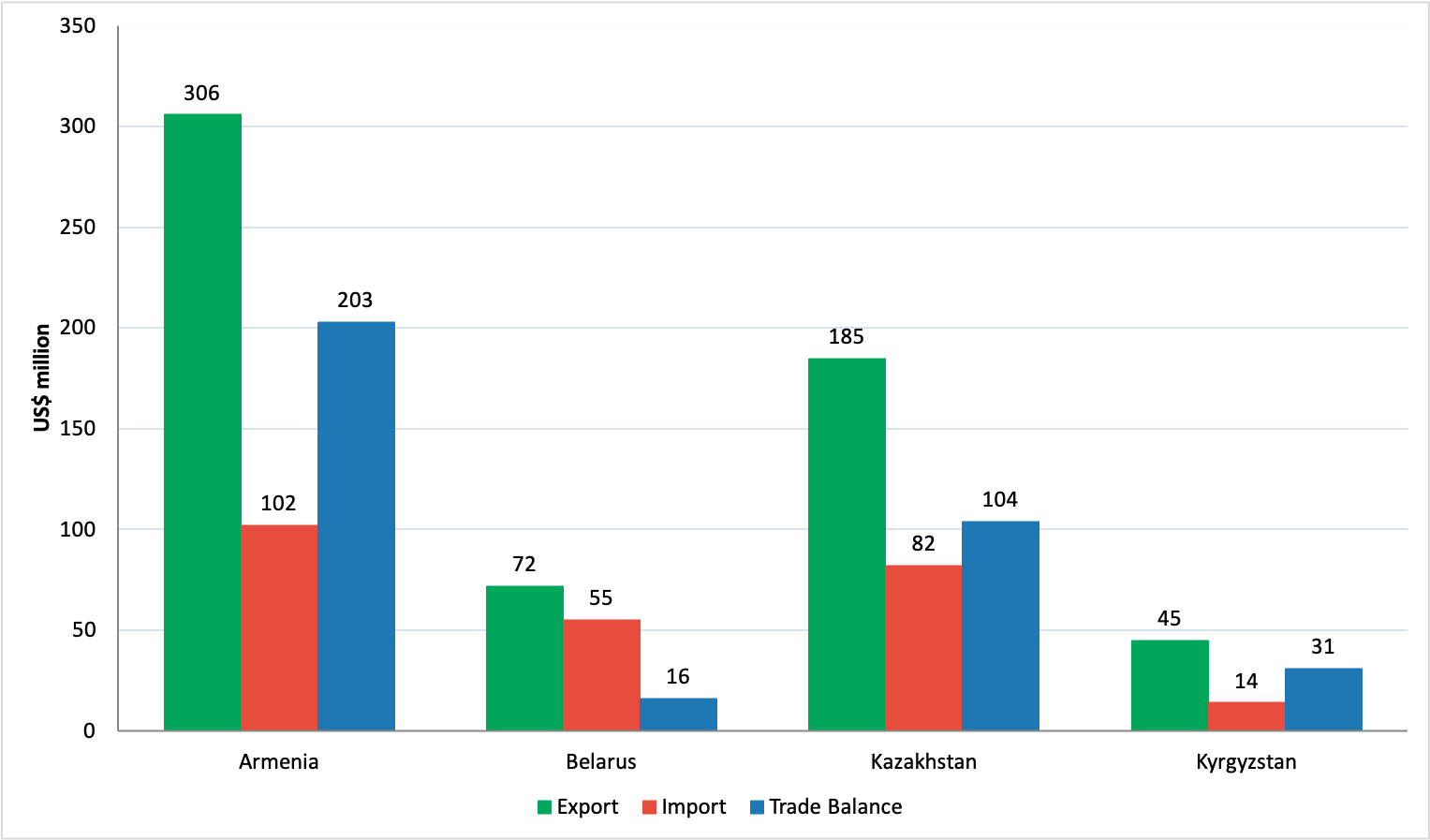
The other four EAEU member states — Armenia, Belarus, Kazakhstan, and Kyrgyzstan — account for a mere US$860 million of total turnover, remaining marginal by comparison. Unlike its trading relationship with Russia, however, India runs a positive trade balance with all other EAEU members (see Figure 1).
Figure 1. India’s Trade Balance with EAEU Countries Excluding Russia (FY2025-26; US$ million)
Source: India’s Ministry of Commerce and Industry; compiled by authors.
However, the significance of the existing trade imbalance should not be overstated. Russian oil supplies are likely to be excluded from any potential FTA and will continue to be governed by bilateral agreements between New Delhi and Moscow. The exclusion of oil trade — which is often subject to sector-specific carve-outs in FTAs — would return turnover figures to a more balanced base, substantially alleviating the structural asymmetry in the relationship.
Successful negotiations could open new economic opportunities for both sides. For India, sectors such as pharmaceuticals, which already have established trade links with the EAEU, could expand their footprint by developing common standards and harmonising safety protocols. The 2016 joint study identified IT and software services as having untapped potential for trade and investment, particularly from India.
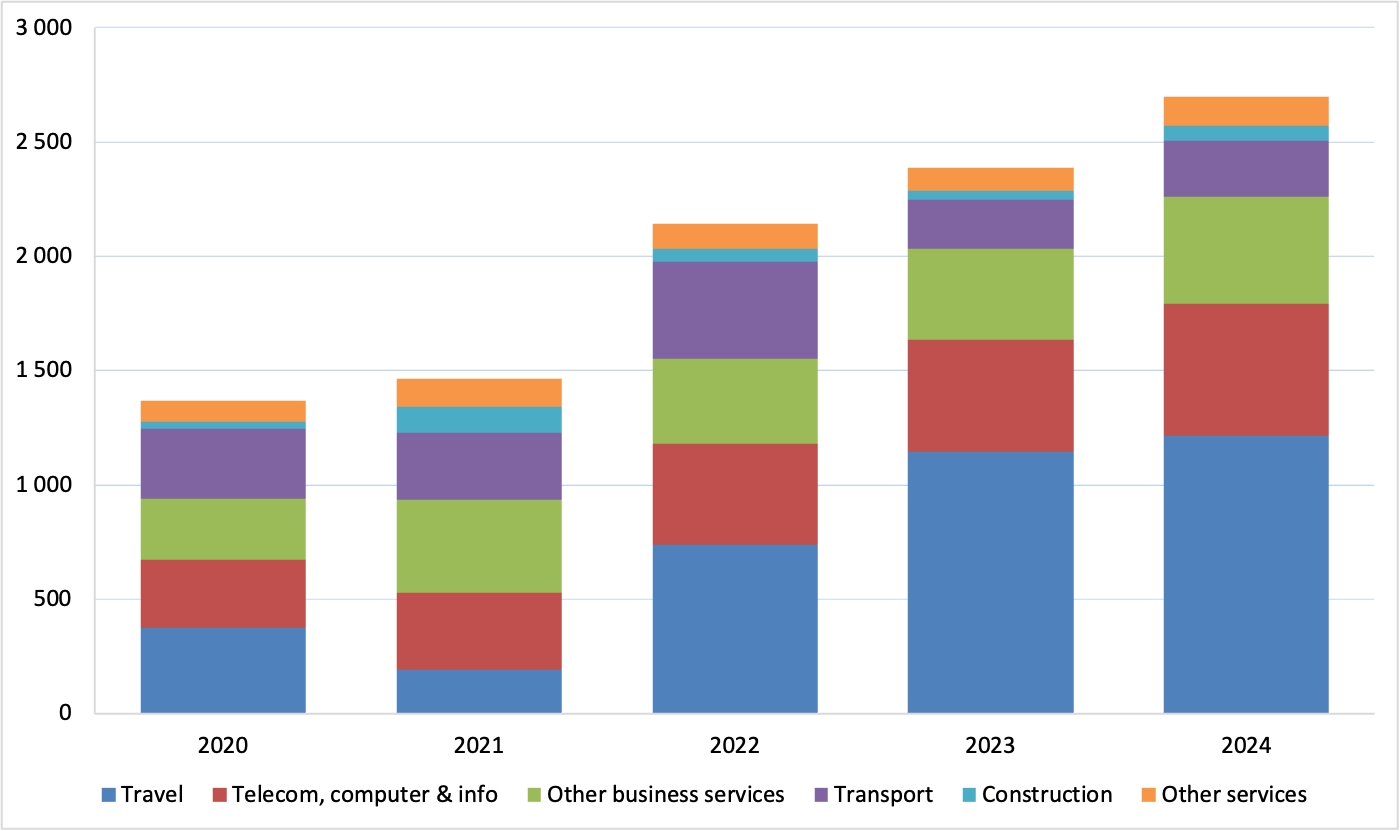
New Delhi should not leave the services sector, the largest and fastest-growing segment of India's economy, out of the negotiations. In 2024, India exported services worth US$2.7 billion to the EAEU, reflecting an annual growth rate of 10.9 percent since 2019 (see Figure 2). Indian companies are well-placed to compete in the Eurasian services market, making it essential that services feature centrally in the negotiations.
As the Union has no supranational competence over trade in services, each member state is entitled to determine its own services trade and investment policy with third countries, and to conclude separate international agreements. This means India will be able to fine-tune the services and investment chapters of a future FTA with individual member states, reaching agreements that best suit its interests. Russia accounts for the bulk of India's commercial services trade within the EAEU, with flows exceeding US$1.6 billion annually.
Figure 2. India’s Services Exports to EAEU countries (2020-24; US$ million)
Source: Compiled by authors based on WTO data
Some experts argue that deeper economic integration between India and the EAEU could benefit India's industrial development through increased sourcing of raw materials — particularly metals and coal — as well as strategic goods such as weapons systems and power engineering products. They contend that expanded technological cooperation would support Indian strategic industries by providing uninterrupted access to high-technology equipment and solutions. Beyond this, both Russia and Kazakhstan are considering ramping up supplies of critical minerals and rare earth metals to India, which aligns with New Delhi's import diversification needs.
In practice, blanket tariff cuts in strategic sectors are unlikely. The war in Ukraine and the sanctions that followed have left Moscow with diminished leverage, prompting greater flexibility on raw materials, engineering equipment, and advanced technologies, effectively allowing India to set favourable terms. For this reason, New Delhi is more likely to pursue phased liberalisation alongside strict rules of origin and safeguards to protect vulnerable domestic sectors.
The war in Ukraine and the sanctions that followed have left Moscow with diminished leverage, prompting greater flexibility on raw materials, engineering equipment, and advanced technologies, effectively allowing India to set favourable terms.
New Delhi is unlikely to agree to an FTA that does not address the interests of its export-oriented industries, including pharmaceuticals, textiles, electronics, engineering goods, and agriculture. These sectors would require additional incentives to engage more actively with EAEU markets, which are currently perceived as high-risk and overregulated.
While much of the FTA discussion takes place between New Delhi and Moscow — given that Russia is India's largest economic partner within the bloc — a potential deal will cover the entire EAEU market. India should therefore treat the other EAEU members as valuable regional partners rather than mere footnotes. Stronger trade ties with Armenia, Belarus, Kazakhstan, and Kyrgyzstan would give India access to new markets and critical resources across Eurasia — an increasingly valuable proposition amid ongoing supply chain disruption. India's total trade with these countries is gradually rebounding after a period of decline, though the recovery remains uneven across individual partners (see Figure 3).
Figure 3. India’s Goods Trade with EAEU Countries Excluding Russia (2020-2025; US$ million)

Source: India’s Ministry of Commerce and Industry; compiled by authors.
Over the past five years, Armenia has emerged as a key destination for Indian defence exports, precision instruments, and electronics, reflecting the growing strategic dimension of bilateral ties. Belarus has long been a significant supplier of fertilisers, textile fibres, wood products, and industrial and agricultural equipment, supporting vital sectors of the Indian economy. A recent gradual recovery in fertiliser imports from Belarus — following a sharp decline over the previous two years — underscores its continued relevance to India's agricultural needs. This trend may consolidate further given that key Belarusian companies have been exempted from sanctions and global fertiliser supply chains remain tight amid ongoing tensions in the Middle East.
The outcome of these negotiations will reflect the depth of New Delhi's commitment to Eurasia as a strategic priority.
Kazakhstan is one of India's most prominent trading partners in Central Asia, with rich reserves of minerals, fuels, chemicals, and fertilisers, and offers opportunities for Indian pharmaceutical and electronics exports. Kyrgyzstan, though a comparatively smaller trading partner, offers India a market for pharmaceuticals, apparel, and chemicals, alongside niche agricultural and mineral imports.
The outcome of these negotiations will reflect the depth of New Delhi's commitment to Eurasia as a strategic priority. In negotiating a deal with the bloc, New Delhi will have to contend with internal tensions within the EAEU, with Moscow's economic pressure on Yerevan raising serious questions about the organisation's unity and cohesion.
Aleksei Zakharov is Fellow, Russia & Eurasia, with the Strategic Studies Programme at the Observer Research Foundation.
Kushagra Agrawal is a Research Intern with the Strategic Studies Programme at the Observer Research Foundation.
The views expressed above belong to the author(s). ORF research and analyses now available on Telegram! Click here to access our curated content — blogs, longforms and interviews.

Aleksei Zakharov is a Fellow with ORF’s Strategic Studies Programme. His research focuses on the geopolitics and geo-economics of Eurasia and the Indo-Pacific, with particular ...
Read More +
Kushagra Agrawal is a Research Intern with the Strategic Studies Programme at the Observer Research Foundation. ...
Read More +


 PREV
PREV