PDF Download
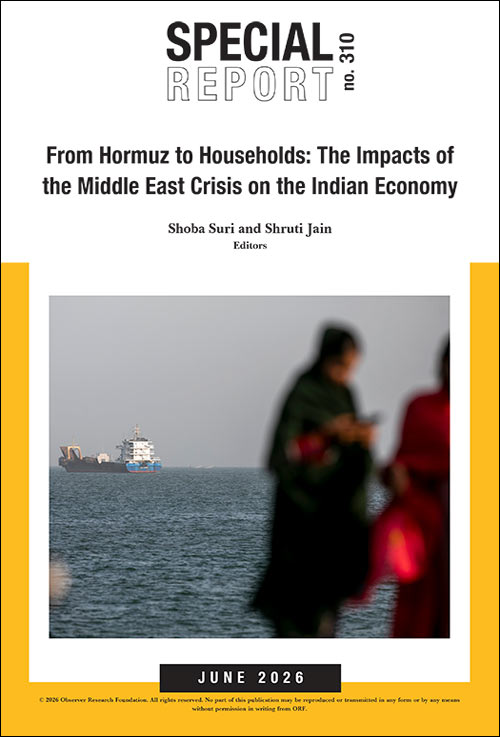
Shoba Suri and Shruti Jain, Eds., “From Hormuz to Households: The Impacts of the Middle East Crisis on the Indian Economy,” ORF Special Report No. 310, Observer Research Foundation, June 2026.
The Strait of Hormuz is one of the world’s most consequential maritime chokepoints, carrying a large share of global seaborne oil, liquefied natural gas, and fertiliser-related trade. The ongoing disruption in the corridor has thus generated impacts that extend well beyond the immediate region. Energy prices are responding to daily conflict-related developments, while uncertainty around shipping routes has intensified pressure on freight, insurance, and import costs. The disruption has also sharpened concerns around fertiliser security and global food production, with fertiliser prices rising sharply since the outbreak of the war and the closure of the Strait. At the same time, higher war-risk insurance premiums and elevated freight costs are adding another layer of strain to energy-importing economies.
For India, these risks pose structural challenges to the economy, which is deeply linked to imported hydrocarbons and petroleum products that are embedded across aviation, power generation, transport, cooking fuels, and industrial activity. As energy and logistics costs rise, the pressure is transmitted through the import bill, inflation, public finances, retail prices, and industrial competitiveness. The war has intensified risks not only for India’s macroeconomic stability, but also for its sectoral growth, including logistics, petrochemicals, textiles, ceramics, consumer durables, metals, cement, construction, and gems and jewellery. Higher natural gas prices, for example, has affected urea production and petrochemical derivatives, creating wide-ranging effects for agriculture, manufacturing, and household welfare. The disruption of supply chains in these critical sectors has also had uneven consequences; for instance, India’s Micro, Small and Medium Enterprises (MSMEs) have experienced disproportionately large impacts of the war. Similarly, lower-income households, farmers, and energy-intensive industries have experienced a direct shock with limited capacity to absorb it.
In this context, it is important to examine both the domains already affected by the war, and those likely to face greater strain if it persists. There is a need to disaggregate the impact across sectors, particularly by distinguishing between commodity sectors, where the shock originates, and service sectors, through which it is transmitted and amplified. This report seeks to address that gap by offering sector-specific analyses while retaining a broader systems lens on how an energy shock reverberates across the Indian economy. The articles in this report trace the transmission pathways from energy shocks to macroeconomic outcomes and identify sector-specific vulnerabilities. They measure the adaptive responses and policy levers created to address the exposure to the ongoing conflict, and build a unified analytical narrative around systemic risk and resilience.
The opening essay by Nilanjan Ghosh builds the conceptual foundation of the report and serves as the analytical bridge between geopolitics and economic transmission.
Part II examines the commodity sectors where the immediate disruptions first emerged. Mannat Jaspal examines how the Strait of Hormuz blockade has affected crude oil supply chains, LNG flows, refining margins, and India’s continued dependence on imported energy. Building on this theme, Lydia Powell describes how volatility in hydrocarbon markets extends far beyond fuel prices into petrochemicals and industrial feedstocks. The analysis then shifts to agriculture in Shoba Suri’s article. The final commodity-sector essay, by Gopalika Arora, examines the vulnerability of the metals, cement, and construction sector to the fallout of the conflict.
Part III moves from the origin of the commodity shock to the pathways through which it is transmitted across the wider economy. In her contribution, Anusha Kesarkar Gavankar examines the maritime and logistical consequences of the conflict in the Middle East. Extending this discussion on connectivity and strategic infrastructure, Samriddhi Vij evaluates the India-Middle East-Europe Economic Corridor (IMEC) against the backdrop of escalating regional instability. The focus then shifts to macroeconomic transmission in Arya Roy Bardhan’s article. This is followed by Manish Vaidya’s piece, which investigates how rising logistics and energy costs reshape export competitiveness, manufacturing economics, and India’s position within global trade networks. The analysis then narrows from markets to households in Kumkum Mohanta’s article. The service-sector section concludes with a sector-specific case study of India’s diamond trade by Soumya Bhowmick.
The report concludes with Shruti Jain’s essay that brings together the sectoral and macroeconomic insights deriving from the chapters into a broader framework for resilience and strategic adaptation.
Read the report here.
Shoba Suri is Senior Fellow, Health Initiative, ORF.
Shruti Jain is Associate Fellow, Centre for Development Studies, ORF.
All views expressed in this publication are solely those of the authors, and do not represent the Observer Research Foundation, either in its entirety or its officials and personnel.
The views expressed above belong to the author(s). ORF research and analyses now available on Telegram! Click here to access our curated content — blogs, longforms and interviews.

Dr. Shoba Suri is a Senior Fellow with ORFs Health Initiative. Shoba is a nutritionist with experience in community and clinical research. She has worked on nutrition, ...
Read More +
Shruti is an Associate Fellow at the Centre for Development Studies, Observer Research Foundation (ORF), where her research examines the intersections between policy, economic diplomacy ...
Read More +


 PREV
PREV