Regulatory reform alone cannot secure India's critical mineral supply chains without a parallel overhaul of exploration incentives, technology access, and the rights framework governing private explorers

The Ministry of Mines recently held the 7th tranche auction of critical mineral blocks as part of its plan to boost domestic exploration. The raison d'être? India is import-dependent for critical energy transition minerals at a time when their exports are being used as tools of geoeconomic leverage. Securing their supply chains is, therefore, a top priority for energy security. In this regard, the discovery of lithium reserves in Jammu and Kashmir was deemed a crowning moment. However, the trajectory from discovery to commercialisation has not been optimal.
Successive auctions of critical mineral blocks since 2023 have been cancelled either due to a lack of bids or qualified bidders. In particular, only one lithium block has been auctioned so far, and even that attracted no participation from major mining companies. Amidst this, the Mines and Minerals (Development & Regulation) Amendment Act 2025 (hereafter referred to as the Amendment) was introduced to mitigate delays in the uptake of domestic mining. It allows holders of mining and composite licences to expand their leased area for the exploration and mining of deep-seated critical minerals. Furthermore, it allows mining licensees to add notified critical minerals to existing licences without payment of any additional fees.
Successive auctions of critical mineral blocks since 2023 have been cancelled either due to a lack of bids or qualified bidders. In particular, only one lithium block has been auctioned so far, and even that attracted no participation from major mining companies.
Mining is a capital-intensive enterprise, more so for deep-seated critical minerals. Notwithstanding their indispensability for emerging energy and AI technologies, extreme price volatility and geopolitical risks discourage mining companies from undertaking such expensive investments. For India, this is exacerbated by ambiguity about existing resources, deficiencies in the licensing regime, and limited access to advanced mining technologies. While the Amendment aims to address this, whether it goes far enough remains to be seen.
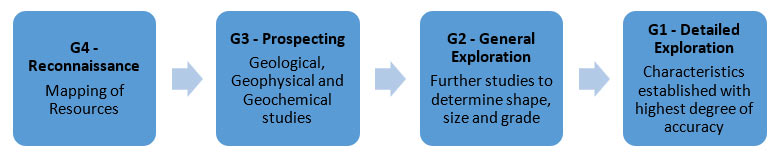
Exploration of resources is the first step in converting them into commercially viable reserves. This comprises geological surveys that assess the location, quality, and quantity of deposits. This data forms the foundation of mine development plans and informs decisions on their scale, type, and duration. As per the UN Framework Classification for Resources (UNECE), exploration studies range from G4 to G1 in increasing order of comprehensiveness and project viability. Mining companies take up projects post G1 studies, as these form the baseline for projected output and revenue.
The pace of such studies in India, however, has been lackadaisical. Only one lithium and two nickel-cobalt blocks have thus far been explored to G2/G3 levels, while most critical mineral blocks have not moved past the G4 stage. The absence of these studies makes it difficult to prepare an accurate roadmap for exploration and investment in potential critical mineral resources.
Figure 1: Flowchart based on UN Framework Classification for Resources (UNECE)
The slow uptake of exploration activities is compounded by the complexity of the licensing regime. The National Mineral Policy 2016 opened exploration, which had until then been dominated by public sector units, to private players. Accordingly, the MMDR Amendment Act 2023 introduced Exploration Licences (ELs) for reconnaissance and prospecting operations by Notified Private Exploration Agencies (NPEAs), alternatively referred to as "explorers." However, this framework lacks adequate incentives for NPEAs.
The National Mineral Exploration Trust (NMET) provides funding for exploration operations. It reimburses the full project cost to NPEAs, but only after it accepts the geological report of the explored site, for which no timelines have been stipulated. While it provides a mobilisation advance of up to 30 percent of the approved project cost, this requires the NPEA to furnish a bank guarantee of an equivalent amount, with the associated premiums constituting an additional cost.
ELs are awarded through reverse-auctioning of revenue share in the auction premiums of the relevant block, with the lowest bid being awarded the concession. With earnings deferred to when the blocks are auctioned in the distant future, explorers are confronted with tight cash flows in the near term.
Worldwide, it has been observed that explorers sell their mineral concession rights directly to mining companies, allowing them to negotiate fair value for their extensive operations. This, however, is not allowed under the provisions of the Act. Instead, ELs are awarded through reverse-auctioning of revenue share in the auction premiums of the relevant block, with the lowest bid being awarded the concession. With earnings deferred to when the blocks are auctioned in the distant future, explorers are confronted with tight cash flows in the near term. Although the Act permits them to enter into a direct agreement with the mining licensee for a lump-sum payment, this seldom leaves them in a position of fair bargaining.
India is a leader in mining major minerals like coal, aluminium, lead, zinc, and gold, and has built expertise in undertaking geological studies for mineral mapping. However, these traditional capabilities are limited in the case of critical minerals, which are usually found at depths of more than a hundred metres. Increasing this range is crucial for ensuring supply security, both at present and in the future as subsurface mines become depleted.
This necessitates sophisticated technological capabilities to make exploration and mining precise and efficient. India is largely import-dependent for such advanced systems. For instance, Canada provides expertise in high-resolution aeromagnetic surveys and deep drilling technologies, while Australia contributes airborne geophysical systems and exploration methodologies. This import regime, however, faces several barriers.
Technologies like hyperspectral imaging and satellite-based reconnaissance systems used for identifying mineral signatures are generally faced with dual-use restrictions due to their potential military applications.
Technologies like hyperspectral imaging and satellite-based reconnaissance systems used for identifying mineral signatures are generally faced with dual-use restrictions due to their potential military applications. Similarly, extensive licensing requirements make deep drilling systems costlier to import. Further, the absence of requisite infrastructure and skilled personnel impedes the integration of these technologies domestically.
The recent Amendment falls short of introducing structural changes. Accurate foundational data is crucial for resource identification. In this regard, the National Geoscience Data Repository should be enhanced using AI-based GIS systems for predictive mineral mapping that improves the targeting of critical mineral blocks.
NPEAs should be awarded mineral concession rights under the ELs — enabling them to sell their discoveries to mining companies. Certainty of returns unlocks financing through various channels such as private equity, venture capital, and capital markets. Moreover, a formula should be introduced to allow mining companies to offset their expenditure on the purchase of these rights against mining licence fees, enabling better price discovery for explorers.
NPEAs should be awarded mineral concession rights under the ELs — enabling them to sell their discoveries to mining companies. Certainty of returns unlocks financing through various channels such as private equity, venture capital, and capital markets.
The NMET should award grants instead of reimbursements to ensure adequate cash flows for explorers. Additionally, India can adopt Canada's Flow-Through Shares mechanism that de-risks financing of early-stage projects by transferring tax deduction rights on expenses from explorers to investors. Furthermore, the Mineral Security Partnership's Finance Network can be tapped into for project financing.
Focus should also be placed on streamlining the import of advanced mining systems through partnerships such as the India-Australia Critical Minerals Investment Partnership and the India-United States TRUST Initiative. Joint ventures with international explorers can enable technology transfer and knowledge sharing for adoption and integration. Domestic R&D on such technologies should be pursued through the Centres of Excellence established under the National Critical Minerals Mission. Recent efforts to reduce import dependence for heavy machinery used in coal mining can serve as a model for achieving self-reliance in critical minerals mining.
Administrative ease in acquiring mining and exploration licences for critical mineral blocks is a much-needed reform. However, the smoothening of regulatory processes in the absence of an investor-friendly environment may not yield the expected results. At a time when resource nationalism threatens supply chain resilience, achieving self-sufficiency in exploration is crucial. Empowering explorers can augment domestic resource exploration. As India cruises ahead in building a robust AI ecosystem and achieving its energy transition goals, securing the supply of critical minerals is fundamental to the manufacturing of clean and advanced technologies. A comprehensive approach to overhauling the mining regime is, therefore, the need of the hour.
Aadya Chaturvedi is a Research Assistant with the Centre for Economy and Growth at the Observer Research Foundation.
The views expressed above belong to the author(s). ORF research and analyses now available on Telegram! Click here to access our curated content — blogs, longforms and interviews.

Aadya Chaturvedi is a Research Assistant with ORF’s Center for Economy and Growth. Her work focuses on Energy and Climate Change, specifically on critical minerals, renewables, ...
Read More +


 PREV
PREV