Pollution is not just a health crisis; it is a measurement crisis. Until India internalises environmental externalities into its productivity and wealth accounts, headline growth numbers will continue to flatter what is, in reality, a steadily depleting productive base.
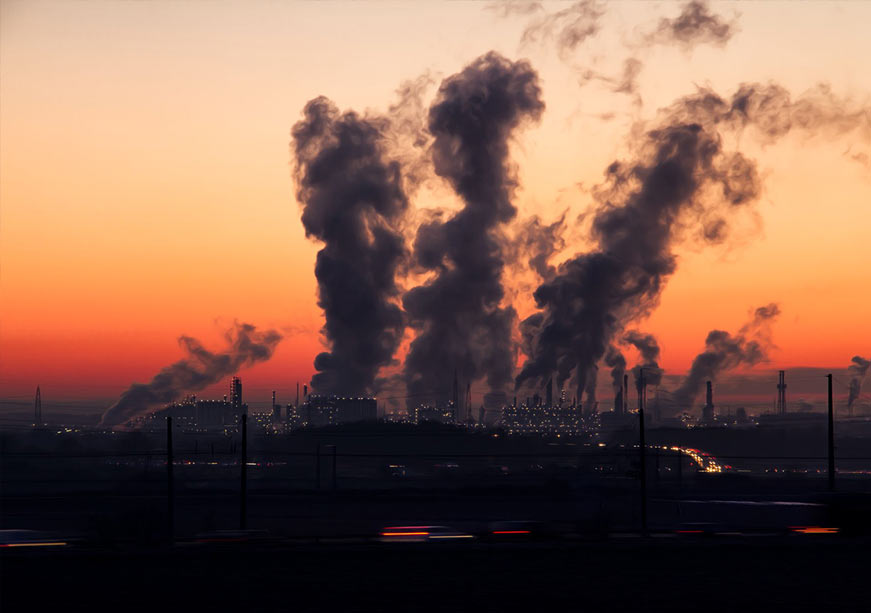
Image Source: Pexels
Part 1 of a three-part series on India and the Architecture of Inclusive Wealth.
For most of the post-liberalisation period, India has measured its economic performance through the familiar arithmetic of GDP, labour productivity, and total factor productivity. These metrics have served as the dashboard for policymakers, investors, and rating agencies alike. However, when the corrosive effects of polluted air on workers, infrastructure, and human capital are factored in, the picture of India’s productive base looks meaningfully different from what conventional metrics suggest. The country is home to 21 of the world’s 30 most polluted cities, and recent assessments by the Lancet Commission on Pollution and Health estimate the annual economic cost of air pollution in India at 3-6 per cent of GDP.
The implication is not merely that India faces a public health challenge. It is apparent that some of the country's apparent progress is being overstated, and some of its underlying capital depletion is being missed in the metrics used to track both. This is precisely the gap the Inclusive Wealth framework, developed under the UN Environment Programme, was designed to close: a stock-based measure of an economy’s produced, human, and natural capital that reveals whether current output is being financed by investment in productive assets or by silent depletion of them. UNEP’s most recent assessment confirms that while India’s physical and human capital have risen steadily, its natural capital has declined — an erosion that polluted air both reflects and accelerates by attacking the very human capital pillar through which environmental losses might otherwise be offset.
The link between particulate matter and worker output is no longer speculative. London’s Ultra Low Emission Zone, one of the most rigorously studied air-quality interventions in the world, cut sick leave by 18.5 per cent and respiratory illness incidents by 10.2 per cent, with annual public health savings exceeding £37 million. The ULEZ baseline was, importantly, already cleaner than most Indian cities by an order of magnitude. New Delhi’s PM2.5 levels routinely exceed the WHO guideline by roughly 30-fold, suggesting that the productivity dividend from comparable Indian interventions could be considerably larger than London’s.
A cleaner economy is a more productive one, and the gains accrue disproportionately to workers in informal and semi-formal sectors — making clean air among the most equitable productivity investments available.
A recent World Bank-linked analysis finds that higher annual exposure to fine particulates reduces year-on-year growth in district-level GDP by about 0.56 percentage points — implying that India’s headline growth rate systematically overstates real progress. The damage runs through five channels: presenteeism, absenteeism, premature mortality, increased healthcare expenditure, and dampened consumer spending. Each is, in effect, a tax on human capital — and in an economy where roughly 80 percent of workers operate in informal or semi-formal sectors without health insurance or paid leave, the incidence is sharply regressive.
The state-level Global Burden of Disease analysis makes this distributional pattern explicit: economic losses from air pollution range from 0.67 per cent of state GDP at the lower end to 2.15 per cent at the higher end, with the heaviest burden falling on Uttar Pradesh, Bihar, Rajasthan, Madhya Pradesh, and Chhattisgarh — precisely the states with the lowest per-capita incomes. Pollution, in this reading, is not a uniform externality, but a regressive shock that widens regional capital divergence — a finding that aligns closely with sub-national Inclusive Wealth (IW) assessments, where low-IW states consistently combine weak human and physical capital with degraded environmental conditions.
The deeper analytical move is to stop treating air quality as a soft public health concern and start treating it as a hard input into the productive base. This is the contribution of Environmentally Adjusted Productivity (EAP), now being piloted by the OECD. EAP treats emissions and pollution as negative outputs, prices them via shadow prices, and subtracts these costs from measured value added. The results are arresting: petroleum refining, air transport, mining, and several heavy-industrial sectors that appear profitable on conventional metrics register negative true productivity once pollution costs are internalised. The implication for capital allocation is significant — investment guided by conventional productivity signals can be drawn toward sectors that, on a fuller accounting, consume more social value than they generate.
Inclusive Wealth provides the broader scaffolding for this insight. Where EAP corrects flow-based productivity measures, Inclusive Wealth corrects stock-based wealth measures by treating produced, human, and natural capital as a single integrated portfolio. The framework, developed through the Economics of Biodiversity review commissioned by the UK Treasury, makes clear that growth financed by drawing down one capital stock to inflate another is incomplete by construction and is an intergenerational transfer. The ecological economics tradition has long made a closely related point: produced and natural capital are imperfect substitutes, especially where damages such as airshed degradation in dense urban basins approach thresholds beyond which physical-capital accumulation can no longer credibly compensate. UNEP’s most recent assessment shows that while India’s natural capital is relatively stable compared to earlier Inclusive Wealth Report estimates, its physical and human capital have grown strongly — a profile that air-quality improvements could meaningfully reinforce by protecting the human-capital gains that compensate for ecological loss.
Pollution, in this reading, is not a uniform externality, but a regressive shock that widens regional capital divergence — a finding that aligns closely with sub-national Inclusive Wealth assessments, where low-IW states consistently combine weak human and physical capital with degraded environmental conditions.
This recasting is not merely academic. The Ministry of Statistics and Programme Implementation has already initiated green wealth accounting under the Natural Capital Accounting and Valuation of Ecosystem Services (NCAVES) project, aligned with the UN System of Environmental and Economic Accounting (SEEA). What remains missing is the integration of air-quality damages into productivity metrics and into the sector-level capital allocation decisions made by public investment platforms such as the National Infrastructure Pipeline.
Three operational shifts would translate this analytical recasting into measurable outcomes. First, the central and state statistical offices should develop India-specific environmentally adjusted productivity series, using shadow prices that reflect domestic health burdens rather than imported global damage estimates. Without India-calibrated shadow prices, EAP risks understating the true penalty in dense urban airsheds such as the Indo-Gangetic plain, where exposure and informality compound.
Second, India should reframe air-quality regulation as human-capital investment rather than environmental compliance. This includes scaling Low Emission Zones beyond Delhi to other major metros, mandating indoor air quality and ventilation standards in manufacturing and logistics and tying SME tax incentives to HVAC modernisation. Worker-level monitoring of sick leave, healthcare utilisation, and output in pilot LEZs would produce the kind of evidence base that London’s ULEZ now offers, and would help build domestic political support for cleaner air on productivity grounds rather than purely health grounds.
Growth financed by drawing down one capital stock to inflate another is incomplete by construction and is an intergenerational transfer.
Third, India should pilot Inclusive Wealth accounting at the subnational level. Early work on a subnational Inclusive Wealth Index for Indian states has shown how the Niti Aayog’s SDG dashboard can be analysed as a stock-based indicator architecture. A subnational IWI that explicitly prices air pollution would expose the divergence between headline growth rankings and true wealth accumulation, thereby influencing federal fiscal design.
The deeper point is that the long-standing framing of a trade-off between growth and environment is increasingly understood as a measurement question rather than an economic one. A cleaner economy is a more productive one, and the gains accrue disproportionately to workers in informal and semi-formal sectors — making clean air among the most equitable productivity investments available. India’s evolving statistical architecture positions the country well to lead this analytical transition rather than follow it. The productivity dividend, on present evidence, is likely to be both substantial and distributionally progressive. The next instalment of this series turns from measurement at the macroeconomic level to its corollary at the firm and financial-sector level: how the financial ratios that guide capital allocation can themselves be rebuilt to reflect the same inclusive-wealth logic.
Soumya Bhowmick is a Fellow and Lead, World Economies and Sustainability at the Centre for New Economic Diplomacy (CNED) at the Observer Research Foundation.
Disclaimer
This article draws on expert consultations supported by the SYLFF Research Grant (SRG) from the Tokyo Foundation in 2025 and 2026. The author was eligible for this grant as a former SYLFF Fellow at the master’s level at Jadavpur University, and the grant has enabled the author to advance work on the Inclusive Wealth Framework through consultations at UNEP headquarters in Nairobi and with other relevant organisations in India and abroad.
The views expressed above belong to the author(s). ORF research and analyses now available on Telegram! Click here to access our curated content — blogs, longforms and interviews.

Dr. Soumya Bhowmick is a Fellow at the Centre for New Economic Diplomacy (CNED) at the Observer Research Foundation (ORF). He completed industry- endorsed Ph.D. ...
Read More +


 PREV
PREV