A jointly governed decarbonisation fund and SME-focused standards reforms could transform CBAM from a trade irritant into a catalyst for climate collaboration
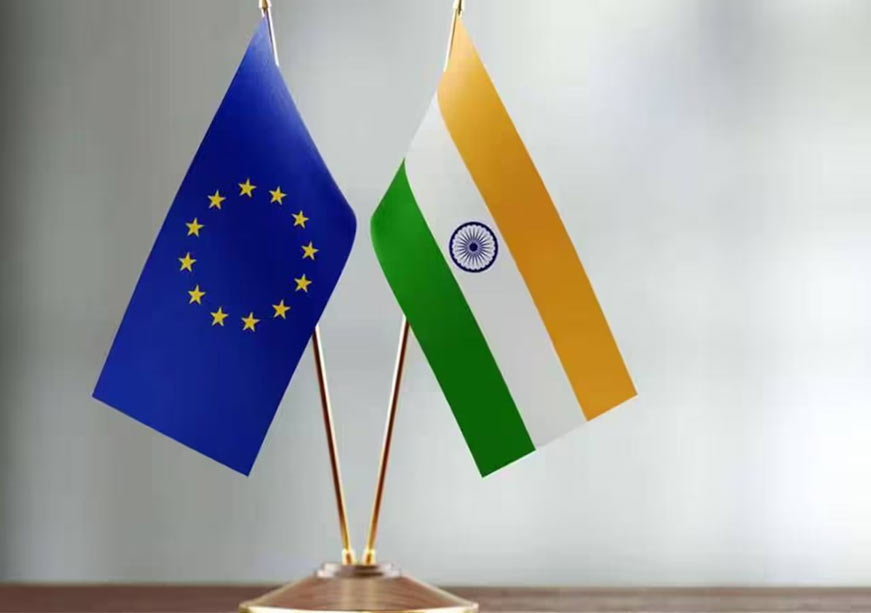
The Carbon Border Adjustment Mechanism (CBAM) has become one of the most consequential and contentious elements of EU trade and climate policy. For India, it is more than a technical irritant: it represents a fundamental challenge to how a rapidly developing economy can grow and decarbonise simultaneously. For the EU, CBAM is a crucial regulation tackling a complex and difficult challenge. Getting the EU-India relationship on CBAM right is profoundly important, not just bilaterally, but as a template for Global North-Global South climate cooperation.
The frictions are real and specific. CBAM imposes significant and highly visible costs and compliance burdens. India's iron and steel sector accounts for approximately 90 percent of the total value of Indian exports subject to CBAM. From 2026 to 2030, CBAM tariffs on Indian iron and steel exports to the EU will amount to approximately EUR 5 billion. For SMEs — which constitute roughly 30 percent of Indian GDP, 45 percent of manufacturing output, and 40 percent of exports — the compliance demands are especially acute. Data suggests that the challenge of verification is already reducing Indian steel exports to the EU.
There is also a deeper issue of governance. India has been a leader in raising concerns in multilateral fora about the governance issues posed by EU measures that intentionally affect the domestic policies of third countries. A unilateral decision from Brussels that shapes Indian industrial policy strikes at questions of sovereignty that go beyond any tariff line.
Such a fund would support green steel capital and operating expenditure premiums, build-up of emissions monitoring, reporting and verification (MRV) infrastructure, technical assistance to SMEs, and technology joint ventures.
Yet the diplomatic posture is shifting on both sides. Indian thought leaders are now asking not just "how do we oppose CBAM?" but "how can CBAM help India with opportunities?" On the EU side, there is growing recognition that, as a first-of-its-kind measure, the CBAM is, by definition, not perfect and must continue to evolve — including through better dialogue with trading partners. Commitments made at the EU-India Delhi summit in January offer a significant near-term window of opportunity for both sides to find constructive solutions.
Two proposals deserve serious attention.
The first is an India CBAM Levy Industrial Decarbonisation Fund. India would collect a CBAM export levy and earmark the revenues to support industrial decarbonisation. The EU could recognise this under Article 9 of CBAM — but recognition should be conditional on the earmark, and accompanied by a European contribution of matching funds, enabling co-governance of objectives. Based on estimates for 2027-28, this fund could provide approximately EUR 1 billion for Indian industrial decarbonisation: EUR 500 million in export levy revenues and EUR 500 million in European climate finance. Such a fund would support green steel capital and operating expenditure premiums, build-up of emissions monitoring, reporting and verification (MRV) infrastructure, technical assistance to SMEs, and technology joint ventures. An initial two-year pilot, with a review clause to recommit for 2029-30, would allow both parties to assess results and build trust.
The EU routinely sets regulatory standards and then gives domestic SMEs extra time and simpler interim requirements to adjust. India and Europe should apply the same logic together — designing a 'standards ladder' for developing-economy SMEs that provides a feasible, step-by-step path toward the clear goals set by CBAM.
The second proposal is an EU-India working group on standards simplification for developing-country SMEs. CBAM requires all parties, for the first time, to seriously consider how to apply the important international climate action principle of differentiated capacities to SMEs in developing economies. India's major companies are as capable of working with CBAM as any worldwide. But 40 percent of India's steel production is in SMEs. Capacity-building technical assistance is necessary but not sufficient. The EU routinely sets regulatory standards and then gives domestic SMEs extra time and simpler interim requirements to adjust. India and Europe should apply the same logic together — designing a 'standards ladder' for developing-economy SMEs that provides a feasible, step-by-step path toward the clear goals set by CBAM. A low-cost, user-friendly digital platform, potentially shared worldwide, could serve as a one-stop shop covering sustainability and security standards.
Taken together, these proposals address CBAM frictions, both diplomatic and economic. They would reduce political drag on a bilateral agenda that encompasses climate, trade, investment, and strategic partnership. They would create space for working-level processes to address technical issues related to CBAM verification and interface with India's Carbon Credit Trading Scheme (CCTS).
India's current emissions intensity is the highest among the world's top ten steel producers. The global expansion of steel capacity is occurring mostly in India. No credible global climate pathway runs without Indian industrial decarbonisation at its centre.
Most importantly, they would reframe the entire question. Decarbonising Indian steel is not merely a bilateral concern — it is a global climate priority. India's steel production is projected to double by 2030 and quadruple by 2047, at which point it will account for nearly one-fifth of global production. India's current emissions intensity is the highest among the world's top ten steel producers. The global expansion of steel capacity is occurring mostly in India. No credible global climate pathway runs without Indian industrial decarbonisation at its centre.
Equal treatment means that any CBAM solution will, in principle, extend to all EU trading partners. A well-designed EU-India deal, built on partnership rather than imposition, could provide the most important template yet for what climate cooperation between developed and developing economies can actually look like.
Jesse Scott is a Senior Fellow at the Observer Research Foundation, as well as adjunct faculty at the Hertie School in Berlin since 2019.
The views expressed above belong to the author(s). ORF research and analyses now available on Telegram! Click here to access our curated content — blogs, longforms and interviews.

Professor Jesse Scott is a Senior Fellow at the Observer Research Foundation, as well as adjunct faculty at the Hertie School in Berlin since 2019. ...
Read More +


 PREV
PREV