PDF Download
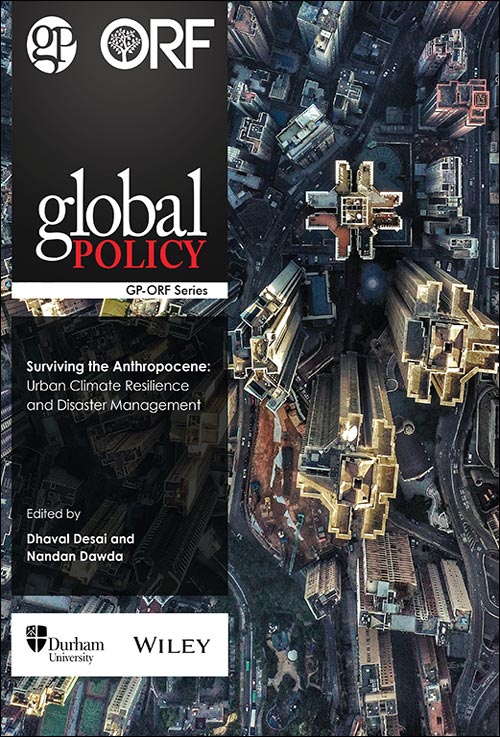
We are living in the Anthropocene, a geological epoch defined not by natural cycles but by the significant impact of unabashed human activity. The disruptive consequences brought about by this epochal age are most evident in our cities. As hubs of innovation, mobility, and economic growth, cities are shaping the future of the planet. Yet, these spaces are also the theatres of ecological distress, climate-induced hazards, and growing vulnerability.
Surviving the Anthropocene: Urban Climate Resilience and Disaster Management comes at this critical juncture, a moment of promise and paradox. With cities responsible for a staggering 70 percent of global greenhouse gas emissions and bearing the brunt of climate-related disasters, from unprecedented heatwaves to devastating floods, the imperative to fortify urban resilience is undeniable. Nowhere is this need more urgent than in the Global South, where urbanisation is fast outpacing resilience-building.
This compendium brings together scholars, practitioners, and policy experts who interrogate and reimagine the approaches towards urban resilience. Across 10 essays, contributors explore the complex interplay between infrastructure, equity, finance, governance, and justice. Their research spans disciplines and scales, from passive cooling technologies and heat action plans to gender-sensitive disaster governance, to carbon markets for African cities, and inclusive water, sanitation and hygiene (WASH) systems in India’s small towns.
A central theme that resonates throughout this volume is the understanding that climate resilience cannot be an afterthought or a mere technical fix. It must be woven into the fabric of how cities evolve, govern, and protect their most vulnerable inhabitants. The essays underscore the importance of leveraging traditional knowledge, decentralised governance, and community empowerment alongside technological innovation and international climate finance. They also caution against the perils of business-as-usual planning, where climate action plans (CAPs) coexist with ecologically damaging urban policies, and advocate for a paradigm shift towards anticipatory, participatory, and just urbanism.
As extreme heat emerges as a defining climate risk across the Asia-Pacific, Madhurima Sarkar-Swaisgood and Aparna Roy set the tone for the volume by advocating for a fundamental shift in how cities plan for resilience. They argue that conventional disaster frameworks often overlook the slow onset of heat, leading to cumulative impacts, especially on vulnerable communities. Their essay calls for a paradigm shift in recognising heat as a systemic urban risk, necessitating integrated governance, equity-driven planning, and thermally sensitive urban design. Digital tools, such as the UN Economic and Social Commission for Asia and the Pacific’s Risk and Resilience Portal, offer a glimpse into data-driven, anticipatory approaches, including artificial intelligence-powered forecasting and dynamic heat mapping.
Sayli Mankikar and Shinjini Saha spotlight the need for community-led, multi-level climate governance as global efforts to meet the Sustainable Development Goals and Paris Climate Agreement goals have fallen woefully short. Brazil’s forthcoming COP30 presidency and its ‘global mutirão’ initiative underscore a shift towards decentralised, participatory models. Although cities have gained recognition as key climate actors, starting from COP15 and including COP28’s Coalition for High Ambition Multi-level Partnerships initiative, they remain constrained by limited mandates and resources. Their essay calls for a recalibrated governance architecture that empowers cities through fiscal autonomy, national integration, and equitable access to climate finance.
Ramanath Jha and Dhaval Desai highlight the misalignment between the emerging city CAPs and long-standing urban practices that deepen vulnerability, such as rampant concertisation, diminishing green spaces, and inadequate stormwater infrastructure. Despite good intentions, weak legal mandates and poor resourcing constrain CAP implementation. Drawing lessons from Surabaya (Indonesia), New York (US), and Bristol (UK), the authors argue for integrated planning, legislative reform, and sustained support from all tiers of the government to convert CAPs from ambitious paperwork into actionable frameworks.
Turning attention to often-overlooked urban geographies, Aditi Dwivedi, Jigisha Jaiswal, Meera Mehta, and Dinesh Mehta examine the climate vulnerabilities of India’s small and medium towns, especially in relation to WASH. These towns face the dual challenge of being both contributors to and casualties of climate change. Evaluating successful innovations in Gujarat and Maharashtra, the authors call for urgent institutional reform and climate-oriented planning to create resilient and inclusive WASH systems, utilising reliable data.
Krishna Vohra puts forth a compelling case for passive cooling via restored green cover, vernacular architecture, and climate-sensitive urban design, as a low-cost, equitable, and immediate strategy to counter rising heat stress. While emerging technologies such as thermoelectric cooling hold promise, cost and supply chain constraints hamper their scalability. The essay argues for reorienting India’s cooling action plan around nature-based solutions and affordable approaches, with passive cooling as the foundation of present-day adaptation.
Kamal Kumar Murari builds on this argument and recommends the adoption of passive cooling strategies, such as ventilation, shading, and insulation, which can lower indoor temperatures by up to 9°C with reduced energy use and emissions. He lays bare the narrow focus of the current heat action plans and urges mainstreaming passive cooling into municipal regulations, building codes, and city planning, particularly to shield vulnerable populations in heat-stressed areas.
In a broader framing of urban resilience, Dhaval Desai’s essay urges Indian cities to adopt inclusive, anticipatory planning grounded in environmental and social equity. Drawing from experiences in New York, Medellín (Colombia), Freetown (Sierra Leone), and the Netherlands, the essay outlines practical tools, including climate-safe infrastructure, real-time alerts, green corridors, and local knowledge systems, that can enable cities to act early, adapt justly, and recover equitably.
Mitali Nikore, Brinda Juneja, and Vandhana Ramesh highlight how climate change magnifies gender-based inequalities, especially for marginalised women burdened by multiple, interconnected vulnerabilities of caste, class, geography, and care work. They present international and Indian case studies to recommend embedding gender equity into all levels of climate governance through mandatory mainstreaming, capacity-building, and institutional reform. Gender-responsive adaptation is both an ethical imperative and a practical necessity for durable resilience, they argue.
Meghna Verma explains that several technocratic and infrastructure-heavy approaches to urban resilience ignore climate justice. She calls for a radical shift toward equity-centred frameworks that acknowledge historical emissions, ensure fair climate finance, and prioritise well-being over growth. For cities to be truly resilient, sustainability must be socially transformative, not just technologically efficient.
Finally, Muhammad Hamisu Uadudu and Ruchi Soni focus on closing the climate finance gap through tools like voluntary carbon markets, blended finance, and green municipal bonds. Using examples from Nigeria, Kenya, Ghana, and Rwanda, they show how African cities are deploying scalable carbon credit systems and resilient infrastructure models. Their essay positions African innovation as a guiding model for cities across the Global South in mobilising climate finance and fostering inclusive, low-carbon urban development.
As cities across the Global South continue to urbanise at unprecedented rates, the choices we make now will define not just how we survive the Anthropocene, but whether we can reimagine cities as spaces of sustainability, justice, and well-being. This compendium, therefore, strives to offer insights to help our cities not only mitigate and adapt to climate disruptions but flourish despite them. We hope this effort will help urban planners, municipal administrators, grassroots leaders, policy analysts, and others committed to shaping cities that are not only resilient but also just and regenerative, through informed decisions.
The views expressed above belong to the author(s). ORF research and analyses now available on Telegram! Click here to access our curated content — blogs, longforms and interviews.

Dhaval is a Vice President - Platforms and Communities at Observer Research Foundation, Mumbai. His spectrum of work covers diverse topics ranging from urban renewal ...
Read More +
Dr Nandan H Dawda is a Fellow with the Urban Studies programme at the Observer Research Foundation. He has a bachelor's degree in Civil Engineering and ...
Read More +


 PREV
PREV