PDF Download DOI: https://doi.org/10.64503/978-93-49061-98-9
In 2014, Prime Minister Narendra Modi sought to reinvigorate India’s growing engagement with Southeast Asia (SEA) by recasting the long-standing ‘Look East’ approach as the more proactive Act East Policy (AEP). Announced at the East Asia Summit in Myanmar, this shift underscored the centrality of Southeast Asia in India’s strategic calculus. Likewise, Indian declarations of its “Neighbourhood First” strategy and the “SAGAR” doctrine as the maritime posture complemented this transformation from Look East to Act East.
The Act East Policy was conceived as a comprehensive framework encompassing security, economic, and political engagement, reflecting a shift from “ordinary” commitment to actionable strategic convergences. Around a decade later, the outcomes of this policy remain impactful but uneven, and merit a systematic assessment. Similarly, the SAGAR doctrine was replaced in 2025 by the more ambitious MAHASAGAR framework, which expanded maritime connectivity, capacity building, and diplomatic partnerships.
In terms of economic convergence, India’s decision to opt out from the Regional Comprehensive Economic Partnership (RCEP) generated disappointment among Southeast Asian partners, who had anticipated greater Indian willingness to embrace trade liberalisation under the AEP. Although protectionist tendencies have constrained deeper economic integration, specific bilateral initiatives—such as cooperation between India and Singapore in semiconductor manufacturing—signal new avenues of engagement in specialised sectors such as emerging technology. In the security domain, India’s export of the BrahMos missile to the Philippines (and the emerging agreement with Indonesia for the same) represents a milestone, though overall defence exports to the region remain limited in scale. Politically, India has increasingly turned towards minilateral arrangements, particularly within the evolving Indo-Pacific strategic architecture, thereby complementing its earlier reliance on multilateral forums.
The unfolding strategic environment confronting India and SEA differs markedly from the time of the inception of the AEP in 2014. The global primacy of the United States (US) is being challenged by a rising China, whose sustained economic growth has translated into expanding military capabilities and heightened diplomatic assertiveness.
This global shift is contributing to an emerging bipolarity in Asia, with Beijing seeking to reshape regional norms and institutions in tandem with its interests. Concurrently, the steady decline of globalisation has been accompanied by the rise of “friend-shoring”, protectionism, and neo-mercantilist sentiments. Collectively, these developments are reconfiguring global supply chains, on one hand, and contesting the international rules-based order on the other. Trade tensions have introduced additional volatility into the international economic order, creating opportunities for China to consolidate its economic influence vis-à-vis the US. Meanwhile, the range of ongoing conflicts at varying levels across Africa, Asia, and Europe has further strained global governance structures.
Within Southeast Asia itself, institutional mechanisms, including ASEAN, the East Asia Summit, and the ASEAN Defence Ministers’ Meeting, have struggled to effectively constrain China’s coercive maritime behaviour, especially in the South China Sea.
These structural transformations carry implications for India’s regional engagement with SEA. The region remains a critical strategic theatre for New Delhi, both as a locus for balancing China’s influence and as a conduit for vital maritime trade routes. However, India’s capacity to counterbalance China militarily in the region remains constrained. Economically, the unrealised potential of India–Southeast Asia engagement is particularly salient at a time when global economic cooperation is fragmenting and India’s economic relations with major partners, including the US, face uncertainty. Against this background, Southeast Asia continues to represent an important market, source of investment, and hub of connectivity.
Politically, while ASEAN retains normative legitimacy, India’s growing engagement with minilateral groupings risks diluting the centrality of established multilateral institutions. Moreover, India’s gradual alignment with coalitions, such as the Quad, which are perceived as counterbalancing China, diverges from Southeast Asia’s longstanding preference for strategic autonomy and non-alignment.
How India navigates these tensions will shape its role as a rising power in the coming years. A proactive approach to balancing China through coordinated efforts with regional partners is imperative. At the same time, India must identify and pursue new pathways for economic cooperation to sustain its growth trajectory. It must also strike a careful balance between engagement in multilateral and minilateral frameworks, recognising that both modalities play distinct yet complementary roles in structuring the regional order. In adapting the AEP to these evolving dynamics, India faces a complex interplay of constraints and opportunities that will ultimately determine the depth and durability of its influence in Southeast Asia. Accordingly, this volume studies how India’s relations with Southeast Asia are evolving and coping with the region’s evolving dynamics and intensifying great-power competition.
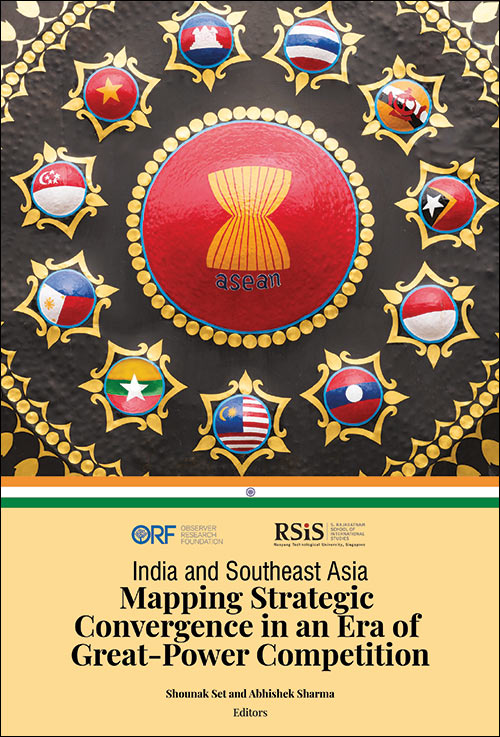
This publication—an outcome of the collaborative effort of the South Asia Program at the S. Rajaratnam School of International Studies, Singapore and the Observer Research Foundation, New Delhi—examines several key questions. How has India’s Act East Policy evolved amid its competition with China in Southeast Asia? What advantages does India enjoy, and what contradictions persist within its approach? How have minilaterals become tools for extending India’s influence in Southeast Asia? How has the Indian Navy responded as maritime competition has deepened, and what is its emerging posture? What are the key bilateral relationships for India in Southeast Asia, and how has India’s engagement with them evolved? What are potential new avenues of cooperation with the region? These questions are key to understanding India’s ability to bridge the gap between its ambitions and capabilities, while identifying pathways to overcome the challenges. A survey of Southeast Asia's evolving place in India's strategic calculus covers several dimensions that are reflected in the ten articles in this publication, all authored by a select cohort of scholars and analysts from both India and Southeast Asia.
Pratnashree Basu assesses the AEP a decade after its launch, examining the extent to which strategic intent has translated into meaningful engagement. Nishant Rajeev studies India’s minilateral frameworks in the Indo-Pacific region and the potential for greater collaboration with Southeast Asia. The maritime domain is a recurring focus, with contributions from Sayantan Haldar and Shounak Set, analysing, respectively, changes represented through Indian naval strategy and posture in maritime Southeast Asia and the export of BrahMos missiles to the Philippines. These changes bore the greatest impact on the rapid transformation of India-Philippines security ties and are adroitly analysed by Don McLain Gill. These analyses are supplemented by an evaluation of India’s bilateral relations with two key states—Indonesia by Apila Sangtam, and Singapore by Sinderpal Singh.
Likewise, a number of chapters in this volume examine India's growing participation in the region through institutional cooperation. Sarah Soh highlights India’s role as a “bridging power” due to its subregional initiative of BIMSTEC; and Abhishek Sharma reviews India’s institutional engagement with ASEAN. Gilang Kembara examines regional maritime security, mapping the genuine convergence, as well as the divergences and potential fault lines.
Collectively, these essays underline a central tension in Indian foreign policy and strategy: finding the equilibrium between the imperatives of strategic autonomy and the growing pressure to assume a more defined security role in a region of overwhelming geopolitical consequence during an era of great-power competition. India’s role in Southeast Asia is being shaped by the perceptions and expectations of its key regional partners, which increasingly view New Delhi as a potential balancer while expecting more consistent economic and security engagement. The breadth and depth of India’s relationships across the region vary considerably, marked by areas of strategic convergence such as shared concerns over China’s assertiveness, and divergences in trade policy and external orientation. India’s growing emphasis on minilateral frameworks has introduced new dynamics that may paradoxically complement and dilute the centrality of ASEAN-led arrangements. Yet, India possesses the capacity to contribute to addressing enduring maritime security challenges, especially in safeguarding critical sea lines of communication and supporting regional capacity-building. Further, emerging technologies present promising avenues for deepening cooperation and contributing to the overall Indian engagement with Southeast Asia.
The aim of this volume is to elevate conversations about India and Southeast Asia and the strategic relationship between the two regions. It probes how durable and strategically coherent the cooperative architecture between India and Southeast Asia truly is.
To that end, the publication focuses on the practicalities of these engagements and examines the institutions, topical issues, and emerging areas through which this dynamic convergence is being built and tested. An analysis of India’s role in this regard will be lopsided and inadequate, if the region’s own perceptions of India are not studied and contextualised.
Read the monograph here.
All views expressed in this publication are solely those of the authors, and do not represent the Observer Research Foundation, either in its entirety or its officials and personnel.
The views expressed above belong to the author(s). ORF research and analyses now available on Telegram! Click here to access our curated content — blogs, longforms and interviews.

Shounak Set is a Marie Sklodowska-Curie Global India Research Fellow at Kings College London specialising in Foreign Policy Analysis and Strategic Studies.
Read More +
Abhishek Sharma is a Junior Fellow with ORF’s Strategic Studies Programme. His research focuses on the Indo-Pacific regional security and geopolitical developments with a special ...
Read More +


 PREV
PREV