PDF Download
Dhaval Desai, “Gender-Responsive Budgeting: Towards the Promise of Inclusive Cities,” ORF Occasional Paper No. 552, Observer Research Foundation, June 2026.
Cities are India’s engines of economic growth, yet these spaces remain deeply exclusionary for women and girls.[1] The National Crime Records Bureau’s (NCRB) Crime in India 2023 report shows a steady rise in crimes against women in metropolitan cities—from 43,414 in 2021 to 48,755 in 2022 and further to 51,393 in 2023—an 18-percent increase over two years. Gender-responsive urban planning is largely absent, and the result is that structural and social inequalities are reproduced and intensified.[2] Why have Indian cities not become safer or more empowering for women despite decades of urban reforms and constitutional decentralisation?
Part of the answer lies in the lack of gender-responsive budgeting based on practical gender needs in urban governance. India’s 2001 National Policy for the Empowerment of Women provided an institutional basis for gender budgeting, emphasising that ministry-level action plans incorporate “gender perspective” in budgeting.[3] Although gender budgeting became a national mandate with the introduction of the Gender Budget Statement in 2005,[4] it has yet to gain prominence in many urban local bodies (ULBs),[5] the tier of governance closest to citizens. In prioritising capital-intensive physical infrastructure and technologically enabled “smartness”, cities allocate fragmented and inconsistent resources to essential social infrastructure. In the absence of gender-sensitive budgeting, public expenditure fails to address the specific needs of women and gender minorities and does not translate constitutional commitments into inclusive outcomes.
Consequently, opportunities, mobility, and agency remain shaped by public spending priorities which, without gender-sensitive budgeting, fail to translate constitutional commitments into concrete fiscal action.[6],[7] As a result, cities overlook the specific needs and lived experiences of women and the transgender population in urban areas.
India’s Ministry of Women and Child Development’s Mission Shakti defines gender budgeting as an approach that integrates gender equality into government planning and budgeting processes.[8] It is a continuous process that incorporates gender perspectives into policy and programme formulation, implementation, and review, ensuring equitable resource distribution and equal opportunities.[9] Implemented from 2022-23 to 2025-26, Mission Shakti adopts a lifecycle approach to women’s development. Its two sub-schemes, Sambal and Samarthya, aim to strengthen interventions for women’s safety, security, and empowerment. Other components include the 2017 Pradhan Mantri Matru Vandana Yojana (PMMVY), which provides maternity benefits; and the following others launched in 2022, including Shakti Sadan, which supports the rehabilitation of distressed women, including victims of trafficking; Sakhi Niwas, which offers safe accommodation for working women; Palna, which provides day-care facilities for children of working mothers; and SANKALP-HEW (Health, Education, and Workforce Empowerment), which supports financial inclusion, entrepreneurship, and digital literacy.[10]
Urban budgets must address gender-specific constraints in infrastructure, services, and planning to make cities more inclusive and reduce gender gaps in education, skills, healthcare, nutrition, employment, political representation, and decision-making. This paper argues that integrating gender-sensitive budgeting into city design, financing, and governance is critical and offers an actionable framework for ULBs, states, and the Union government.
India is urbanising rapidly and its urban population, 31 percent in 2011, is projected to grow to 40 percent (600 million-plus) by 2036, with urban areas contributing more than 70 percent to gross domestic product (GDP).[11] While women constitute nearly half of the urban population (985 females per 1,000 males), a continued trend towards gender parity suggests they may outnumber men in the future.[12] How India navigates this rapid urbanisation and ensures inclusive growth will be critical for the realisation of its ‘Viksit Bharat’ vision of becoming a developed country by 2047.[13]
Cities are often viewed as spaces that neutralise patriarchal norms.[14] However, research by urban sociologists such as Saskia Sassen (2001) and Ananya Roy (2009) shows that urban transformation can also widen inequalities, particularly in countries in the Global South such as India.[15],[16]
Although cities offer greater opportunities for women’s economic empowerment across formal, informal, and home-based work, persistent gaps in mobility and public services constrain these gains. Metropolitan cities are witnessing a rise in crimes against women, including rape, molestation, domestic violence, harassment, and dowry cases.[17] Even digital urbanisation has gendered consequences, as witnessed in the emergence of cybercrimes, from “revenge porn” to blackmail and cyberbullying.[18],[19]
These vulnerabilities are further shaped by class, caste, occupation, and migration status. Women vendors, night-shift workers, domestic and sanitation workers, residents of informal settlements, and transgender persons face heightened risks in public spaces alongside limited access to essential services.[20] Urban improvement projects, such as slum redevelopment or road widening, often unintentionally deepen marginalisation.[21] Shrinking footpaths, inadequate street lighting, poor first- and last-mile connectivity, and limited public sanitation further constrain women’s daily mobility.[22]
Safety concerns also reinforce restrictive gender norms within households, with families imposing higher restrictions on women’s mobility, including early curfews.[23],[24] Such responses illustrate how perceived urban risks can intensify patriarchal control over women and girls.
The current urbanisation model, combined with entrenched social inequalities, patriarchal norms, and weak institutions, creates distinct challenges for women. Recognising these core disparities is key to gender-inclusive urban development.
The United Nations (UN) World Conferences on Women (WCW) placed gender equality on the global agenda in 1975 and led to the adoption of the Convention on the Elimination of All Forms of Discrimination Against Women (CEDAW) by the UN General Assembly in 1979. The momentum continued at the Copenhagen conference in 1980 and the Nairobi conference in 1985. The Beijing Conference and Platform for Action at the WCW held in China in 1995 marked a turning point in the global adoption of gender-sensitive budgeting.[25] Research by feminist economists and sociologists during this period further highlighted how conventional budgeting frameworks contained implicit biases that rendered women’s economic contributions, especially unpaid care work, invisible.[26],[27]
Today, more than 100 countries have adopted the principles of gender-sensitive budgeting, though outcomes remain ambiguous. Only about a quarter have comprehensive systems to track gender allocations or assess their impact.[28] As a result, gaps persist in resource allocation for preventing and addressing gender-based violence and discrimination.[29]
In India, global developments—along with contributions from sociologists and economists who emphasise the need for public expenditure to reflect gendered differences in access, time use, vulnerability, and opportunity—helped advance the concept, especially after the early 2000s.[30],[31] The Government of India institutionalised gender-sensitive budgeting through the introduction of a two-part Gender Budget Statement in the Union Budget 2005-06. Part A addressed schemes with 100 percent allocation to women, while Part B included those with at least 30 percent allocation.[32] As of 2022, 57 of 58 central ministries had institutionalised gender-sensitive budgeting cells.[33] The Union Budget 2024-25, for the first time, introduced part C to capture schemes with allocations below 30 percent—a practice continued in subsequent budgets.[34] For example, the Union Budget 2026-27 allocated INR 5.01 lakh crore (~ US$54 billion) to the gender budget, an 11.55 percent increase from INR 4.49 lakh crore (~ US$48 billion) in 2025-26. By 2026, 53 central ministries and departments, along with five Union Territories,[a] reported gender budget allocations.[35]
However, despite two decades of a central mandate, adoption at the state level remains uneven, with several states introducing gender-sensitive budgeting only recently. Notably, Jharkhand[36] and Uttarakhand[37] have included it in their respective budgets for the current financial year.
Adoption is weaker at the local level, where gender-sensitive budgeting remains peripheral due to limited capacity in ULBs, insufficient data, and limited autonomy and political incentives.[38] Although consolidated national data is unavailable, only a few municipalities—such as Mumbai and Pune—have implemented gender-sensitive budgeting among India’s 266 municipal corporations and 2,018 municipalities.[39]
Figure 1: Evolution of Gender-Sensitive Budgeting in India
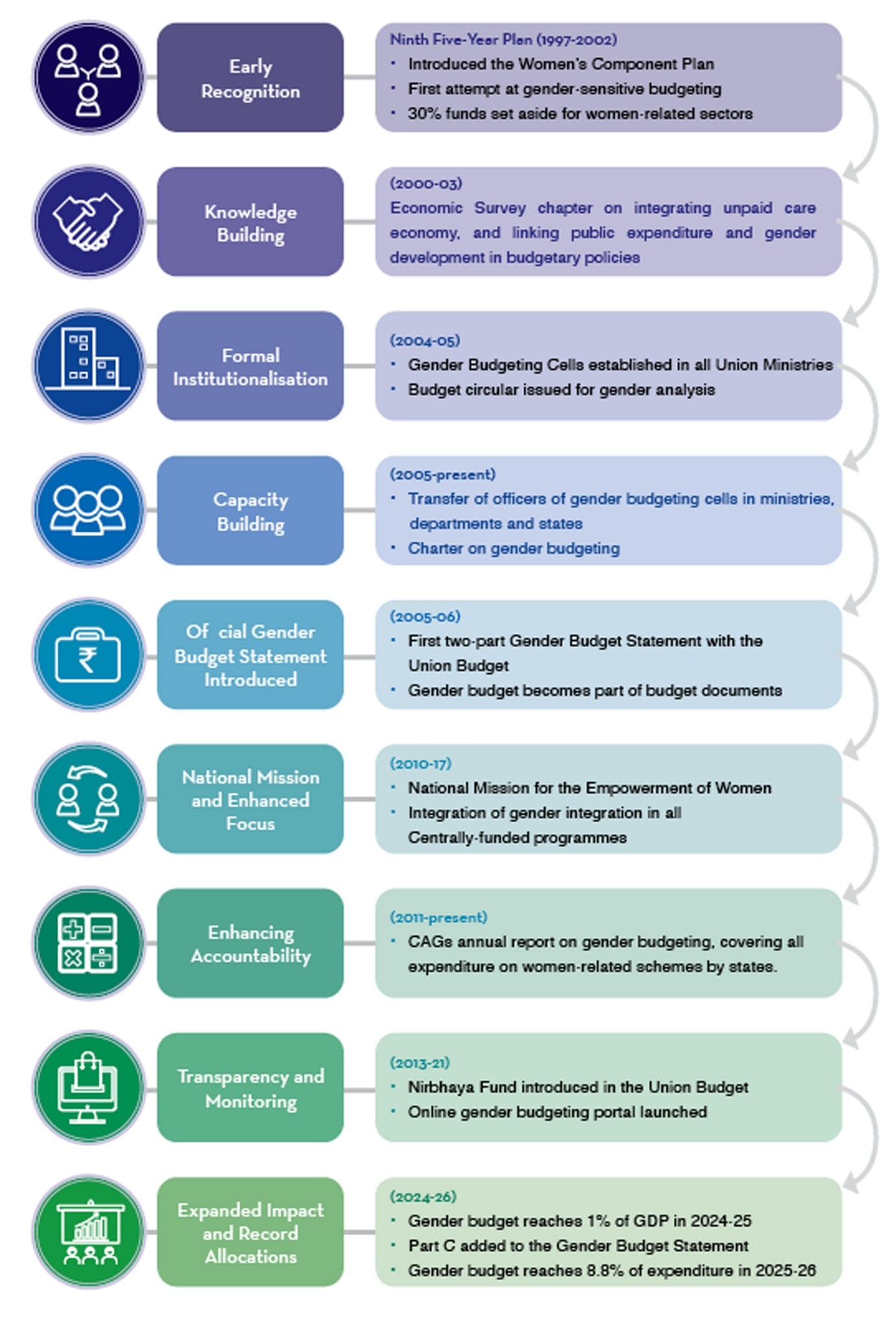
Source: Author’s own, using various sources; IMF.[40] Graphic courtesy Rahil Miya Shaikh, ORF.
Gender-sensitive budgeting engages with gender dynamics across disciplines, including sociology, development economics, anthropology, and urban planning. It also focuses on women’s right to participatory urban planning,[41] access to public places and urban commons; safety and security—including protection from cybercrimes[42]—gender-sensitive design and infrastructure,[43] dignified livelihoods; and property rights. Together, these factors highlight how city design and governance can either constrain or enable women’s mobility, social interactions, economic participation, and everyday well-being.
Despite robust research, most cities stop at gender auditing—including the Ministry of Urban Affairs’ testing of a gender assessment framework in six cities under the Smart Cities Mission—without adopting gender-sensitive budgeting as a tool for inclusive solutions.[44] These audits, focused largely on service gaps and safety, rarely link insights to municipal budgeting.[45] The result is a governance paradox: cities identify problems but seldom fund solutions. Consequently, despite progressive gender laws, constitutional decentralisation, and a national gender-sensitive budgeting framework, urban spaces remain unsafe and exclusionary for women for several reasons.
As Lekha Chakraborty notes in Fiscal Policy for Sustainable Development in Asia-Pacific: Gender Budgeting in India, experiences with the devolution of power in other Global South countries often reveal incomplete decentralisation, where devolved functions are not matched by financial powers.[46] In Morocco, limited local revenue authority and weak gender-disaggregated data hinder implementation. Mexico incorporates gender criteria into fiscal transfers, but rigid conditions restrict local flexibility. In South Africa, despite strong constitutional backing, dependence on national transfers and uneven local capacity weaken integration into planning. Similarly, mandated allocations—such as earmarking 5 percent of local budgets for gender-sensitive issues—often become a compliance exercise due to fragmented fiscal empowerment and weak mainstreaming.[47]
India reflects similar contradictions. Despite legislative efforts to decentralise through the Constitution (74th Amendment) Act (CAA), 1992, most ULBs lack substantial revenue authority and rely heavily on higher-level transfers. Local gender-sensitive budgeting initiatives are constrained by limited capacity and the absence of granular, gender-disaggregated data.[48]
Prioritising Cars Over People: India’s urban planning has historically emphasised road expansion, flyovers, expressways, and automobile mobility. This infrastructure-dominant development model sidelines the needs of pedestrians, street vendors, informal workers, and public transport users—groups largely comprising women.[49] Shrinking footpaths, poor lighting, lack of mixed-use spaces, and unsafe transit hubs further undermine women’s mobility.
The Marginalisation of Care Work: Unpaid and underpaid care work, mainly performed by women, is the backbone of cities. These essential tasks include cooking, water collection, sanitation management, and caregiving to infants and the elderly. Yet municipal budgets lack dedicated allocations for community kitchens, crèches, elderly care centres, halfway homes, caregivers’ allowances, breastfeeding rooms, and accessible primary healthcare. This perpetuates the invisibility and undervaluation of care work.[50]
Weak Local Capacities and Gender-Absent Institutions: While the Constitution (74th Amendment) Act (CAA) accorded constitutional status to ULBs, recognising them as the third tier of government, they remain impoverished, with capacity constraints and overstretched administrations.[51] Most municipal corporations spend over 70 percent of their budgets on salaries, leaving little room for new investments and innovations.[52] Without gender-sensitive budgeting units, gender experts, and mandatory gender audits, most cities lack the institutional mechanisms or administrative capacity to integrate gender considerations into planning.
Safety as an Afterthought: Cities often respond to gender-based violence through intensified policing—patrols, CCTV cameras, and helplines. While necessary, safety is also a design challenge.[53] Well-lit streets, high-footfall areas, open visibility, mixed-use planning, and accessible public transport reduce fear and risk,[54] yet these principles rarely shape urban design in India.
Fragmented Governance and Lack of Accountability: Without exception, Indian cities suffer from fragmented governance across multiple agencies, including municipal corporations, development authorities, electricity boards, transport corporations, and private entities mandated to perform civic tasks through public-private partnerships.[55] This fragmentation makes gender-sensitive budgeting difficult, as no single agency has either the mandate or accountability.
Ineffective State Finance Commissions: The CAA aimed to transform India’s fiscal federalism and make local governments empowered, self-governing institutions. Besides a slew of broader constitutional mandates for decentralisation of power, it mandated the constitution of the State Finance Commissions (SFCs) every five years, primarily to evaluate the financial health of the ULBs, recommending revenue sharing, intergovernmental financial transfers via grants-in-aid, and enhanced own revenue collection by ULBs in the interest of the sound finances of municipalities. Although their reports are tabled in state legislatures, state governments have largely ignored their recommendations or compiled them only superficially. This has left ULBs financially weak, without an independent tax base or sustainable revenue model.[56]
If budgets are political statements of priority, India’s municipal budgets reveal a longstanding pattern of women’s invisibility. Most planning documents, including City Development Plans (Master Plans) and Smart City proposals, seldom acknowledge gender as a critical planning component that affects safety, home ownership, public health, and access to mobility and other essential civic services.[57] Instead, gender is treated as a peripheral concern, addressed through sporadic schemes or interventions such as GPS-enabled buses with panic buttons[58] or CCTV surveillance in public spaces.[59] While important, these measures do not transform the fiscal policies that shape how cities operate. Moreover, funding constraints undermine even these interventions, resulting in poorly maintained systems such as faulty panic buttons in buses and taxis.[60] Extensive digital surveillance also raises privacy concerns, with studies claiming that some of the “most surveilled cities are the least safe.”[61] Instead, encouraging more on-street activities and footpaths can ensure the safety of children, women, older people, and persons with disabilities.
Gender-sensitive budgeting addresses this gap by compelling urban institutions to assess how spending decisions affect women and men differently. Municipal budgets often rest on implicit assumptions about households, labour markets, and the state’s role in caring responsibilities.[62] When these assumptions remain unchallenged, the resulting budgets reproduce inequality. In this scenario, the municipal planning matrix is blind to single women, female-headed households, and informal women workers.
This exclusion becomes most apparent in moments of crisis. Women suffered from the maximum job losses, increased domestic care burdens, and heightened mobility restrictions during the COVID-19 pandemic.[63] Sanitation workers lacked safety equipment, migrant women encountered a severe shortage of shelters, and domestic workers were rendered jobless during the elongated lockdowns. While the pandemic was an unprecedented catastrophe, long-term underinvestment in the care infrastructures of affordable housing, health centres, crèches, night shelters, and public toilets exacerbated their vulnerabilities.
Gender-sensitive budgeting, with disaggregated data collection, gender audits, need-based investments, and robust monitoring, can foster inclusive cities.
Indian cities consistently underinvest in services and infrastructure that shape women’s daily lives, including mobility, safety, sanitation, informal settlements, and healthcare and social services.
Mobility and Public Transport: For most urban women, mobility is essential for accessing work, education, healthcare, and public life. The World Bank reports that 84 percent of women’s trips in cities are undertaken via public, intermediate public, and non-motorised transport.[64] Yet fear of sexual harassment, overcrowding, and unreliable schedules, especially in buses and suburban trains, have contributed to the disproportionately low share of women of 14 percent in overall public transport trips.[65] On the other hand, women from low-income groups and informal settlements find metro rail, despite its better safety, reliability and comfort, unaffordable, especially with the added costs of first- and last-mile connectivity.[66]
Moreover, urban transport systems, designed primarily for peak-hour commuting, overlook women’s ‘trip-chaining’ patterns involving multiple short journeys linked to work and household responsibilities.[67] Municipal budgets rarely reflect the need for easily accessible, affordable, and safe first- and last-mile connectivity options.
Safety and Security: Safety audits by independent entities consistently highlight inadequate lighting, compromised pedestrian infrastructure, deserted stretches near transport hubs and public places, and a lack of mixed-use streets—all of them discouraging women’s mobility within cities.[68] Municipal investment in public spaces tends to prioritise ‘beautification’ rather than accessibility or gender-sensitive design.[69]
Weak maintenance further undermines safety: streetlights remain non-functional for long periods of time,[70] faulty CCTV cameras are not repaired,[71] and footpaths are encroached upon or else are damaged.[72] These failures are not because of a lack of awareness but stem from lopsided budgeting, where safety is relegated to the police, and public space design is divorced from gender considerations.
Sanitation and Public Toilets: Access to clean, safe, and affordable public toilets remains a persistent challenge. Studies, including one by the Observer Research Foundation in Mumbai,[73] indicate that women commuting for long hours on suburban trains for work often avoid drinking water while travelling due to limited access to toilets at stations and other public places, leading to health issues such as dehydration and urinary tract infections. Municipal allocations for public toilets largely favour men’s urinals because they are cheaper to construct. To cater to the unique needs of women, women’s toilets require more space, adequate lighting and privacy, water connectivity, safe sanitary pad disposal, and regular cleaning.[74]
Housing and Informal Settlements: Housing is central to women’s empowerment. The Pradhan Mantri Awas Yojana (Urban) (PMAY-U) addresses barriers to ownership through provisions for female co-ownership and mandates basic amenities such as toilets, electricity, cooking gas, and tap-water connections.[75] However, its Credit-Linked Subsidy Scheme remains exclusionary in terms of affordability and access, limiting benefits for economically weaker groups.[76]
In informal settlements—home to a large share of low-income urban women—the lack of piped water, lighting, waste management, drainage, and paved roads disproportionately affects women. These neighbourhoods receive minimal municipal investment, reflecting structural biases in public expenditure.[77]
Health, Care, and Social Services: Urban health systems remain uneven despite interventions such as the National Urban Health Mission (NUHM). The mission’s impact has been constrained by inconsistent funding, limiting its ability to build infrastructure, procure equipment, train personnel, and conduct outreach in underserved areas.[78],[79]
These shortcomings mirror broader failures of municipal bodies to deliver health services, despite public health being a mandated function under the 12th Schedule following the Constitution (74th Amendment) Act. In many cities, municipal health services do not even meet government norms, giving the poor no option but to resort to more expensive private healthcare.[80] A 2025 study corroborates this gap: despite targeted national-level programmes, urban health systems have lower coverage for the poor. Women in cities report lower contact with health workers (25.9 percent) than rural women (34.7 percent).[81]
Health outcomes further underscore inequality. Women from the poorest urban households are 3.7 times more likely to die than those from the richest. The death rate increased substantially for women in the early reproductive age group, indicating accessibility challenges to antenatal care in informal settlements.[82]
Limited fiscal autonomy, constrained technical and administrative capacity, a lack of gender-disaggregated data, and governance fragmentation impede the implementation of gender-sensitive budgeting at the city level.
Limited Fiscal Autonomy and Institutional Capacity: ULBs across India remain cash-strapped, with an ever-widening gap between the financial resources available to them and the functions they perform. The clear recommendations by SFCs, established following the enactment of the CAA, for the devolution of financial powers to the ULBs has received only superficial recognition.[83]
The cash-starved ULBs were straddled with an even bigger unfunded mandate when the Goods and Services Tax (GST) subsumed most of their revenue handles, including octroi, the biggest revenue generator, in 2017.[84] Compounding the challenge is that many states have resorted to populist measures, especially on the eve of legislative elections, by widening property tax exemptions, which, after the abolition of octroi, fetches the maximum revenue for the ULBs.[85],[86]
Such decisions have led several ULBs to rely on state and central grants for up to 75 percent of annual municipal budgets, thereby denying them the flexibility to tailor budgets to local gender needs.[87] The tied nature of many grants, in which the funds are earmarked for specific projects under the Government of India or multilateral aid programmes, restricts local discretion and innovation.[88]
As a result, very few ULBs have gender-responsive budgeting cells, even when several states have established them at the department level. Without robust institutional mechanisms, gender-sensitive budgeting remains rhetorical.
Lack of Gender-Disaggregated Data: ULBs rarely collect gender-disaggregated data, resulting in planning processes that inadvertently reinforce gender bias.[89] Without data on time use, safety, travel patterns, and health outcomes, urban planning fails to capture women’s unique needs.
Only Kerala and Tamil Nadu have completed the census of the transgender population and implemented social sector schemes under the Ministry of Social Justice and Empowerment’s 2022 Support for Marginalised Individuals for Livelihood and Enterprise (SMILE) scheme, which supports rehabilitation, education, health, and skill development. Allocations for transgender welfare have increased, reaching INR 76.88 crore in 2025-26.[90]
However, smart city interventions across urban India rely on big data, where algorithms prepared on skewed datasets that consider men as default citizens, exclude the lived realities of women and prioritise surveillance over structural safety.[91] The absence of gender-disaggregated data also exacerbates institutional gender imbalances, as state urban development departments and ULBs remain male-dominated, compounding the lack of gender-focused research, analysis, and design thinking.[92]
Fragmented Urban Governance, Weak Women’s Representation and Capacity: Urban governance in India remains highly fragmented. Transport is managed by state-level corporations, policing by state departments, water and sewerage by parastatals, and housing and road infrastructure by state-managed development authorities. Megacities, such as Mumbai,[93] Delhi,[94] and Bengaluru,[95] exemplify this fragmentation, with key urban functions split across more than 20 municipal, state, and central agencies and ministries. This fragmentation makes it difficult to introduce inter-departmental gender-sensitive budgeting, leaving no single agency accountable for gender outcomes.[96]
Women councillors have limited influence on planning and finance despite the CAA reserving one-third of ULB seats for women. The role of women councillors, especially those without political or administrative experience, is often compromised, as male-dominated civic committees often sideline their views and concerns.[97] In several instances, women councillors also function as proxies for male relatives, becoming nominal elected representatives and unable to exercise any substantive authority.[98]
Successful examples of gender-sensitive budgeting from several cities—when backed by political will and institutional support—offer valuable lessons for India.
Vienna’s pioneering efforts to mainstream gender-sensitive budgeting: Vienna is often regarded as a world-leading example of gender-inclusive policies, having made gender-sensitive budgeting mandatory across all public budgets since 2005. Its gender mainstreaming and implementation are grounded in the following principles:[99]
Vienna has engaged with the European Women’s Lobby (EWL) since 2005[100] for capacity-building and awareness campaigns within city departments and communities to integrate gender-sensitive budgeting into its approximately €15 billion in annual outlay.[101]
Gender-sensitive budgeting has not only advanced equity but also reaped measurable economic benefits for the Austrian capital. A 2019 study examined mechanisms that improved the compatibility of family and work life, leading to higher female labour force participation rates, and explored other determinants that influenced the city’s GDP. For example, employment rates for mothers ages 20-39 increased by 1.5 percentage points following the city’s non-contributory kindergarten initiative. The initiative increased job opportunities, enabling 1,000 additional women in that age group to join the labour market. Additionally, kindergartens and crèches created 7,600 jobs, nearly 6,000 of them locally.[102]
Gender-sensitive budgeting has generated direct employment and unlocked the city’s female labour potential, thereby enhancing their economic participation and strengthening the local economy.
Barcelona’s Feminist City Agenda and Care Economy Model: Barcelona offers a distinctive model by integrating gender-sensitive budgeting into municipal governance through a care economy lens. Under the 2017-2020 Democratisation of Care initiative, the Barcelona City Council recognised care as central to the city’s socioeconomic life, promoting shared societal responsibility and reducing gender inequalities. City Council’s Caring City initiative further recognises both paid and unpaid care work as fundamental to the city’s socioeconomic fabric, redistributing care responsibilities beyond traditional women-oriented roles.[103]
The city’s Gender Justice Plan (2021-25) lends a gender perspective across all expenditure heads of the municipal budget. It set aside nearly 85 percent of the budget to address societal inequalities and awarded subsidies of over €42 million for gender-sensitive projects.[104] The city council conducts regular gender impact assessments of budget programmes to track how public expenditure has addressed gender gaps.
The systemic use of sex-disaggregated data has improved women’s access to services and strengthened their economic participation. For instance, over 1,800 women received labour rights support, 726 women from vulnerable groups secured employment, and nearly 100 women-led projects, along with 153 women entrepreneurs, were supported through business development programmes.
In the care economy, more than 4,500 women were supported through the neighbourhood-based care services, and more than 8,000 care-related enquiries were handled through centralised support services for caregivers. The plan also reserved 10 percent of public housing for women and single-mother households, trained nearly 3,000 police officers to identify and respond to gender-based violence, implemented anti-harassment protocols at 40 nightlife venues across the city’s metro rail and bus systems, implemented specific programmes to reduce gender inequalities in physical education in 335 schools, and redesigned playgrounds to create more inclusive and co-educational spaces in 17 schools.[105]
Barcelona’s Gender Justice Plan thus demonstrates how gender-responsive budgeting can shift mainstream public expenditure toward reducing structural inequalities and generate measurable impacts in employment, housing access, care services, safety, and education.
Seoul’s Public Investment for Enhanced Safety: Seoul has advanced gender-responsive urban design and budgeting by prioritising women’s safety through targeted infrastructure rather than relying solely on surveillance technologies. Its gender budget expanded by more than 1,000 percent, from KRW 272.2 billion for 60 programmes in 2013 to KRW 3.25 trillion for 333 programmes in 2020.[106]
Since the launch of the Women-Friendly City Project in 2007, the Seoul Metropolitan Government has integrated women’s perspectives into city planning, with targeted investments in well-lit pedestrian infrastructure, safer walkways, and inclusive public transport access. These urban design measures followed a citywide survey, which revealed that over 77 percent of women expressed concerns about insecurity and mobility constraints in public transport, streets, and public places.[107]
The project has delivered measurable outcomes, including 69.2 km of women-friendly walkways, 50 parks, improved pedestrian routes, and expanded street lighting. Investments in public restrooms and women-centred mobility services have further enhanced accessibility and participation in public life and the workforce. These infrastructure interventions are an integral part of Seoul’s gender-responsive budgeting, which mandates all civic departments to address gender needs in their plans and budgets.[108]
These outcomes underscore that increased social infrastructure spending in education, childcare, and care services significantly contributes to inclusive development.
Cape Town’s Gender-Responsive Service Delivery in Low-Income Settlements: Although gender-sensitive budgeting remains underdeveloped in South African cities, Cape Town is an outlier. The city has embedded gender perspectives in its planning to streamline water, sanitation, transportation, and childcare services in low-income settlements. The city undertook participatory studies involving young women to understand how reliable, affordable, and easily accessible basic services reduced women’s unpaid care burdens, enabling greater mobility and economic participation.[109]
Based on these findings, Cape Town combined household surveys, focus group discussions, and primary service delivery data to link service quality with women’s work opportunities. For example, improvements in access to safe water, sanitation, transport, and education gave women more time for economic engagement, especially within the low-income townships and informal settlements.
Later studies acknowledged that gender-responsive delivery of essential services led to enhanced female labour force participation and, thereby, greater economic inclusion.[110] For example, the campaign provided piped or tap water to 98 percent of households in the city,[111] ensured basic water and sanitation services to over 230,000 recognised informal settlements,[112] installed 10,000 community taps and 50,000 toilets,[113] and increased access to clean sanitation services to 95.5 percent of the population in informal settlements.[114] Additionally, 196 lower-income neighbourhoods received housing and infrastructure upgrades through micro-developer support, and provided subsidised electricity connections to 1,578 households in informal settlements.[115]
Gender-Responsive and Participatory Budgeting in Penang: Penang pioneered gender-responsive and participatory budgeting (GRPB) by integrating gender principles into participatory public finance. The city formally adopted gender-responsive budgeting in 2012 through a collaboration among the Penang State Government, the Penang Women’s Development Corporation (PWDC), and the two local councils, viz., Penang Island City Council and Seberang Perai Municipal Council. This collaboration established a smart institutional platform to incorporate gender perspectives and community voice directly into budget planning, design, implementation, and monitoring.[116]
Originally introduced as gender-responsive budgeting, the model was reframed as GRPB in 2014 to emphasise community participation in defining budget and public expenditure priorities. With the mission statement of ‘Different People, Different Needs,’ Penang’s GRPB model recognises that men, women, girls, and boys, and the diverse groups within these categories of citizens, have different needs, priorities, lived experiences, and responses to public expenditure.[117] PWDC’s 2016 GRPB Manual outlines both the conceptual basis for gender-responsive budgeting and the practical steps for implementing GRPB at the local government and community levels.
The model follows a four-phase participatory process: (i) demographic surveys to generate baseline, gender-disaggregated data; ii) focus group discussions to facilitate citizen engagement; iii) community prioritisation and voting on identified needs; and iv) planning, presentation, and negotiation with government stakeholders to secure budget allocation. Typically piloted locally and scaled citywide, this approach strengthens accountability, trust, and community ownership.[118]
GRPB has informed community projects with inclusive design features benefiting women, children, people with disabilities, and the elderly. For example, the development of Taman Areca in Sungai Pinang incorporated a universal playground, a separate women’s exercise area, flat walkways for older residents, and a community garden managed by residents. These design choices reflect gender- and age-inclusive needs identified through participatory budgeting, improving safety, comfort, and accessibility for women and gender minorities in public spaces.[119]
A milestone was the institutionalisation of the 2019 Gender Inclusiveness Policy, which integrates GRPB across departments as a standard budgeting practice. Relying on periodic collection of gender-disaggregated data and gap analysis, this policy explicitly focuses on narrowing gender gaps and ensuring equal opportunities for women’s participation in decision-making and service design.[120]
Penang’s GRPB approach has gained international recognition, with cities in Malaysia’s neighbourhood adopting its community-inclusive, participatory budgeting. For example, the Kuala Lumpur City Hall. Penang’s model is thus expanding beyond Malaysia to benefit more women and gender minorities at a regional level.[121]
Taken together, the experiences of Vienna, Barcelona, Seoul, Cape Town, and Penang demonstrate that effective gender-sensitive budgeting must be institutionalised, participatory, and embedded within broader urban planning frameworks. Together, they offer a rich canvas of scalable, context-adaptable global best practices that Indian cities can emulate to embed gender equity into urban planning and budgeting.
ULBs in India must adopt a clear institutional and analytical framework to mainstream gender-sensitive budgeting within urban governance. This requires assessing every public expenditure—across roads, housing, sanitation, mobility, health, and digital infrastructure—through a gender lens. Gender-sensitive budgeting enables cities to respond to the layered realities of women’s lives rather than considering them as an afterthought. Drawing on frameworks developed by Diane Elson,[122] Rhonda Sharp,[123] and Indian scholars such as Yamini Mishra,[124] this paper presents the following five pillars as central to an urban gender-sensitive budgeting approach.
Together, these strategies can help cities become enablers of equity and opportunity.
The implementation of gender-sensitive budgeting requires overcoming entrenched gender binaries and fostering transformative reforms, including changes to political and administrative mindsets, across all levels of government. Responsibilities must be clearly distributed, with distinct roles for the national and state governments and ULBs.
Union Government: At the national level, the Government of India must anchor gender-sensitive budgeting through financial incentives and regulatory frameworks. The first step is to include ULBs within the national Gender Budget Statement, with a dedicated section for urban schemes administered through municipalities, modelled on Parts A, B, and C. All schemes reported under the statement should include a mandatory rationale for gender-related expenditure.
Union ministries implementing schemes such as the Atal Mission for Rejuvenation and Urban Transformation (AMRUT), PMAY-Urban, National Urban Digital Mission (NUDM), and the National Urban Health Mission (NUHM) must mandate gender-disaggregated reporting for fund releases. Structural incentives, such as performance-linked grants for gender-responsive planning, could motivate ULBs to adopt reforms.
Capacity-building programmes led by institutions such as the National Institute of Urban Affairs (NIUA),[131] and the All-India Institute of Local Self-Government should integrate specialised modules on gender-sensitive budgeting.[132] Without an ecosystem of trained personnel, reforms will remain guidelines rather than substantive.
State Governments: States play a critical role, as ULBs operate under state legislation. As such, states must urgently adopt the CAA in letter and spirit. Operationalising the CAA’s mandate to devolve power through state- and ULB-level governance and to usher in institutional, administrative, and fiscal autonomy is crucial for cities to transition toward gender-sensitive budgeting. States must also implement the recommendations of the State Finance Commissions to improve the fiscal health of ULBs with committed transfers and revenue-sharing. Simultaneously, they must urgently conduct property tax reforms, rationalise user charges, and expand local revenue bases for ULBs to deliver measurable gender-responsive outcomes.
Importantly, the states must follow the framework under which the recommendations of the national-level Finance Commission are conclusively accepted by the National Parliament, paving the way for unconditional, general-purpose “statutory fiscal transfers” from the Union Government to the states.[133] While these transfers were managed by the erstwhile Planning Commission of India, they are channelled through line ministries as conditional grants under “centrally-sponsored schemes” after its dissolution. Additionally, integrating gender criteria as a mandatory condition for intergovernmental fiscal transfers would strengthen the positive gender equality outcomes.[134]
These reforms must be backed by establishing Gender Budget Cells (GBCs) within not only state urban development departments but also ULBs to create a dedicated coordination channel between finance departments, women’s commissions, and ULBs. The GBCs, staffed with civic officials, economists, technocrats, and planners, with a balanced gender ratio, must serve as resource hubs that support ULBs in applying gender-responsive tools, conducting audits and ensuring compliance with gender-sensitive budgeting requirements.
Simultaneously, states must invest in leadership development programmes and workshops for women councillors who often face institutional and patriarchal barriers within the male-dominated committees. Such support can significantly expand their influence in municipal decision-making.
States must also support ULBs in building reliable, granular, and evidence-based gender-disaggregated data systems, including safety mapping, time-use surveys, service delivery assessments, and gender audits, by establishing state- and city-level data laboratories that provide the necessary technical assistance.
Urban Local Bodies (ULBs): At the city level, ULBs must embed gender-sensitive budgeting in routine governance practices.
First, ex-ante analysis during budget preparation should identify gender gaps, align resources, and inform demands for equitable transfers.
Second, participatory budgeting forums involving women’s groups, NGO networks, and informal workers should be institutionalised to ensure budgets reflect intersectional realities of caste, class, migration status, disability, and occupation. Participatory budgeting experiments in Cape Town and Barcelona show that such forums enhance accountability and align fiscal decisions with lived experiences.
Third, sustained collaborations between local governments, universities, and think tanks can help embed academic insights directly into local governance and planning processes, bridge data gaps on critical urban issues such as informal labour and housing, and lead to more responsive city-level policy design and implementation.
Fourth, ULBs must invest in gender-responsive infrastructure, including well-lit streets, accessible footpaths, bus stops, 24-hour public toilets, community kitchens, integrated crisis centres, primary health centres, mental health support and community crèches. Many of these interventions have modest costs but significant social returns, with increased female labour force participation, improved health, and greater access to public spaces.
Fifth, cities should introduce routine gender audits of mobility systems, public spaces, public amenities, digital infrastructure, and housing programmes. Audits must inform reallocation decisions in subsequent budgets.
Sixth, municipalities must ensure that frontline workers, including sanitation staff, health workers, bus drivers, conductors, and public transport personnel, who are the human interface of public services, receive gender-sensitisation training.
Turning gender-sensitive budgeting from concept to practice requires a phased and realistic roadmap that allows for local adaptation.
Phase I – Diagnostics and Preparation: Cities must begin with gender-disaggregated surveys, assessments of practical and strategic gender needs, safety audits, mobility studies, and consultations with women’s groups to identify context-specific challenges. This phase should also establish GBAs.
Phase II – Integrating Gender into Planning: The survey findings must then feed into planning processes. City Development Plans/Master Plans and annual municipal budgets must explicitly integrate gendered needs. For example, an annual budget might allocate funds to repair streetlights and pavements in streets identified as unsafe if the city Master Plan revision proposes mixed-use neighbourhoods to increase footfall and safety. The planning must ensure the representation and voice of elected women representatives and of civil society organisations that represent their intersectional vulnerabilities and multiple marginalities.
Phase III – Reallocation and Targeted Investments: After preparation and planning, cities should reallocate funds towards gender-sensitive interventions. Small but strategic investments often yield optimum results. A modest investment in maintaining panic buttons in public transport modes can significantly enhance women’s mobility; similarly, upgrading sanitation facilities in markets can improve women vendors’ working conditions and increase their economic participation.
Phase IV – Participatory Monitoring and Social Accountability: Women’s collectives, academic institutions, and civil society organisations should be invited to participate in post-implementation reviews. Public dashboards showing budget utilisation, progress on safety indicators, and service improvements must be available on ULB websites, with real-time updates, to build trust and transparency.
Phase V – Consolidation and Institutionalisation: Finally, binding legal and institutional provisions must underpin and reinforce gender-sensitive budgeting. The states must amend their respective municipal Acts to make gender-sensitive budgeting mandatory, include gender indicators in municipal performance reviews, and integrate gender priorities into recruitment rules, procurement guidelines, and training curricula.
Cities can move from pilot-based experimentation to full institutionalisation when gender-sensitive budgeting becomes part of the bureaucratic DNA, embedded in rules, systems, and organisational culture.
Cities both reflect and reproduce the power relations, social hierarchies, and institutional biases embedded within their planning, design, and budgeting systems. Fiscal priorities at the state and ULB levels have long sustained a gender-blind model of urban development, making cities exclusionary for women, especially those from low-income and vulnerable communities.
Indian cities must urgently realign their fiscal priorities to ensure that women can move freely, work safely, access services equitably, and participate meaningfully. This requires political will at the Union and state levels, institutional capacity within ULBs, and active participation by women’s groups, civil society organisations, and urban communities. It also requires recognising care and the informal economy, safety, and accessibility to basic services and opportunities as core urban necessities, not peripheral ideas.
Gender-sensitive budgeting offers a transparent and accountable way to ensure that the lived realities of women shape a city’s priorities. It turns fiscal choices into opportunities for fairness and inclusion, rather than reinforcing exclusion. If Indian cities adopt this approach with genuine commitment, the urban landscape could change dramatically, becoming a place where women can live with dignity, safety, and freedom. Unwavering political commitment, especially from the ruling dispensation in the state government, and ensuring the required level of governance and fiscal freedom for cities to tackle unforeseen challenges, including changing budgetary priorities and their integration into performance matrices, will determine its success.
Dhaval Desai is Senior Fellow and Vice President, ORF Mumbai.
All views expressed in this publication are solely those of the author, and do not represent the Observer Research Foundation, either in its entirety or its officials and personnel.
[a] Government statements and releases have not named these five UTs.
[1] “India's Smart Cities Mission,” UN Women, October 2017, New Delhi, https://asiapacific.unwomen.org/en/news-and-events/stories/2017/10/india-smart-cities-mission.
[2] Mahera Imam, “Conceptualising Cyber-Crime Against Women: Beyond Numbers and Online Misbehaviour,” Impact and Policy Research Institute, November 13, 2025, https://www.impriindia.com/insights/cyber-crime-against-women/#google_vignette.
[3] Department of Women and Child Development, Ministry of Human Resource Development, Government of India, “National Policy for the Empowerment of Women 2001,” Ministry of Human Resource Development, 2001, https://prsindia.org/files/bills_acts/bills_parliament/2008/bill184_20080923184_National_policy_for_empowerment_of_women.pdf.
[4] Ministry of Finance, Government of India, https://www.pib.gov.in/PressNoteDetails.aspx?NoteId=154811&ModuleId=3®=3&lang=2#:~:text=India%20marked%20a%20major%20milestone,of%20India's%20Gender%20Budgeting%20Framework.
[5] Darshini Mahadevia, Neha Bhatia and Ritika Sebastian, Gender Responsive Budget: Analysis on Urban Development Sector, Ahmedabad, CEPT University, 2017, https://www.feministpolicyindia.org/documents/resources/GRB%20Analysis%20of%20Urban%20Development%20Sector%20Report%20for%20CUE%20Website_26.04.2017.pdf.
[6] Bina Agarwal, Gender and Green Governance: The Political Economy of Women’s Presence Within and Beyond Community Forestry, (New Delhi: Oxford University Press, 2010) pp. 488.
[7] Natalia Alonso-Morales, Alejandro Sáez-Martín and Arturo Haro-de-Rosario, “The role of local public spending in the achievement of the social dimension of sustainable development: An empirical analysis,”
Sustainable Futures, Volume 9, 100475 (2025), https://doi.org/10.1016/j.sftr.2025.100475.
[8] Mission Shakti, Ministry of Women and Child Development, Government of India, “Knowledge Hub: Gender Budgeting,” Mission Shakti, https://missionshakti.wcd.gov.in/gender-budgeting/about.
[9] Mission Shakti, “Knowledge Hub: Gender Budgeting”
[10] Ministry of Women and Child Development, Government of India, https://www.pib.gov.in/PressReleasePage.aspx?PRID=2098874®=3&lang=2
[11] Auguste Tano Kouamé, “India urbanisation critical for getting developed tag,” The Economic Times, January 26, 2024, https://economictimes.indiatimes.com/news/economy/infrastructure/view-india-urbanisation-critical-for-getting-developed-tag/articleshow/107155247.cms?from=mdr
[12] Ministry of Women and Child Development, Government of India, https://www.pib.gov.in/PressReleasePage.aspx?PRID=1806605®=3&lang=2
[13] Prime Minister’s Office, Government of India, https://www.pib.gov.in/PressReleasePage.aspx?PRID=2156701®=3&lang=2
[14] Elizabeth Wilson, The Sphinx in the City: Urban Life, the Control of Disorder, and Women, (Los Angeles: University of California Press, 1991), pp. 7.
[15] Ananya Roy, City Requiem, Calcutta: Gender and the Politics of Poverty, (Minneapolis: University of Minnesota Press, 2003), pp. 34.
[16] Saskia Sassen, “Toward a Feminist Analytics of the Global Economy,” Indiana Journal of Global Legal Studies, Vol. 4: Iss. 1, Article 2 (1996), https://www.repository.law.indiana.edu/cgi/viewcontent.cgi?article=1081&context=ijgls.
[17] Jignasa Sinha, “Delhi: Crimes against women fall 5.7%, but still worst in India,” Hindustan Times, September 30, 2025, https://www.hindustantimes.com/cities/delhi-news/crimes-against-women-fall-5-7-but-still-worst-in-india-101759174079148.html.
[18] Tyrone Kirchengast and Thomas Crofts, “The Legal and Policy Contexts of ‘Revenge Porn’ Criminalisation: The Need for Multiple Approaches,” Oxford University Commonwealth Law Journal, 19 (1): 1–29 (2019), https://doi.org/10.1080/14729342.2019.1580518.
[19] Mahera Imam, “Conceptualising Cyber-Crime Against Women: Beyond Numbers and Online Misbehaviour”
[20] Neha Dasgupta, “Women as street food vendors in India: An uncertain workspace,” International Journal of Advanced Academic Studies, 6(2):11-14 (2024), https://doi.org/10.33545/27068919.2024.v6.i2a.1109.
[21] Amani Ragheb and Rasha El-Ashwamy, “Strategic actions of urban development to define the intervention policies of slums,” City, Territory and Architecture 8, 10 (2021), https://doi.org/10.1186/s40410-021-00139-w.
[22] Aditi Ratho and Shruti Jain, Women on the Move: The Impact of Safety Concerns on Women’s Mobility, Observer Research Foundation, May 2021, https://www.orfonline.org/public/uploads/posts/pdf/ORF_Monograph_WomenOnTheMove.pdf.
[23] Lubna Ismailee, “When “Safety” Becomes A Curfew,” Youth ki Awaaz, December 2025, https://www.youthkiawaaz.com/2025/12/when-safety-becomes-a-curfew-what-reclaim-reveals-about-our-society/.
[24] Sonali Mukherjee and Farrukh Shah, World of India’s Girls: A study on the perception of girls’ safety in public spaces, Save the Children, 2018, https://resourcecentre.savethechildren.net/pdf/wings_2018_world_of_indias_girls_report.pdf.
[25] New Delhi, Ministry of Finance, Government of India, Gender Budget 2024-25, (New Delhi: Ministry of Finance, 2025), 3, https://missionshakti.wcd.gov.in/public/documents/gbdocuments/17107782611749468962.pdf#:~:text=Australia%20was%20the%20first%20country%20in%20the,national%20and%20sub%2Dnational%20levels%20of%20the%20government.
[26] Diane Elson, “Labor Markets as Gendered Institutions: Equality, Efficiency and Empowerment Issues,” World Development, Volume 27, Issue 3, 611-627 (1999), https://doi.org/10.1016/S0305-750X(98)00147-8.
[27] Debbie Budlender et al., Gender Budgets Make Cents: Understanding gender responsive budgets, (London: The Commonwealth Secretariat, 2002), pp. 31.
[28] Kevin Deveaux and Geoff Dubrow, Action Kit: Engaging Parliaments in Gender-Responsive Budgeting, New York, UN Women, 2022, https://www.unwomen.org/sites/default/files/2022-11/Action-kit-Engaging-parliaments-in-gender-responsive-budgeting-en.pdf.
[29] Katherine Gifford and Zohra Khan, Strengthening Public Finance Management Systems for Gender
Equality and Women's Empowerment: Promising Practices and Remaining Gaps, New York, UN Women, 2023, https://www.unwomen.org/sites/default/files/2023-06/Strengthening-public-finance-management-systems-for-gender-equality-and-womens-empowerment-en.pdf.
[30] Indira Hirway, “Understanding Poverty: Insights Emerging from Time Use of the Poor,” in Unpaid Work and
the Economy: Gender, Time Use and Poverty in Developing Countries, ed. Rania Antonopoulos and
Indira Hirway, (Hampshire: Palgrave Macmillan, 2010), 22-51, http://ndl.ethernet.edu.et/bitstream/123456789/42479/1/99.pdf.
[31] Vibhuti Patel, “Gender Budgeting in India” (paper presented at the national workshop ‘Gender Budgeting –An Effective Tool for Achieving Women’s Empowerment,’ Patna, India, April 15, 2007), https://gender-financing.unwomen.org/en/resources/g/e/n/gender-budgeting-in-india-by-dr-vibhuti-patel.
[32] Ministry of Finance, Government of India, Gender Budget 2024-25.
[33] Akanksha Khullar, “Gender-Responsive Budgeting in India: A Stocktaking,” Observer Research Foundation, Issue Brief No.638 (2023). https://www.orfonline.org/public/uploads/posts/pdf/20240610192648.pdf.
[34] Nileena Suresh, “Gender Budget Gets 19% More, But Health, Nutrition Remain Underfunded,” IndiaSpend, July 24, 2024, https://www.indiaspend.com/gendercheck/gender-budget-gets-19-more-but-health-nutrition-remain-underfunded-917251.
[35] Ministry of Women and Child Development, Government of India, https://www.pib.gov.in/PressReleseDetail.aspx?PRID=2229460®=6&lang=1#:~:text=The%20share%20of%20Gender%20Budget,statement%20of%20FY%202026%2D27.
[36] Testbook, “Question: Jharkhand Budget 2026–27,” Testbook, https://testbook.com/question-answer/the-jharkhand-budget-2026-27-presente--6992d1b9582b897eedd70400#:~:text=4.6,inclusivity%20in%20Jharkhand's%20development%20policies.
[37] “U’khand: Dhami govt unveils Rs 1.11 lakh crore budget; prioritises poor, youth, farmers and women,” India Tribune, March 9, 2026, https://www.indiatribune.com/ukhand-dhami-govt-unveils-rs-111-lakh-crore-budget-prioritises-poor-youth-farmers-and-women.
[38] “What is Gender Budgeting: Its Key Features, Benefits, & Challenges,” The Gender, August 19, 2024, https://thegender.org/gender-budgeting-features-benefits-challenges/.
[39] Ministry of Panchayati Raj, Government of India, “Local Government Directory,” Ministry of Panchayati Raj, https://lgdirectory.gov.in/.
[40] Lekha Chakraborty, Asia: A Survey of Gender Budgeting Efforts, IMF Working Paper, Washington DC, International Monetary Fund, 2016, https://www.imf.org/-/media/websites/imf/imported-full-text-pdf/external/pubs/ft/wp/2016/_wp16150.pdf.
[41] Kalpana Vishwanath, “Planning Cities as if Women Matter,” Seminar 648 (2013): 72-75, https://www.academia.edu/7837676/Planning_Cities_as_if_Women_Matter.
[42] Freedom House, “Freedom on the Net 2020,” https://freedomhouse.org/country/india/freedom-net/2020.
[43] Shilpa Phadke, Sameera Khan and Shilpa Ranade, Why Loiter? Women and Risk on Mumbai Streets, (New Delhi: Penguin Books, 2011).
[44] New Delhi, Ministry of Housing and Urban Affairs, Government of India, She Rises – Towards Gender Transformation of Indian Cities: Pilot Testing of an Assessment Framework in Six Smart Cities (New Delhi: 2024), https://safetipin.com/wp-content/uploads/2024/03/towards-gender-transformation-of-indian-cities-2024.pdf.
[45] Kanika Kaul and Saumya Shrivastava, Safety of Women in Public Spaces in Delhi: Governance and Budgetary Challenges, New Delhi, Centre for Governance and Budget Accountability and Jagori, 2017, https://www.cbgaindia.org/wp-content/uploads/2017/01/Safety-of-Women-in-Public-Spaces-in-Delhi-Governance-and-Budgetary-Challenges.pdf.
[46] Lekha Chakraborty, “Fiscal Decentralization and Ex Ante Gender Budgeting: Case Studies of Selected Countries Including India,” in Fiscal Policy for Sustainable Development in Asia-Pacific: Gender Budgeting in India, ed. Lekha Chakraborty (Singapore: Springer Nature, 2022), 119–164.
[47] Chakraborty, “Fiscal Decentralization and Ex Ante Gender Budgeting: Case Studies of Selected Countries Including India,” 119–164.
[48] Chakraborty, “Fiscal Decentralization and Ex Ante Gender Budgeting: Case Studies of Selected Countries Including India,” 119-164.
[49] Ramanath Jha, “Strengthening Urban India's Informal Economy: The Case of Street Vending,” Observer Research Foundation, Issue Brief No. 249 (2018), https://www.orfonline.org/public/uploads/posts/pdf/20230821134447.pdf.
[50] Nancy Folbre, Who Cares: A Feminist Critique of the Care Economy, (New York: Rosa Luxemburg Stiftung, 2014), pp. 1.
[51] Ramanath Jha, “The Unfinished Business of Decentralised Urban Governance in India,” Observer Research Foundation, Issue
Brief No. 340 (2020).
[52] “Municipal corporations are gasping for funds, depend on State, Centre for grants,” The Hindu, January 11, 2023, https://www.thehindu.com/data/data-municipal-corporations-in-india-are-gasping-for-funds/article66360699.ece.
[53] Mohammed Abdul-Kadhum Al-Ghiyadh and Saba J. Neamah Al-Khafaji, IOP Conference Series: Materials Science Engineering, 1058 012065 (2021), https://doi.org/10.1088/1757-899X/1058/1/012065.
[54] Serena Orlandi, Danila Longo and Beatrice Turillazzi, “Integrating Security-by-Design into Sustainable Urban Planning for Safer, More Accessible, and Livable Public Spaces,” Sustainability, 17, 7186 (2025), https://doi.org/10.3390/su17167186.
[55] V. R. Rachana, “India’s Cities Without Ownership: A Continuing Tale of Deficiency,” Economic and Political Weekly, Volume LIII, No. 39 (2018), https://www.janaagraha.org/files/publications/Indias_Cities_without_Ownership_EPW_September2018_by_Vachana.pdf.
[56] Ramanath Jha, “The Unfinished Business of Decentralised Urban Governance in India,” Observer Research Foundation, IssueBrief No. 340 (2020). https://www.orfonline.org/public/uploads/posts/pdf/20230414145728.pdf.
[57] Shena Visakha, Re-Thinking Urban Planning From the Lens of Gender, Vidhi Centre for Legal Policy, April 20, 2020, https://vidhilegalpolicy.in/blog/re-thinking-urban-planning-from-the-lens-of-gender/.
[58] Snehil Sinha, “64K public vehicles to be tracked real-time in Delhi; panic buttons also set up,” Hindustan Times, December 19, 2025, https://www.hindustantimes.com/cities/delhi-news/64k-public-vehicles-to-be-tracked-realtime-in-delhi-panic-buttons-also-set-up-101766079328813.html.
[59] Regina Mihindukulasuriya, “Hyderabad, Chennai, Delhi among world’s top 50 most surveilled cities, says report,” The Print, July 22, 2020, https://theprint.in/india/hyderabad-chennai-delhi-among-worlds-top-50-most-surveilled-cities-says-report/466219/.
[60] “Panic buttons inoperational in nearly 40,000 buses, cabs, and private taxis in Maharashtra, says State Transport Commissioner,” The Times of India, December 12, 2025, https://timesofindia.indiatimes.com/city/mumbai/panic-buttons-inoperational-in-nearly-40000-buses-cabs-and-private-taxis-in-maharashtra-says-state-transport-commissioner/articleshow/125937285.cms.
[61] Asma Hafiz, “More CCTV, more crime: India’s most-surveilled cities are the least safe,” rest of world, February 27, 2023, https://restofworld.org/2023/cctv-crime-surveillance-india/.
[62] Diane Elson, “Integrating Gender Issues into National Budgetary Policies and Procedures: Some Policy Options,” Journal of International Development, 10(7), pp. 933–947 (1998), https://doi.org/10.1002/(SICI)1099-1328(1998110)10:7%3C929::AID-JID563%3E3.0.CO;2-5.
[63] Rai Chowdhury, Amita, Gautam Bhan, and Keya Sampat, Impact of COVID-19 and Lockdowns on Domestic Workers: First Report, Rajasthan Mahila Kaamgaar Union (RMKU) and Indian Institute for Human Settlements (IIHS), 2020, https://doi.org/10.24943/ICLDW10.2020.
[64] Gerald Ollivier et al., Toolkit for Enabling Gender Responsive Urban Mobility and Public Spaces. India, Volume I, The ‘What-To-Do’ Note for Policymakers, Washington DC, World Bank Group, 2022, https://documents1.worldbank.org/curated/en/099651410192229435/pdf/IDU-1ef8184c-2ec0-4af5-ae85-e22d67ee8c62.pdf.
[65] Sonal Shah et al., Kalpana Viswanath, Sonali Vyas and Shreya Gadepalli, Women and Transport in Indian Cities, Institute for Transportation and Development Policy and Safetipin, 2017, https://www.itdp.in/wp-content/uploads/2017/12/171215_Women-and-Transport-in-Indian-Cities_Final.pdf.
[66] “State of Urban Transport Systems,” Centre for Science and Environment, 2018, https://www.cseindia.org/state-of-urban-transport-systems-8971.
[67] “Women and Transport in Indian Cities”
[68] Safetipin, How Safe is Your City? Safety audit report of 8 cities, New Delhi, Safetipin, 2015, https://safetipin.com/wp-content/uploads/2020/01/Safety-Audit-Report-of-8-Cities_Safetipin_2015.pdf.
[69] Gupta et al., “A Systematic Literature Review on Inclusive Public Open Spaces: Accessibility Standards and Universal Design Principles,” Urban Science 9, no. 6: 181 (2025), https://doi.org/10.3390/urbansci9060181.
[70] Mihika Shah, “Residents across sectors flag issue of defunct streetlights,” Hindustan Times, January 16, 2016, https://www.hindustantimes.com/cities/gurugram-news/residents-across-sectors-flag-issue-of-defunct-streetlights-101768502060681.html.
[71] Ishika Verma, “32,000 Faulty Cameras, 15,000 Missing: Delhi's CCTV Network Under Scrutiny,” NDTV, July 25, 2025, https://www.ndtv.com/india-news/32-000-faulty-cameras-15-000-missing-delhis-cctv-network-under-scrutiny-8946641.
[72] Jashvitha Dhagey, “Footpaths in India: The dangerous gap between policy and reality,” Question of Cities, January 12, 2024, https://questionofcities.org/footpaths-in-india-the-dangerous-gap-between-policy-and-reality/.
[73] Akela, "60 pc of women who take locals suffer from UTI," Mumbai Mirror, May 30, 2010, https://mumbaimirror.indiatimes.com/mumbai/other/60-pc-of-women-who-take-locals-suffer-from-uti/articleshow/16021300.html.
[74] Amita Bhakta et al., “The need of the hour: Providing water in shared toilet facilities for menstrual hygiene management in urban India,” Journal of Water, Sanitation and Hygiene for Development 14 (2): 113-121 (2024), https://doi.org/10.2166/washdev.2024.265.
[75] Ministry of Housing and Urban Development, Government of India, https://www.pib.gov.in/PressNoteDetails.aspx?NoteId=151895&ModuleId=3®=3&lang=2.
[76] Manav Khaire, “Exclusion by Design: A case study of an Indian urban housing subsidy scheme,” Policy and Society, Volume 42, Issue 4 (2023): 493–505, https://doi.org/10.1093/polsoc/puad015.
[77] Sam Asher et al., “Residential Segregation and Unequal Access to Local Public Services: Evidence from 1.5m Neighborhoods in India,” International Growth Centre, Working Paper IND-20165 (2024), https://www.theigc.org/sites/default/files/2025-03/Asher%20et%20al%20Working%20Paper%20February%202024.pdf. .
[78] Ministry of Health and Family Welfare, Government of India, “National Urban Health Mission,” Ministry of Health and Family Welfare, https://nhm.gov.in/index1.php?lang=1&level=1&sublinkid=970&lid=137.
[79] U Venkatesh, Suneela Garg, and Sridevi Gnanasekaran, “The National Urban Health Mission (NUHM): Impact, Challenges, and Future Directions for Urban Health Care in India,” Journal of the Epidemiology Foundation, 2(4):152-162 (2024), https://www.researchgate.net/publication/387659211_The_National_Urban_Health_Mission_NUHM_Impact_Challenges_and_Future_Directions_for_Urban_Health_Care_in_India.
[80] Arima Mishra et al., “Health Care Equity in Urban India,” Azim Premji University, 2021, https://azimpremjiuniversity.edu.in/media/publications/downloads/report/Health-Care-Equity-in-Urban-India.f1694504273.pdf.
[81] Indrani Gupta and Alok Kumar Singh, Addressing Urban Health Challenges in India: Shifting Focus to the Urban Poor (CSEP Discussion Paper 22), New Delhi, Centre for Social and Economic Progress, 2025, https://csep.org/wp-content/uploads/2025/03/Addressing-Urban-Health-Challenges-in-India-Shifting-Focus-to-the-Urban-Poor.pdf.
[82] “Health Care Equity in Urban India”
[83] Reserve Bank of India, Strengthening Decentralisation - Augmenting the Consolidated Fund of the States by the Thirteenth Finance Commission: A Normative Approach, Mumbai, Department of Economic Analysis and Policy Study No. 29, Reserve Bank of India, 2009, https://rbidocs.rbi.org.in/rdocs/Content/PDFs/APDRG130809.pdf.
[84] Dhaval Desai, Emancipating the third tier of Government for India’s urban ‘Amrut Kaal’, Observer Research Foundation, October 17, 2024, https://www.orfonline.org/expert-speak/emancipating-the-third-tier-of-government-for-india-s-urban-amrut-kaal.
[85] Faisal Mallik, “Ordinance waives property tax on flats smaller than 500 sq ft,” Hindustan Times, February 7, 2022, https://www.hindustantimes.com/cities/mumbai-news/ordinance-waives-property-tax-on-flats-smaller-than-500-sq-ft-101644252911828.html.
[86] Rakesh Joshi, “The return of populism,” Business India, December 11, 2022, https://businessindia.co/magazine/cover-feature/the-return-of-populism.
[87] Dipak K. Dash, “Despite key role in funding local bodies, state finance panels remain weak: Study,” The Times of India, January 18, 2026, https://timesofindia.indiatimes.com/business/india-business/despite-key-role-in-funding-local-bodies-state-finance-panels-remain-weak-study/articleshow/126625335.cms.
[88] PRIA, Democratic Decentralization of Urban Governance, New Delhi, PRIA Occasional Papers Series No. 4, 2008, https://pria.org/knowledge_resource/1517978986_Urban%20Governance%20-%20Occasional%20Papers%20Series%20-%20No.%204.pdf.
[89] Amita Bhide, “Traditional urban planning fails women; make them visible in planning to transform cities,” Question of Cities, July 29, 2022, https://questionofcities.org/traditional-urban-planning-fails-women-make-them-visible-in-planning-to-transform-cities/#:~:text=Most%20Indian%20cities%20fail%20to,some%20estimation%20of%20women%20commuters.
[90] Press Information Bureau, Government of India, “Support for Marginalised Individuals for Livelihood and Enterprise,” PIB Research Bureau, May 5, 2025, https://static.pib.gov.in/WriteReadData/specificdocs/documents/2025/may/doc202555550601.pdf.
[91] Anwesha Bhhattacharya, comment on “Smart Cities, Women, and Safety: When Technology Empowers or Excludes,” Urban Collective Action Network, comment posted November 9, 2025, https://urban.org.in/fellow-blogs/smart-cities-women-and-safety-when-technology-empowers-or-excludes/ (accessed January 19, 2026).
[92] National Institute of Urban Affairs, Mainstreaming Women-Led Urban Frameworks, New Delhi, National Institute of Urban Affairs, July 2023, https://www.urban20.org/wp-content/uploads/2023/11/Mainstreaming-women-led-urban-frameworks.pdf.
[93] Ramanath Jha, “Mumbai: The highly inclusive governance architecture,” Observer Research Foundation, November 12, 2018, https://www.orfonline.org/expert-speak/mumbai-the-highly-inclusive-governance-architecture-45494.
[94] Manisha Jain, Karina M. Pallagst, “Land use beyond control – how fragmented governance created sprawl in the Delhi Metropolitan Area,” disP - The Planning Review, 51(3), 29-43 (2015), https://doi.org/10.1080/02513625.2015.1093349.
[95] Meenu Nair and Anilkumar PP, “Redefining the roles and jurisdictions of civic bodies to provide efficient public service delivery: A case of Bengaluru Metropolitan region” (paper presented at the 60th ISOCARP World Planning Congress: Reinventing the (In)Visible Cities, Siena, Italy, October 8-12, 2022), https://isocarp.org/app/uploads/2025/04/ISOCARP_2024_Meenu_121.pdf.
[96] V. R. Rachana, “India’s Cities Without Ownership: A Continuing Tale of Deficiency”
[97] Sunaina Kumar and Ambar Kumar Ghosh, “The State of Women’s Representation in Urban Local Self-Government in India: A Review,” Observer Research Foundation, Occasional Paper No. 446 (2024), https://www.orfonline.org/public/uploads/posts/pdf/20240827111028.pdf.
[98] Priyadarshi Amar, Apurva Bamezai, and Rithika Kumar, “Mere Proxies or Genuine Leaders? Women in Local Politics in the Context of Gender Quotas,” SSRN, (2025), http://dx.doi.org/10.2139/ssrn.5200785.
[99] City of Vienna, “The Five Principles of Gender Mainstreaming,” City of Vienna, https://www.wien.gv.at/en/living-together/gender-mainstreaming-five-principles.
[100] Gender Budgeting, “Gender Budgeting in the City of Vienna,” Gender Budgeting, https://genderbudgeting.eu/post/49/#:~:text=We%20oversee%20a%20budget%20of,main%20streets%20in%20Vienna%20recently.
[101] “This is the Estimate for the Vienna Budget 2026,” VOL.AT, November 14, 2025, https://www.vol.at/this-is-the-estimate-for-the-vienna-budget-2026/9804515#:~:text=The%20estimate%20for%20the%20Vienna%20budget%202026%20is%20available.,amount%20to%202.63%20billion%20euros.
[102] Julia Bachtrögler et al., “Equality as a Growth Factor: The Economic Benefits of Gender Budgeting in Vienna,” Austrian Institute of Economic Research, 2019, https://www.wifo.ac.at/wp-content/uploads/upload-8250/s_2019_gleichstellung_summary_65742_-1.pdf.
[103] Barcelona, Barcelona City Council, Twenty Years of Conventions – Voices of Senior Citizens: Proposals
and Actions (2003-2023), Barcelona City Council, 2023, https://ajuntament.barcelona.cat/personesgrans/sites/default/files/2025-01/20%20anys%20de%20convencions%20Les%20veus%20de%20les%20persones%20grans%20-%20ENG.pdf.
[104] Barcelona, “Agenda 2030: Municipal Action to Drive Gender Justice,” Barcelona City Council, March 2023, https://ajuntament.barcelona.cat/agenda2030/en/latest/municipal-action-to-drive-gender-justice-1269527.
[105] Barcelona, “Municipal Action to Drive Social Justice,” Barcelona City Council, March 2023, https://www.barcelona.cat/infobarcelona/en/municipal-action-to-drive-gender-justice_1269527.html.
[106] NA Sung-Eun, “A Study on the Analysis of Gender Budgeting in Seoul,” Seoul Foundation of Women and Family, October 8, 2021, https://www.seoulwomen.or.kr/sfwf_eng/contents/sfwfeng-policysearch.do?&schM=view&page=2&viewCount=5&id=24935&schBdcode=&schGroupCode=#:~:text=The%20gender%20budget%20for%20Seoul,the%20implementation%20of%20gender%20budgeting.
[107] Seoul Solution, “Women Friendly City Project,” Seoul Solution, November 6, 2011, http://seoulsolution.kr/en/content/1695.
[108] Cem Oyvat, Özlem Onaran, “The effects of social infrastructure and gender equality on output and employment: The case of South Korea,” World Development, Volume 158, 105987 (2022), https://doi.org/10.1016/j.worlddev.2022.105987.
[109] Ellen Zambeli et al., “Gender-Responsive Public Services and Young Urban Women’s Economic Empowerment: A Report on Research in Ghana and South Africa,” ActionAid International and Institute of Development Studies, 11–12, 2017, https://actionaid.org/sites/default/files/gender-responsive_public_services_and_young_urban_womens_economic_empowerment_19th_aug.pdf?utm_source.
[110] Ellen Zambeli et al., “Gender-Responsive Public Services and Young Urban Women’s Economic Empowerment: A Report on Research in Ghana and South Africa”
[111] City of Cape Town, Integrated Annual Report 2023-24: Making Progress Possible Together, Cape Town, Cape Town City Council, 2024, https://resource.capetown.gov.za/documentcentre/Documents/City%20research%20reports%20and%20review/CCT_Integrated_Annual_Report_2023-24.pdf.
[112] City of Cape Town, Progress Report To Citizens, Cape Town, Cape Town City Council, 2021, https://resource.capetown.gov.za/documentcentre/Documents/City%20research%20reports%20and%20review/Mayco_EMT_Progress_Report_to_Residents.pdf.
[113] OECD, Water Governance in Cape Town, South Africa, OECD Studies on Water (Paris: OECD Publishing, 2021), https://www.oecd.org/content/dam/oecd/en/publications/reports/2021/03/water-governance-in-cape-town-south-africa_9ea13a18/a804bd7b-en.pdf.
[114] “Progress Report to Citizens”
[115] City of Cape Town, Integrated Annual Report 2024-25: Making Progress Possible Together, Cape Town, Cape Town City Council, 2025, https://resource.capetown.gov.za/documentcentre/Documents/City%20research%20reports%20and%20review/CCT_Integrated_Annual_Report_2024-25.pdf.
[116] Penang Women Development Corporation, “Setting the Standard for Public Expenditure Management,” PWDC, https://www.pwdc.org.my/gender-responsive-and-participatory-budgeting-grpb/.
[117] Penang Women’s Development Corporation, Gender Responsive and Participatory Budgeting Manual, Penang, PWDC, 2016, https://www.pwdc.org.my/wp-content/uploads/2025/10/English-GRPB-Manual.pdf.
[118] Participedia, “Gender Responsive and Participatory Budgeting in Penang, Malaysia,” Participedia, https://participedia.net/case/5285.
[119] “Penang councils share inclusive budgeting models,” The Star, September 6, 2025, https://www.thestar.com.my/metro/metro-news/2025/09/06/penang-councils-share-inclusive-budgeting-models#goog_rewarded.
[120] Penang Women’s Development Corporation, “Viewing Governance Through Gender-Inclusive Lens,” PWDC, https://www.pwdc.org.my/gender-inclusiveness-policy/.
[121] “Penang advances social development framework and strengthens gender-inclusive governance,” Bulletin Mutiara, November 20, 2025, https://www.buletinmutiara.com/penang-advances-social-development-framework-and-strengthens-gender-inclusive-governance/.
[122] Diane Elson, Budgeting for Women’s Rights: Monitoring Government Budgets for Compliance with CEDAW, New York, United Nations Development Fund for Women, 2006, https://gender-financing.unwomen.org/en/resources/b/u/d/budgeting-for-womens-rights-monitoring-government-budgets-for-compliance-with-cedaw.
[123] Rhonda Sharp, Budgeting for Equity: Gender budget initiatives within a framework of performance-oriented budgeting, New York, United Nations Development Fund for Women, 2003, https://www.unwomen.org/sites/default/files/Headquarters/Media/Publications/UNIFEM/BudgetingForEquity1stHalf.pdf.
[124] Yamini Mishra, Gender Responsive Budgeting: Understanding the Basics, Bangkok, UNESCAP, 2017, https://www.unescap.org/sites/default/files/1.%20Understanding%20GRB.pdf.
[125] Manisha Sharma, Sonal Shah and Abhijeet Sengupta, “Digital ticketing for gender-responsive bus transport systems,” Hindustan Times, May 14, 2024, https://www.hindustantimes.com/ht-insight/gender-equality/digital-ticketing-for-gender-responsive-bus-transport-systems-101715692817873.html.
[126] Nandan Dawda, “Towards A Comprehensive Framework for Public Transport System Planning in India,” Observer Research Foundation, Occasional Paper No. 455 (2024), https://www.orfonline.org/public/uploads/posts/pdf/20241123112003.pdf.
[127] M. J. Joseph and Tom Thomas, People at the Margins: Whose Budgets? Whose Rights? New Delhi, UN Women, https://ruralindiaonline.org/en/library/resource/people-at-the-margins-whose-budgets-whose-rights-the-transgender-question-in-india-policy-and-budgetary-priorities/.
[128] Debbie Budlender, Budget Call Circulars and Gender Budget Statements in the Asia Pacific: A Review, New York, UN Women, 2015, https://asiapacific.unwomen.org/sites/default/files/Field%20Office%20ESEAsia/Docs/Publications/2016/05/UN-Women-CCBGS.pdf.
[129] Swapna Bist Joshi, A Practitioner’s Guide to Gender Responsive Planning and Implementation, New Delhi, UN Women, 2013, https://www.feministpolicyindia.org/documents/resources/A%20Practitioners%20Guide%20to%20Gender%20responsive%20planning%20and%20implementation.pdf.
[130] Sona Mitra and Mridusmita Bordoloi, “Trends in Women’s Workforce Participation in Indian,” in India Gender Report, ed. Ritu Dewan and Swati Raju, (New Delhi: Feminist Policy India, 2024), 62-70.
[131] National Institute of Urban Affairs, “Projects,” Ongoing Projects, National Institute of Urban Affairs, https://niua.in/projects.
[132] All-India Institute of Local Self Government, “Profile,” AIILSG, https://www.aiilsg.org/profile.html.
[133] Janet G. Stotsky, Lekha Chakraborty and Piyush Gandhi, Impact of Intergovernmental Fiscal Transfers on
Gender Equality in India: An Empirical Analysis, New Delhi, National Institute of Public Finance and Policy, 2019, https://nipfp.org.in/media/medialibrary/2019/04/WP-240_2019.pdf.
[134] “Impact of Intergovernmental Fiscal Transfers on Gender Equality in India: An Empirical Analysis”
The views expressed above belong to the author(s). ORF research and analyses now available on Telegram! Click here to access our curated content — blogs, longforms and interviews.

Dhaval is a Vice President - Platforms and Communities at Observer Research Foundation, Mumbai. His spectrum of work covers diverse topics ranging from urban renewal ...
Read More +


 PREV
PREV