Beijing Scan is ORF’s fortnightly insight on China, analysing crucial political, economic, foreign policy, and military developments.
 (1).jpg)
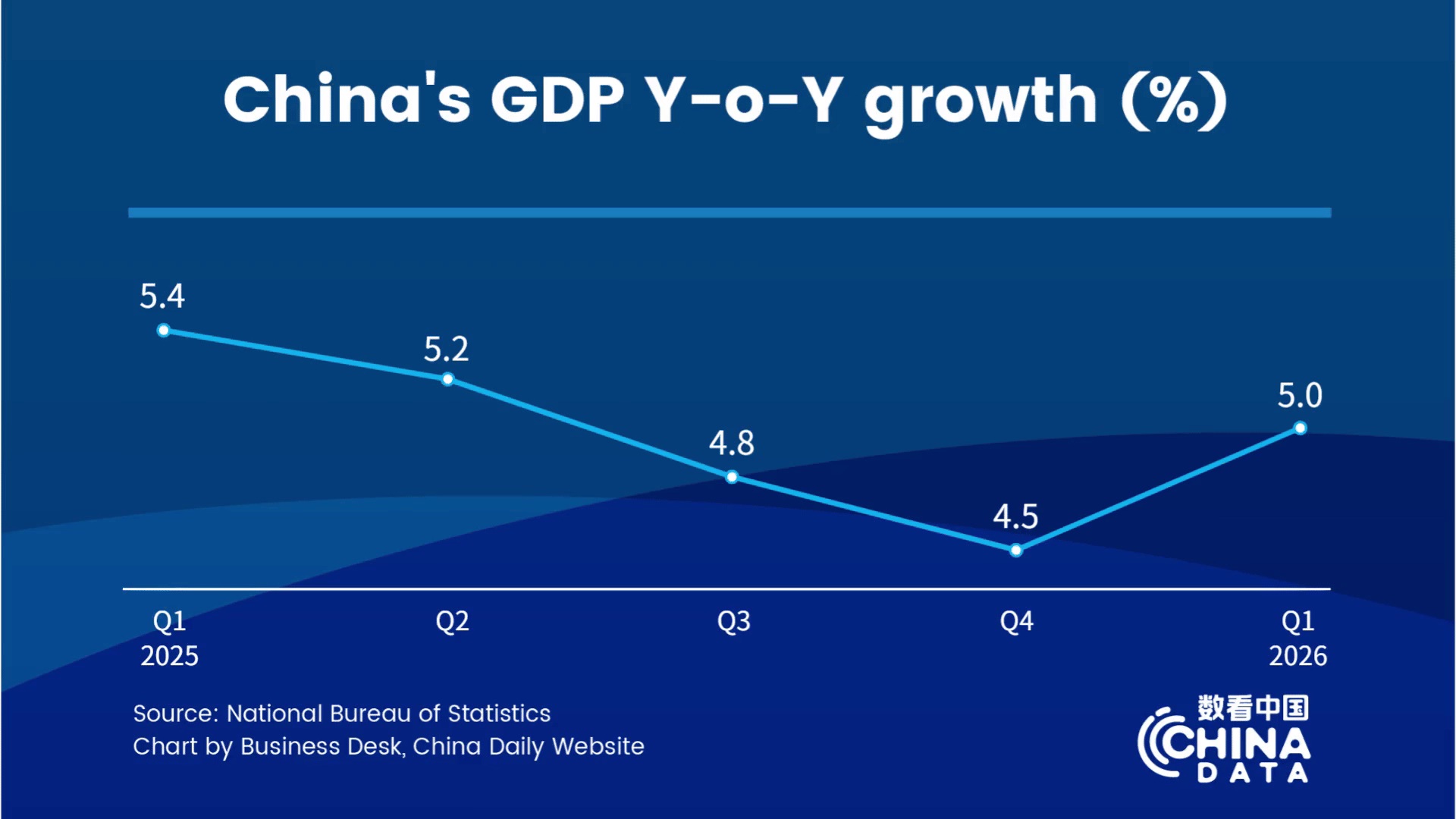
China's gross domestic product (GDP) grew faster than expected at 5 percent year-on-year in the first quarter of 2026, surpassing the economists’ expectations of around 4.8 percent. This figure marks the first release of official GDP figures since Beijing reduced its annual economic growth target last April to a range of 4.5 percent-5 percent, the lowest since 1991. What made it a significant achievement was that it came despite the conflict in the Middle East, which started on 28 February, severely disrupting global energy supplies.
Image 1: China’s GDP Year-on-Year Growth
Source: China Daily
Experts believe the full impact of the Iran War on the Chinese economy is yet to be visible and may have a larger impact in subsequent quarters. It is also important to note that Q1 2026's 5.0 percent is actually a step down from Q1 2025's 5.4 percent, so while the quarter-on-quarter acceleration looks positive, the year-on-year trend is still gradually softening.
Meanwhile, China's industrial sector posted strong profit growth in the first quarter of 2026. Profits of China's major industrial firms—those with annual revenues greater than 20 million yuan (US$2.93 million)— increased 15.5 percent year-on-year to reach 1.696 trillion yuan (about US$247.3 billion) during the January-March period, the fastest rate since September. The strong performance coincided with a rebound in China’s producer price index. The gauge of factory-gate prices rose in March for the first time in more than three years, amid rising global commodity prices driven by the US-Israel war on Iran.
Additionally, China has kept its 1-year Loan Prime Rate (LPR) at 3.0 percent and its 5-year rate at 3.5 percent, marking the 11th consecutive month without a change. This decision is in line with market expectations, as the seven-day reverse repo rate has remained stable at 1.4 per cent. Experts attribute the cautious stance to robust Q1 GDP growth (5.0 per cent) and compressed bank net interest margins (1.42 per cent). However, analysts predict potential rate cuts in the second half of 2026 if economic pressures rise from tariffs or a global trade slowdown.
Meanwhile, uncertainty remains over US President Donald Trump's tariff policies vis-à-vis China. China currently faces a 10 percent US tariff on most of its goods. However, US officials indicate that levies may be restored to a higher level by the beginning of July. US Treasury Secretary Scott Bessent recently held talks with Chinese Vice Premier He Lifeng to discuss Trump's travel plan to Beijing around May 14 -15.
Over the past month, Taiwan has occupied a central place in China’s political discourse. Beijing has portrayed opposition leader Cheng Li-wun’s visit and the first KMT–CCP summit in a decade as significant developments.
Moreover, for a long time, Taipei’s outreach to its diplomatic allies has been shaped by the shadow of China’s expanding global influence. The recent episode involving Taiwanese President Lai Ching-te’s visit to Eswatini clearly illustrates this phenomenon.
Image 2: Diplomatic Shift from Taiwan to China – Decade-wise

Source: Authors
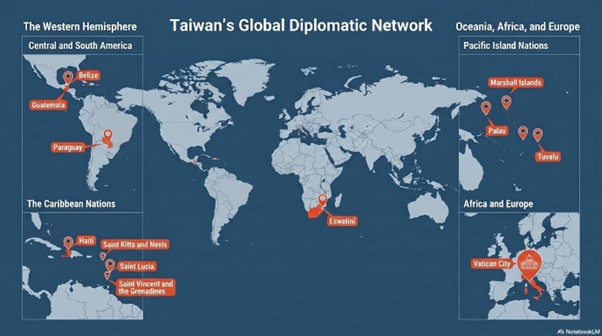
As Taiwan’s sole African partner and one of just 12 diplomatic allies worldwide, Eswatini sits at the core of Taipei’s diplomacy, making disruptions to high-level visits politically consequential. Beijing has, over the past decade, intensified efforts to isolate Taiwan diplomatically by persuading countries in the Global South to switch recognition from Taipei to Beijing.
Image 3: Taiwan’s 12 Remaining Diplomatic Allies
Source: Authors
This strategy has been especially visible in Africa, where China’s extensive trade relationships, infrastructure investments, and development financing provide it with significant leverage. This has resulted in a steady erosion of Taiwan’s diplomatic presence: from several allies in previous decades to just one today: Eswatini. For Beijing, isolating Taiwan is not merely symbolic; it reinforces its claim that Taiwan is part of China and limits Taipei’s ability to act as a sovereign actor on the global stage.
Expectedly, when Lai planned his Eswatini visit, Chinese pressure prompted three African states to deny overflight rights to Taiwanese aircraft. Lai ultimately rerouted his flight, arriving in Eswatini on May 2, 2026.
The successful completion of the trip carries symbolic and strategic weight. For Taiwan, it reaffirms its commitment to maintaining formal diplomatic ties with its remaining partners and signals resilience in the face of external coercion. For Eswatini, hosting the Taiwanese President reinforces its independent foreign policy stance. The visit also highlights the evolving nature of Taiwan’s diplomacy. With formal allies dwindling, Taipei has increasingly relied on substantive partnerships: trade, technology, and cultural exchanges, with non-diplomatic partners under the New Southbound Policy. Therefore, official allies like Eswatini remain crucial for Taiwan’s participation in international forums and for sustaining its identity as a state within the international system.
In sum, Lai Ching-te’s eventual arrival in Eswatini is more than a routine diplomatic visit; it is a reflection of the ongoing contest between Taiwan’s efforts to preserve its global space and China’s strategy to constrain it. The episode demonstrates how economic statecraft and geopolitical influence continue to shape even the most routine aspects of international diplomacy, particularly in regions like Africa, where strategic competition is intensifying.
China’s military modernisation continues at a rapid pace, with a notable advance in recent weeks alongside parallel shifts in the regional security environment. On March 31, the defence conglomerate NORINCO conducted the maiden flight of the Changying-8 (CY-8), a heavy, multi-terrain cargo drone designed for short take-off and landing and high-altitude operations. Developed by Beijing Northern Changying UAV Technology, the platform carries up to 3.5 tons, matching its own weight for a total take-off mass of seven tons.
With a 25-meter wingspan, 18-cubic-meter cargo hold, and enclosed fore and aft bays, the CY-8 is optimised for austere environments. Its sub-500-meter runway requirement and 3,000-kilometre range enable operations from remote islands to the Tibetan plateau. The CY-8 joins a growing cohort, including under-development W5000 and Baiying (Boying) T1400, reflecting Beijing’s push to expand resilient logistics capabilities for high-altitude and islands through an unmanned route.
Table 1: China’s Heavy-lift Drone Development Landscape
| Drone / Designation | Developer | Status | MTOW | Payload | Range | Propulsion | Key Role |
| CY-8 (Changying-8 / Norinco Luca) | Beijing Northern Changying / Norinco | First flight Mar 2026 | 7 t | 3.5 t | >3,000 km | Twin turboprop | Mil/civ logistics, STOL ops, airlift |
| Jiutian / Jetank | China -AVIC (XAC) | First flight Dec 2025 | 16 t | 6 t | 7,000 km (ferry) | Jet (multi-engine) | drone mothership, Swarm, network warfare |
| W5000 | Air White Whale | Certification pending; delivery ~2026 | 10.8 t | 5 t | 2,600 km | Twin turbofan | Commercial cargo logistics |
| CM100 | Shenyang-based (undisclosed) | Under development | ~20 t (est.) | 10 t | — | — | Heavy logistics (China Post / JD intent) |
| HH100/HH200 | XAC / AVIC | First flight 2024/2026 | — | 700 kg | 2,360 km | Twin turboprop | Cargo; improved over HH100 |
| TP1000 | Yitong UAV System | First flight Apr 2025 | — | 1 t | 1,000 km | Twin turboprop | Commercial cargo; 30+ orders |
| YH-1000 / YH-1000S | CAAA | YH-1000 May 2025; YH-1000S Feb 2026 | 2.3 t | 1.2 t | 1,500 km | Twin hybrid (NEV + turboprop) | Logistics, rescue, mil dual-use |
| Tengden unnamed 2-t variant | Tengden Sci-Tech | First flight Aug 2024 | — | 2 t | 2,000 km | Twin turboprop | Cargo; 16.1 m wingspan |
| Shenyang 2-t transport | Shenyang-based (undisclosed) | Production line Dec 2025 | — | 2 t | — | — | Short-runway (800 m) logistics |
| Boying T1400 | United Aircraft (Shenzhen) | First flight Oct 2024 | — | 650 kg | — | Unmanned helicopter | Mountain/maritime ops; -40 to +55 C |
| Tianma-1000 | ASN Technology / Norinco | First flight Jan 2026 | — | 1 t | 1,800 km | Turboprop | Logistics |
| Y-9 Unmanned Concept | Shaanxi Aircraft / AVIC | Concept (displayed Oct 2025) | ~60 t | ~20-30 t (est.) | — | 4x turboprop | PLA strategic airlift concept |
Source: Authors
However, the PLA faced a sharper test of its operational tempo and strategic messaging this month. Initially, the PLA Navy concluded Sea Guardian IV naval exercises with Pakistan, underscoring a stable pattern of maritime cooperation. But the tempo shifted on April 17, when the Japanese destroyer JS Ikazuchi transited the Taiwan Strait on a date Beijing links to the Treaty of Shimonoseki and national humiliation. China responded with a Joint Readiness Combat Patrol in waters disputed with Japan, in a pointed approach, blending historical narrative with contemporary deterrence signalling.
However, the more consequential development emerged through Japan’s evolving military posture. During the 2026 Balikatan Exercises, Tokyo moved beyond symbolic participation, deploying around 1,400 personnel, a Hyūga-class helicopter destroyer, Murasame and Osumi class warships, US-2 amphibious and C-130H aircraft, and Type 88 surface-to-ship missile systems. This marks Japan’s first operational deployment of combat capabilities into the South China Sea and Taiwan Strait, and participation in combat operations such as counter-landing and live-fire sinking exercises. The shift is structural: deterrence in the Western Pacific is becoming more distributed, with Japan assuming a clearer, more assertive role in shaping the regional balance.
Naturally, Beijing has grown increasingly concerned about Tokyo’s assertive operations in its near seas. Alongside diplomatic and media protests, China has signalled its response at sea: the PLA Navy has conducted exercises near Luzon and deployed the Liaoning aircraft carrier for operations in the South China Sea. Two lessons are therefore evident here: first, China is building resilient and flexible systems such as the CY-8 to sustain logistics in difficult environments. Second, Japan’s evolving military posture from symbolic support to operational role and potential active deterrence signals that a distributed and competitive security environment is shaping up in the Western Pacific.
Disclaimer: Beijing Scan is the fortnightly China newsletter of the Observer Research Foundation, offering incisive analysis of key political, economic, foreign policy, and military developments.
Written by Atul Kumar, Kalpit A. Mankikar, and Antara Ghosal Singh, the views expressed are those of the authors.-----
The views expressed above belong to the author(s). ORF research and analyses now available on Telegram! Click here to access our curated content — blogs, longforms and interviews.

Atul Kumar is a Fellow in Strategic Studies Programme at ORF. His research focuses on national security issues in Asia, China's expeditionary military capabilities, military ...
Read More +
Kalpit A Mankikar is a Fellow with Strategic Studies programme and is based out of ORFs Delhi centre. His research focusses on China specifically looking ...
Read More +
Antara Ghosal Singh is a Fellow at the Strategic Studies Programme at Observer Research Foundation, New Delhi. Her area of research includes China-India relations, China-India-US ...
Read More +


 PREV
PREV