PDF Download
Soma Sarkar, “An Equity-Driven Adaptation Framework for Urban Flooding in India,” ORF Occasional Paper No. 548, Observer Research Foundation, May 2026.
India’s experience with urban flooding has moved beyond occasional disruptions, as in the past decade. For cities such as Mumbai, Chennai, Delhi, and Guwahati, as well as in the Himalayan states, floods are now an annual reality. Indian cities face growing risk of floods due to erratic and intense rainfall, unplanned urbanisation and land use changes, shrinking wetlands, and ageing, insufficient stormwater drainage infrastructure. The 2025 monsoon underscored this crisis: cloudbursts and flash floods in the Himalayas, sustained heavy rainfall in Mumbai from May to July with intermittent spells until withdrawal,[1],[2] and severe flooding in Assam and Rajasthan.[3],[4] In August, Mumbai received 875 mm of rainfall in just four days,[5] while Punjab witnessed one of the season’s most severe floods.[6] Heavy-rain-induced flash floods caused casualties in Dehradun and Kolkata in September 2025.[7]
Such high-intensity rainfall events are becoming the new norm, rendering the climate increasingly difficult to predict. Indian cities remain unprepared for these shifts, raising a pressing question: are they willing to redesign for the next deluge?
Despite recurrent flooding, responses remain largely reactive. There is an urgent need for Indian cities to confront the challenges of over-densification and poor planning while integrating water- and climate-sensitive approaches into urban governance. These challenges extend beyond preventing waterlogging to safeguarding the sustainability of urban life under climate uncertainty. Hybrid adaptation models that prioritise equity are essential.
Unplanned urbanisation is one of the key causes of urban flooding, alongside heavy rainfall over cities and upstream catchments, construction on the floodplains and low-lying areas, and clogged stormwater drainage systems.[8] Urbanisation-induced changes in catchments can increase flood peaks by 1.8 to eight times and flood volumes by up to six times.[9] Climate-change-induced intense rainfall, sea-level rise, and ageing infrastructure have exposed the limits of conventional flood-control paradigms across the world. In response, cities in developed countries, such as Rotterdam (The Netherlands), Copenhagen (Denmark), and Hamburg (Germany), have adopted “living with water” strategies that combine grey infrastructure with nature-based and spatial planning solutions.[10] Similarly, in the United States (US), coastal cities such as New York and New Orleans have adopted layered resilience frameworks emphasising coastal buffers, floodable public spaces, revised zoning, and community-level preparedness alongside large-scale protective barriers.[11]
While cities in the Global North are shifting from flood control to flood resilience, those in the Global South remain more vulnerable—not only due to exposure to monsoon systems but also because of their socioeconomic and political contexts.[12] An assessment of inundation across 138 capital cities found that high-income countries are better equipped to manage heavy rainfall, with capacity closely tied to economic strength.[13] Low- and middle-income countries, by contrast, face constraints due to inadequate infrastructure and persistent development inequalities created by colonial trade exploitation. A study of 42 Indian cities shows that decrease in non-built-up (NBU) areas, such as green spaces and waterbodies, significantly increases flood risk;[14] whereas a one-unit increase in such areas reduces the odds of flooding by 6.2 percent.[15]
Monsoon variability makes the densely populated South Asian subcontinent among the most vulnerable to natural disasters such as droughts and floods,[16] affecting over one billion people across timescales.[17] The economic costs are substantial: the 2018 Kathmandu urban road flooding alone caused losses exceeding US$65,000, including direct and indirect costs,[18] while in 2023, India suffered losses of over INR 1 lakh crore due to natural disasters affecting areas of high exposure and asset concentration.[19] The impacts of urban flooding also vary across geographies. In coastal cities, for instance, stormwater drainage is constrained during high tides, as opening floodgates can lead to seawater ingress.[20] In Mumbai, comparing a 1966 topographic map with 2009 satellite imagery revealed extensive land use change in the Mithi River catchment, with built-up area increasing by 59.66 percent.[21] The 2005 Mumbai flood marked a watershed moment, causing over 1,000 fatalities and widespread damage to infrastructure, businesses, and homes. For the insurance industry, it remains the costliest natural catastrophe on record, with claims of INR 2,250 crore at 2005 values[22]—estimated to rise to as much as INR 20,000 crore if a similar event were to occur today.[23]
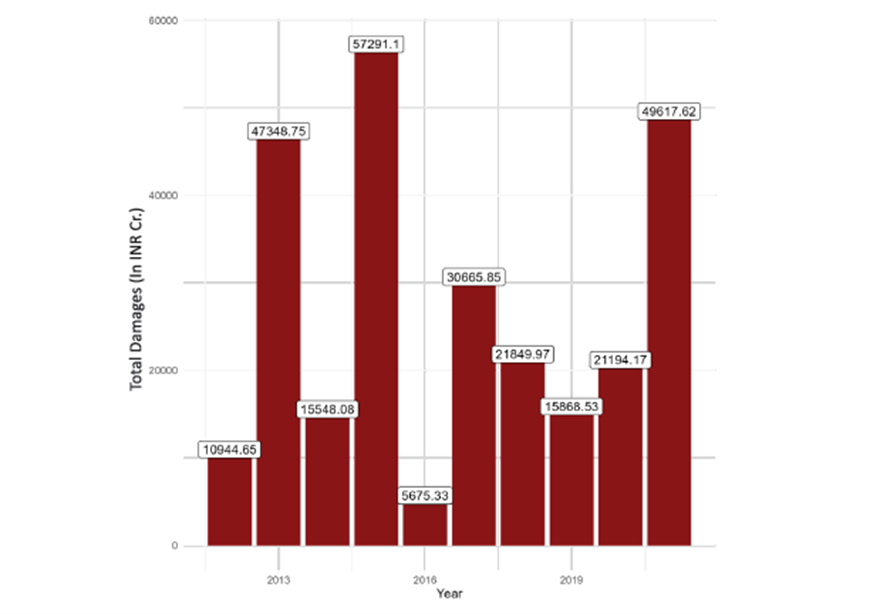
Figure 1: Economic Loss Due to Rains and Floods in India (2012–2021)
Source: Ministry of Jal Shakti, Government of India.[24]
To provide an aggregate understanding of the total damage and its composition, Figure 1 presents the estimated all-India cost of damages due to rain and floods, combining losses to crops, houses, and public utilities. The chart highlights the peak years of 2013, 2015, 2017, and 2019. In 2013, glacial lake outburst flooding and extreme rainfall in Uttarakhand triggered large‑scale destruction of housing, roads, bridges, and public infrastructure in the upper Ganga basin. The 2015 peak reflects severe urban and peri‑urban flooding in Chennai and coastal Andhra Pradesh during an intense northeast monsoon phase, where prolonged inundation damaged standing crops, paralysed transport and power systems, and led to widespread loss of houses and livelihoods. The 2017 spike was driven by extensive flooding across the eastern and northern Indo‑Gangetic plains, including the states of Assam, Bihar, West Bengal, and Uttar Pradesh, and spilling over into the Terai in southern Nepal and low‑lying areas of northern Bangladesh, where riverine flooding and embankment breaches destroyed agricultural land, rural housing, and critical lifeline infrastructure. In 2018, Kerala was devastated by extreme rainfall, triggering floods and landslides that caused 500 casualties, destroyed 19,000 homes, displaced 1.1 million people, and affected another 5.5 million people. As per World Bank estimates, there was a total economic loss of US$3.4 billion, while the United Nations (UN) system estimated recovery costs of US$3.7 billion.[25] In 2019, heavy and spatially extensive monsoon rains, compounded by high reservoir levels and emergency releases from dams, produced another multi‑state flood episode affecting at least thirteen states.
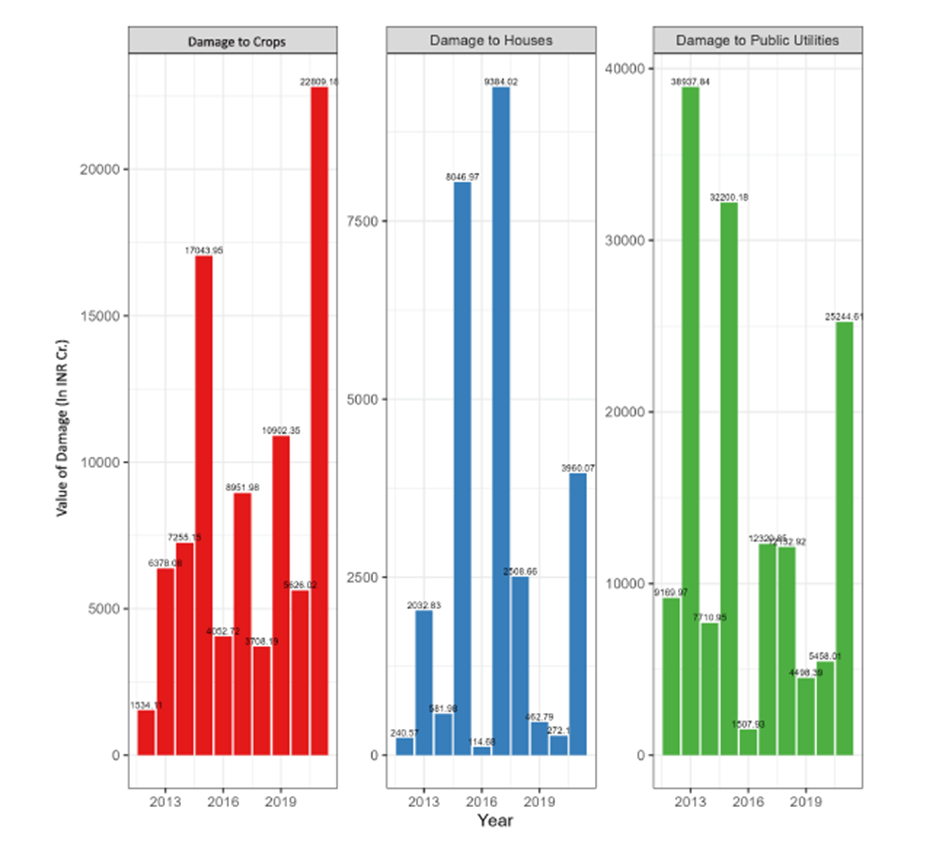
These events correspond with peaks in total flood-related losses between 2012 and 2021 and indicate a broader upward trend in overall damages (measured in crores). Figure 2 disaggregates these losses by crops, houses, and public utilities.
Figure 2: Composition of Economic Loss Due to Rains and Floods in India (2012–2021)
Source: Ministry of Jal Shakti, Government of India.[26]
The extent of damage varies from year to year, but the worst flood years have resulted in substantial losses. As reflected in total losses (see Figure 1), 2013, 2015, 2017, and 2019 recorded considerably higher damage to crops, houses, and public utilities than the preceding years. Within each year, the magnitude of damage (measured in crore) also varies across categories. In 2013, for instance, while losses to crops and houses went up compared to 2012, damage to public utilities increased more sharply. Over time, crop losses have risen significantly, while damage to public utilities appears to decline, with 2019 as an exception. Overall, floods and similar natural disasters entail insurmountable economic losses.
Drainage and infrastructure deficits also play a key role in urban flooding. Much of the sewerage and drainage network is ageing, with limited monitoring of condition and performance.[27] Space constraints have led to the narrowing of existing drains, with bridge piers often constructed within them. On top of that, the drains are often choked with plastic bags, which makes solid waste management integral to this discourse. Urban heat islands have also been identified as a cause for enhancing convective rainfall in and around cities and inducing flooding.[28] With reducing permeable surfaces, the amount of rainwater run-off into drains and sewers is huge, which the current stormwater infrastructure is not equipped to manage. In many cities, the drains are either undersized or non-existent mainly because of low priority given to the allocation of funds for storm drainage.[29],[30]
Estimates indicate a 24.9-percent rise in the number of people exposed to floods globally, from 28.1 million in 1970 to 35.1 million in 2020, with the highest number of flood-related deaths and economic losses being witnessed in Asia.[31] Monsoon variability has amplified in recent decades, with a phenomenal rise in extreme rainfall events. The South Asian summer monsoon circulation is projected to weaken under global warming.[32] This weakening of the low-level westerly winds is associated with the latent heating over the Tibetan Plateau, which drives increased summer precipitation. The intensified heating triggers an anomalous meridional circulation—rising air over the plateau and sinking to the south—resulting in a low-level anticyclone over the northern tropical Indian Ocean. Researchers have also argued that the South Asian Monsoon rainfall increase is caused by the northward shift of circulation driven by extratropical processes.[33]
Studies point to a threefold increase in widespread extreme rainfall events over central India between 1950 and 2015,[34] due to greater variability in low-level monsoon westerlies over the Arabian Sea driving intense moisture supply and triggering extreme rainfall episodes across the central subcontinent. A granular decoding of the rainfall patterns has shown that 55 percent of the tehsils (administrative sub-districts) in India witnessed an increase in southwest monsoon rainfall between 2012 and 2022.[35] At the city level, trends also indicate rising rainfall intensity: in Chennai, one-day extreme rainfall has increased by 10–15 percent over the past century, with both atmospheric and anthropogenic factors contributing to the 2015 floods.[36],[37]
Research shows that between 1985–2020 in Mumbai, the average annual rainfall has been 2208.82 mm, increasing at a rate of 5.18 mm/year. Similarly, it was found that the frequency of heavy (> 120 mm/day) and extremely heavy (250 mm/day) rainfall events has increased over Santacruz after 1994 and Colaba after 2005.[38] The 2025 monsoon reflected these shifting rainfall patterns, with early onset and intensity causing extensive damage to life and property in several parts of the country.[39] These shifts are further amplified by climate change: the early onset of the monsoon combined with multiple western disturbances induced heavy rainfall and a higher number of floods, landslides, and cloudbursts. The western disturbances are extratropical storms originating in the Mediterranean region moving eastwards, which brings rainfall during the winter and spring months.[40] However, their growing frequency during the southwest monsoon season signals a profound change in India’s rainfall regime. The pressing question is: are we prepared for these monsoon variabilities, which defy the known patterns, intensify the risks, and make our cities and communities at large vulnerable?
Changes in land use patterns and increasing concretisation raise flood frequency by intensifying surface run-off.[41] Studies show that built-up areas in the Mumbai Metropolitan Region expanded from 400 sq. km in 1999 to 761 sq. km in 2019—an increase of about 90 percent over two decades.[42]
3: Total Green Cover of Mumbai in 1988, 1998, 2008 and 2018
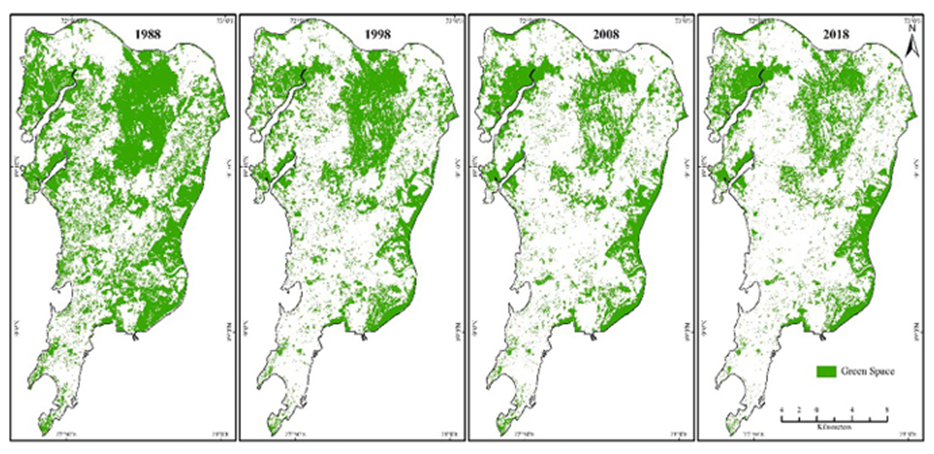
Source: Rahaman et al. (2020)[43]
Figure 3 shows temporal changes in the total area and share of green cover for 1988, 1998, 2008, and 2018. The coverage of green spaces has reduced from 29,260 hectares in 1988, accounting for 46.42 percent, to 16,814 hectares in 2018, accounting for 26.67 percent.[44] Between 1988–1998 alone, about 14 percent of the green spaces transformed into built-up areas. Studies have also shown that areas with higher land surface temperature (> 30.5 °C) have increased threefold during 1988–2018 in Mumbai due to increasing built-up areas and subsequent latent heat.[45]
The expansion of built-up areas and the loss of blue-green cover increase flood vulnerability by disrupting natural drainage. For example, studies deconstructing the 2005 floods in Mumbai show that land use changes, including green-to-built conversions, overwhelmed drainage alongside Mithi River encroachments.[46] Over the past years, cities like Bengaluru have witnessed a dramatic loss of wetland area, where open-water surfaces declined from 64 km² in 1965 to 55 km² in 2018, but built-up areas expanded rapidly.[47] Similarly, in Kolkata, the East Kolkata Wetlands lost significant area between 2009 and 2019 due to conversion for urban settlements and infrastructure.[48] In Ahmedabad, the overall area of waterbodies along four prominent lakes—Vastrapur, Memnagar, Thaltej, and Sola—has reduced by almost 46 percent.[49] Concretised surfaces prevent infiltration, causing rapid run-off that overwhelms drainage systems. These land use and land cover changes, coupled with climate extremities of excess rainfall events, increase the risk of floods.
Flooding not only compromises access to potable water but disrupts sanitation services, often leading to outbreaks of waterborne diseases.[50] However, entrenched socioeconomic inequalities mean that its impacts are unevenly distributed, with certain groups bearing a disproportionate burden. This inequity underscores that flooding is not only a governance challenge but also an equity crisis, exposing structural vulnerabilities in India’s central and eastern states.[51]
In most cities, slum dwellers and low-income communities are among the most vulnerable, as their settlements are often located in high-risk areas with limited means to reduce the flood impacts.[52] In riverine and coastal cities, they are frequently pushed into low-lying zones or peripheral areas beyond embankments, increasing the risks of displacement and health issues.[53] Their capacity to respond is also not uniform due to underlying sociocultural divisions and economic and political constraints. A case study of Dehradun, for instance, revealed extreme vulnerability of the urban poor, with low absorptive and coping capacity.[54] Both vulnerability and coping strategies were found to be different across the community due to differential decision-making capability and resource capacity of households.
In Bengaluru, recurring floods have exposed the precarity of newer migrants, many of whom are temporary or circular workers living in informal, makeshift settlements on the urban periphery.[55] They remain underrepresented in the governance systems of their destination city, and as these newer migrant settlements are often not notified, the residents face serious challenges in accessing basic services as well as flood mitigation and response measures, leaving them especially vulnerable during flood disasters.
Women are disproportionately affected due to gendered roles and responsibilities, as well as constraints in accessing clean water and sanitation. Flood conditions often exacerbate challenges related to menstrual hygiene. A study conducted in Bangladesh in the aftermath of the 2024 floods highlighted critical barriers such as lack of private sanitation facilities in shelters and inadequate provision of menstrual hygiene products, forcing women to rely on unsafe alternatives that compromise health and dignity.[56] Similarly, research from Assam shows that despite the inclusion of gender-sensitive water, sanitation, and hygiene measures in disaster management guidelines, implementation remains weak during flood response and recovery.[57] Even where sanitary napkins are distributed, the absence of disposal mechanisms limits their use, and the lack of separate toilets for women further compounds challenges.
Floods also disproportionately impact persons with disabilities, whose vulnerabilities are often overlooked in environmental justice discourse.[58] Barriers such as limited mobility, inaccessible shelters, and inadequate transport complicate evacuation and recovery. During the 2013 Uttarakhand floods, rescue operations faced difficulties in evacuating individuals with locomotor disabilities due to inaccessible terrain and the lack of assistive devices. Similarly, in the 2018 Kerala floods, it was found that relief camps lacked ramps, sign language interpreters, and accessible sanitation.[59]
The differentiated experiences—across class, gender, migration status, and disability—highlight how marginalised populations bear the brunt of climate-induced extremes. They underscore the need for inclusive, climate-sensitive urban planning that recognises and addresses diverse vulnerabilities within cities.
The unrelenting trail of extreme weather events has exposed the acute vulnerability of Indian cities to intensifying climate risks. They reveal a structural mismatch between rapid urbanisation and the growing intensity and frequency of extreme events, while cities remain underprepared to adapt, cope, and respond.[60] This recurring cycle of human and economic loss demands systemic reforms, where water- and climate-sensitive urban planning must shift from a discretionary policy choice to a national imperative.
Reimagining cities to respond effectively to water and climate challenges requires coordinated action across multiple fronts, including sustainable and circular water management, equitable service delivery, flood resilience, and robust sanitation systems. In this context, a water-sensitive city model was proposed by R.R. Brown et al. in 2009, articulated through an urban water management transitions framework, as depicted in Figure 4.[61] The water-sensitive city is a culmination of an integrated approach that brings together water supply, sanitation, flood protection, and environmental protection servicing as a strategy to ensure long-term sustainability, liveability, resilience, and prosperity.[62]
Figure 4: Urban Water Transition Framework
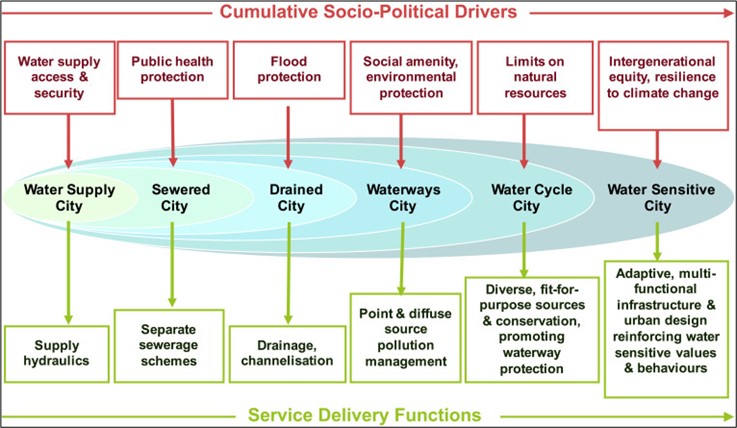
Source: Wong et al. (2020)[63]
In developed countries, the ‘water-sensitive city’ concept has evolved towards second-generation outcomes, emphasising higher standards for water conservation, greater resource circularity, climate adaptation, and more inclusive, liveable environments. These cities benefit from robust planning systems and well-developed water, wastewater, and stormwater infrastructure, which provide a foundation for this transition.
In the Global South, however, challenges are manifold. Rapid urbanisation is often characterised by informality, including unplanned settlements and insecure land tenure, and existing infrastructure remains under strain while delivering basic services such as potable water and sanitation. As a result, priorities differ, requiring adaptive frameworks grounded in local socioeconomic conditions and shaped by infrastructural and access constraints.
Historically, flood adaptation strategies were highly localised and reactive. Prior to the twentieth century, levees and barriers were built to mitigate known damage, with little attempt to anticipate future risk.[64] By the mid-twentieth century, this shifted towards infrastructure-centred resilience, where engineered solutions like dams and levees were deployed based on cost benefit analyses and geared towards economic returns.[65] These measures were deterministic and did not account for climatic uncertainty.[66] Over time, this approach evolved into rigid, top-down regulatory frameworks. With the growing challenges of climate change, adaptation strategies began to emphasise long-term planning and ecosystem-based management. Current discourse centres on approaches that are localised in scale but hybrid in design, combining structural, nature-based, institutional, and community-centred interventions.
Ancient Indian cities were organised around waterbodies, embedding systems for rainwater and surface water harvesting, storage, and equitable distribution for agriculture, sanitation, and rituals. In Bihar, for example, bunds (ahars) diverted monsoon run-off into channels (pynes) feeding rice fields, sustaining agriculture since the Mauryan times.[67] As ecological, socioeconomic, and cultural contexts vary across regions, so do place-specific vulnerabilities. This demands adaptation solutions attuned to regional specific climate risks. Measures effective in one region may not be relevant in another. For example, in the Sundarbans, where cyclonic flooding and sea-level rise inundate farmland and settlements, floating gardens on bamboo rafts enable cultivation during submergence. Similarly, in the drought-prone Bundelkhand region, check dams, tanks, and the rejuvenation of natural waterbodies serve as effective adaptation strategies. Solutions must therefore be rooted in local risk profiles.[68]
Another critical question in adaptation discourse concerns the adequacy and structure of adaptation finance—specifically, whether public finance alone can sustain flood adaptation in Indian cities and how private capital can help bridge persistent finance gaps. This challenge is compounded by the fact that adaptation often offers limited returns on investment under conditions of uncertainty, whereas resilience initiatives can attract private capital through innovative financing mechanisms. In India, the adaptation finance gap is acute: the country requires approximately US$206 billion annually by 2030, yet current funding meets less than 10 percent of this requirement.[69] Private sector engagement remains limited, as flood adaptation projects generate few direct financial returns, face uncertain cash flows, and largely serve public goods with limited revenue-generating capacity.
The way forward lies in innovative hybrid financing strategies. Blended finance mechanisms that combine public and private capital, results-oriented financing linked to verified resilience outcomes, differentiated risk pricing across climate scenarios, and community-led adaptation supported by targeted public subsidies can help align private incentives with public resilience objectives.[70] In this collaborative approach, the public sector anchors long-term commitment and absorbs tail risks, while private entities provide scalable capital and operational efficiency. This alignment can transform vulnerability into bankable resilience.
For cities in the Global South, strengthening existing infrastructure—water, sanitation, and stormwater systems—and ensuring universal access is the first step. Recent World Health Organization (WHO) data highlights that despite progress since 2015, one in four people globally (2.1 billion) still lack access to safely managed drinking water, while 3.4 billion lack safely managed sanitation.[71] A climate- and water-sensitive city cannot exist where basic infrastructure is absent or non-functional. Priority must therefore be given to equitable access to water, sanitation, and stormwater drainage, particularly in informal settlements.
Cities must also integrate blue-green infrastructure, including wetlands, urban forests, and sponge city systems. Studies indicate that green roofs and infiltration trenches can reduce urban run-off by about 25 percent in Indian cities.[72] In 2014, China implemented the Sponge City model for sustainable drainage practices,[73] managing stormwater through soil beds, lakes, and vegetation.[74] While scholars have deliberated on the overall costs of a sponge city project, considering the total environmental, economic, and social costs and benefits, it is a highly recommended mitigation intervention.[75] The 2011 floods in Copenhagen, Denmark, prompted the city to embrace a sponge city model combining nature-based surface features (wetlands and parks) with large underground structures (storage pipes and retention basins).[76] The Netherlands’ Room for the River programme likewise aims to reduce flood risk by giving rivers more space.[77] In India, urban flooding gained policy prominence after the 2005 Mumbai floods, triggered by an unprecedented cloudburst that caused widespread destruction.[78] The civic administration was unprepared to tackle a disaster of that magnitude, and this forced the National Disaster Management Authority (NDMA) to treat urban flooding as a distinct category requiring targeted intervention.[79]
The impacts of climate extremes, including flooding, can be reduced by various measures like good forecasting methods using Doppler radars, risk mapping—including mapping the vulnerable populations—revamping the drainage infrastructures, and better waste management of solid waste to prevent clogging.[80] In fact, siltation due to sediments and waste in drains impedes the flow and reduces the capacity of the existing drainage infrastructure. The NDMA guidelines on Urban Flood Disaster Management have recommended that “pre-monsoon desilting of drains will be completed before 31 March every year,” but it is not executed by the local authorities in a timely manner.[81] A more holistic approach is needed, centred on flood-sensitive geographic information system (GIS)-based city planning and design. This includes vulnerability mapping, preparation of flood inundation maps, and analysis of hazard zones under different rainfall and urban expansion scenarios.[82]
Urban flood management in developing countries also requires attention to socioeconomic dimensions of land use and urban development.[83] Community-based participatory planning is therefore critical to addressing climate vulnerabilities. Bottom-up approaches that engage grassroots communities ensure that both climate risks and local needs are addressed, while also leveraging local knowledge for vulnerability mapping and long-term planning.[84] It also helps in addressing intersectionality and social equity concerns.
Urban flooding in India is no longer an episodic aberration, but a structural condition produced at the intersection of a changing monsoon, uneven urbanisation, and deeply stratified and unequal access to infrastructure and decision-making. Climate change is amplifying existing vulnerabilities rather than creating new ones. Intensifying extreme rainfall and shifting circulation patterns are colliding with floodplain encroachments, disappearing wetlands, and inadequate drainage systems, resulting in a flood regime that is both more frequent and more spatially unpredictable.
Actionable policy measures include strengthening land use regulation and protecting drainage basins by enforcing no-development zones within 500 m of wetlands and floodplains and mandating wetland zoning in city-level master plans. Climate risk and social vulnerability mapping must be embedded in land use planning. Steps should also be taken to subsidise the expansion of blue-green infrastructure, like permeable pavements, rain gardens, and restored tanks. Innovative financial architectures, like blended finance that leverages concessional public capital to de‑risk private investment in blue‑green infrastructure, and flood risk reduction, must be explored. Private investments can be incentivised through tax credits and viability gap funding for Public Private Partnerships (PPPs) in such projects. National protocols like the NDMA guidelines must be expanded to embed not only gender-responsive measures but also include disability as a critical intersectionality.
In addition, city-specific Climate Action Plans (CAPs) have the potential to build water- and climate-sensitive cities by localising the Nationally Determined Contributions (NDCs) into measurable targets. For example, the pilot project on canal restoration bonds projects in Kochi focuses on flood management and water quality improvements.[85] In the present context, the shift towards water- and climate-sensitive planning is not a normative aspiration but a practical necessity. Global approaches—such as Water Sensitive Cities, China’s Sponge Cities, and The Netherlands’ Room for the river—demonstrate that blue‑green infrastructure, nature‑based solutions, and circular water management can reduce run-off, restore ecological buffers, and create co‑benefits for urban liveability. Adaptive translation of global frameworks into locally situated practices would strengthen the core water, sanitation, and stormwater systems and protect the urban commons.
Rethinking urban flooding in India in the time of climate disruption warrants a paradigm shift from fragmented, reactive, top-down crisis management to integrated, anticipatory, and participatory resilience building.
Soma Sarkar is Associate Fellow, Urban Studies Programme, Observer Research Foundation.
All views expressed in this publication are solely those of the author, and do not represent the Observer Research Foundation, either in its entirety or its officials and personnel.
[1] Snehal Mutha, “Mumbai Breaks Record, Receives Highest Rainfall in May,” Hindu, May 27, 2025, https://www.thehindu.com/news/cities/mumbai/mumbai-breaks-record-receives-highest-rainfall-in-may/article69621953.ece
[2] India Today News Desk, “Mumbai Rain News Highlights: Devendra Fadnavis Says Situation Under Control, Rain Yellow Alert Issued for Thursday,” India Today, August 20, 2025, https://www.indiatoday.in/india/story/mumbai-rain-weather-forecast-live-update-news-heavy-rainfall-monsoon-airlines-travel-advisory-2773851-2025-08-20
[3] “North-East India Floods 2025,” Northeastern Chronicle, https://www.northeasternchronicle.in/news/north-east-india-floods-2025/
[4] Ashutosh Mishra, “2 Dead, Hundreds Evacuated as Rain, Flood Ravage Rajasthan; Army on Ground,” India Today, August 24, 2025, https://www.indiatoday.in/india/story/rajasthan-flood-news-death-rain-alert-weather-kota-bundi-tonk-army-ndrf-2775892-2025-08-24
[5] India Today News Desk, “Mumbai Rain News Highlights: Devendra Fadnavis Says Situation Under Control, Rain Yellow Alert Issued for Thursday,” India Today, August 20, 2025, https://www.indiatoday.in/india/story/mumbai-rain-weather-forecast-live-update-news-heavy-rainfall-monsoon-airlines-travel-advisory-2773851-2025-08-20
[6] Amita Bhaduri, “FAQ on Punjab Floods September 2025: What You Need to Know,” India Water Portal, September 7, 2025, https://www.indiawaterportal.org/climate-change/disasters/faq-on-punjab-floods-september-2025-what-you-need-to-know
[7] Ishita Mishra, “Dehradun: Heavy Rain, Floods, Persons Missing,” Hindu, September 16, 2025, https://www.thehindu.com/news/national/uttarakhand/dehradun-heavy-rain-floods-persons-missing-september-16-2025/article70055428.ece
[8] K. Gupta, “Challenges in Developing Urban Flood Resilience in India,” Philosophical Transactions of the Royal Society A: Mathematical, Physical and Engineering Sciences 378, (2020), https://doi.org/10.1098/rsta.2019.0211
[9] National Disaster Management Authority, Urban Floods (New Delhi: National Disaster Management Authority, Government of India), https://ndma.gov.in/Natural-Hazards/Urban-Floods
[10] P. Kabat, W. van Vierssen, JJ. Veraart, et al., “Climate Proofing the Netherlands,” Nature 438, (2005), 283–284, https://doi.org/10.1038/438283a
[11] Jeroen C. J. H. Aerts, W. J. Wouter Botzen, Kerry Emanuel, Ning Lin, Hans de Moel, and Erwann O. Michel-Kerjan, "Evaluating Flood Resilience Strategies for Coastal Megacities," Science 344 (2014), 473–475
[12] Nitesh Shukla, Arup Das, and Tarak Nath Mazumder, “Complexities of Urban Resilience in the Global South: Key Insights from Surat City, India,” Mitigation and Adaptation Strategies for Global Change 30 (2025), https://doi.org/10.1007/s11027-025-10240-x
[13] Jie Fan et al., “Exploring How Economic Level Drives Urban Flood Risk,” Nature Communications 16 (2025), https://www.nature.com/articles/s41467-025-60267-6
[14] Vidhee Avashia, Amit Garg, and S. K. Ghosh, “Implications of Land Use Transitions and Climate Change on Local Flooding in Urban Areas: An Assessment of 42 Indian Cities,” Environmental Modelling & Software 125 (2020), https://www.sciencedirect.com/science/article/abs/pii/S0264837719316011
[15] Avashia, Garg, and Ghosh, “Implications of Land Use Transitions and Climate Change on Local Flooding.”
[16] Deepti Singh, Michael Tsiang, Bala Rajaratnam, and Noah S. Diffenbaugh, “Observed Changes in Extreme Wet and Dry Spells during the South Asian Summer Monsoon Season,” Nature Climate Change 4, (2014), 456–461, https://www.nature.com/articles/nclimate2208
[17] Andrew G. Turner and H. Annamalai, “Climate Change and the South Asian Summer Monsoon,” Nature Climate Change 2, (2012), 587–595, https://www.nature.com/articles/nclimate1495
[18] Sadiksha Chauhan, Robert Dongol, and Raju Chauhan, “Evaluation of Economic Loss of Urban Road Flooding: A Case of Kathmandu Metropolitan City,” MethodsX (2023), https://www.sciencedirect.com/science/article/pii/S2667010023000963
[19] George Mathew, “India Suffered Economic Losses of over Rs 1 Lakh Crore in Natural Catastrophes in 2023 Report,” Indian Express, January 15, 2025, https://indianexpress.com/article/business/india-economic-losses-natural-catastrophes-9779008/
[20] Lirong Dong, Jiahong Liu, Jinjun Zhou, Chao Mei, Hao Wang, Jia Wang, Hongyuan Shi, and Sana Nazli, “The Influence of Astronomical Tide Phases on Urban Flooding during Rainstorms: Application to Macau,” Urban Climate 47 (2024), https://www.sciencedirect.com/science/article/pii/S2214581824003471
[21] P.E. Zope, T.I. Eldho, and V. Jothiprakash, “Impacts of Urbanization on Flooding of a Coastal Urban Catchment: A Case Study of Mumbai City, India,” Natural Hazards 75 (2015), 887–908, https://doi.org/10.1007/s11069-014-1356-4
[22] Vineet Kumar, “Billion-dollar Rain: Why India Can’t Afford to Ignore Urban Flood Risk,” Swiss Re, July 28, 2025, https://www.swissre.com/risk-knowledge/mitigating-climate-risk/billion-dollar-rain-india.html
[23] Kumar, “Billion-dollar Rain.”
[24] Government of India, Ministry of Jal Shakti, “State Wise Flood Damage Statistics,” https://cwc.gov.in/sites/default/files/flood-damage-data-merged.pdf
[25] World Reconstruction Conference, “Greening Recovery: The Case of Kerala Floods 2018,” (2019), https://www.gfdrr.org/en/events/WRC4/session4b
[26] Government of India, Ministry of Jal Shakti, “State Wise Flood Damage Statistics,” https://cwc.gov.in/sites/default/files/flood-damage-data-merged.pdf
[27] Farhat Rafiq, Sirajuddin Ahmed, Shamshad Ahmad, and Amir Ali Khan, “Urban Floods in India,” International Journal of Scientific & Engineering Research 7, no. 1 (January 2016), 721–726, https://www.researchgate.net/profile/Shamshad-Ahmad-2/publication/326441140_Urban_Floods_in_India/links/5b4dc9e20f7e9b240fe56b45/Urban-Floods-in-India.pdf
[28] Rajashree Kotharkar, Aparna Ramesh, and Anurag Bagade, “Urban Heat Island Studies in South Asia: A Critical Review,” Urban Climate 23 (2018), 1–19, https://www.sciencedirect.com/science/article/abs/pii/S2212095517301128?via%3Dihub
[29]Rajesh Kumar Vishwakarma, Himanshu Joshi, and Ashantha Goonetilleke, “Sustainability Evaluation of the Stormwater Drainage System in Six Indian Cities,” Sustainability 15 (2023), https://www.mdpi.com/2071-1050/15/20/14906
[30] Kapil Gupta, "Challenges in Developing Urban Flood Resilience in India,” Philosophical Transactions of the Royal Society A: Mathematical, Physical and Engineering Sciences 378 (2020)
[31] United Nations Office for Disaster Risk Reduction (UNDRR), “GAR 2025 Hazard Explorations: Floods,” Global Assessment Report 2025, April 2025, https://www.undrr.org/gar/gar2025/hazard-exploration/floods
[32] Haolin Luo, Ziqian Wang, Chao He, Deliang Chen, and Song Yang, “Future Changes in South Asian Summer Monsoon Circulation under Global Warming: Role of the Tibetan Plateau Latent Heating,” npj Climate and Atmospheric Science 7 (2024), 1–10, https://www.nature.com/articles/s41612-024-00653-x
[33] Yong-Jhih Chen, Yen-Ting Hwang, and Jian Lu, “Robust Increase in South Asian Monsoon Rainfall under Warming Driven by Extratropical Clouds and Ocean,” Climate and Atmospheric Science 7 (2024), https://www.nature.com/articles/s41612-024-00843-7?fromPaywallRec=false
[34] M.K. Roxy, Subimal Ghosh, Amey Pathak, R. Athulya, Milind Mujumdar, Raghu Murtugudde, Pascal Terray, and M. Rajeevan, “A Threefold Rise in Widespread Extreme Rain Events over Central India,” Nature Communications 8 (2017), https://www.nature.com/articles/s41467-017-00744-9
[35] Shravan Prabhu and Vishwas Chitale, “Decoding India’s Changing Monsoon Patterns: A Tehsil-level Assessment,” Council on Energy, Environment and Water (CEEW), January 17, 2024, https://www.ceew.in/sites/default/files/decoding-how-climate-change-is-changing-monsoon-rainfall-patterns-in-india.pdf
[36] P. Guhathakurta, O.P. Sreejith, and P.A. Menon, “Impact of Climate Change on Extreme Rainfall Events and Flood Risk in India,” Journal of Earth System Science, 120 (2011), 359–373, https://www.ias.ac.in/public/Volumes/jess/120/03/0359-0373.pdf
[37] Rakesh Teja Konduru, G. Mrudula, Vivek Singh, Atul Kumar Srivastava, Abhay K. Singh, “Unravelling the Causes of 2015 Winter Monsoon Extreme Rainfall and Floods over Chennai: Influence of Atmospheric Variability and Urbanization on the Hydrological Cycle,” Urban Climate, 47 (2023), https://doi.org/10.1016/j.uclim.2022.101395 https://www.sciencedirect.com/science/article/pii/S2212095522003133
[38] Rohit Mann, Anju Gupta, Amit Dhorde and Swati Sharma, “Observed Trends and Coherent Changes in Daily Rainfall Extremes over Greater Mumbai, 1985–2020,” Theoretical and Applied Climatology, 151 (2023), 1889–1910, https://doi.org/10.1007/s00704-022-04354-4 https://link.springer.com/article/10.1007/s00704-022-04354-4
[39] Chandana S., “Rains, Ruins, Resilience: Story of India’s Dramatically Shifting Monsoon,” India Today, September 5, 2025, https://www.indiatoday.in/interactive/photo-essay/india-monsoon-extreme-rainfall-pattern-floods-climate-change-307-05-09-2025
[40] DTE Staff, “Monsoon Rains 2025: How Climate Change Intensified India’s Rains,” Down To Earth, August 26, 2025, https://www.downtoearth.org.in/climate-change/monsoon-rains-2025-how-climate-change-intensified-indias-rains
[41] Yash Parshottambhai Solanki, Vijendra Kumar, Kul Vaibhav Sharma, Arpan Deshmukh, Deepak Kumar Tiwari, “Flood Hazard Analysis in Mumbai using Geospatial and Multi-criteria Decision-making Techniques,” Journal of Water and Climate Change 15, 2484–2500 (2024), https://doi.org/10.2166/wcc.2024.053
[42] Samarth Y. Bhatia, Gopal R. Patil, and Krishna Mohan Buddhiraju, “Analysing Urban Sprawl of the Mumbai Metropolitan Region Using Remote Sensing and Socioeconomic Data,” The International Archives of the Photogrammetry, Remote Sensing and Spatial Information Sciences (2023), https://isprs-archives.copernicus.org/articles/XLVIII-M-3-2023/35/2023/isprs-archives-XLVIII-M-3-2023-35-2023.pdf
[43] Saidur Rahaman, Selim Jahangir, Md Senaul Haque, Ruishan Chen, and Pankaj Kumar, “Spatio-temporal Changes of Green Spaces and Their Impact on Urban Environment of Mumbai, India,” Environment, Development & Sustainability 23, (2021)
[44] Rahaman et al., “Spatio-temporal Changes of Green Spaces and their Impact on Urban Environment of Mumbai, India”
[45] Rahaman et al., “Spatio-temporal Changes of Green Spaces and their Impact on Urban Environment of Mumbai, India”
[46] Chirag Ramesh Gudhka, Sahil Shrikant Bhandari, Pritesh Sudhir Morankar, Aayush Deepak Badade, “Mumbai Floods: Case Study on Floods in Reclaimed City,” International Journal of Creative Research Thoughts 9 (2021), https://ijcrt.org/papers/IJCRT2107149.pdf
[47] Katja Brinkmann, Ellen Hoffmann and Andreas Buerkert, “Spatial and Temporal Dynamics of Urban Wetlands in an Indian Megacity over the Past 50 Years,” Remote Sensing 12 (2020), https://www.mdpi.com/2072-4292/12/4/662
[48] Subham Mukherjee, “Assessment of Environmental Water Security of an Asian Deltaic Megacity and Its Peri-Urban Wetland Areas,” Sustainability 13 (2021), https://www.mdpi.com/2071-1050/13/5/2772
[49] Ritu Sharma, “Overall Area of Water Bodies along Four Key Lakes in Ahmedabad Has Reduced by 46%, Says Report, Points out ‘Lack of Water Sensitivity in Statutory Plans’,” Indian Express, June 9, 2025, https://indianexpress.com/article/cities/ahmedabad/overall-area-of-water-bodies-along-four-key-lakes-in-ahmedabad-reduced-10055802/
[50] Aditya Acharya and Rahul Silori, “A Probable Framework for Flood-Induced Risk Evaluation to Water, Sanitation, and Hygiene (WASH) Systems,” in Water, Sanitation, and Hygiene in Emergencies, ed, Aditya Acharya (Oxford: Elsevier, 2025), 233–245, https://www.sciencedirect.com/science/article/abs/pii/B978044321499800012X
[51] Komali Yenneti, Sabyasachi Tripathi, Yehua Dennis Wei, Wen Chen, and Gaurav Joshi, “The Truly Disadvantaged? Assessing Social Vulnerability to Climate Change in Urban India,” Habitat International 56 (2016), 124–135, https://www.sciencedirect.com/science/article/abs/pii/S0197397515303027
[52] Monalisa Chatterjee, “Slum Dwellers’ Response to Flooding Events in the Megacities of India,” Mitigation and Adaptation Strategies for Global Change 15 (2010), 337–353, https://link.springer.com/article/10.1007/s11027-010-9221-6
[53] Archana Mahesh Patankar, “The Exposure, Vulnerability, and Ability to Respond of Poor Households to Recurrent Floods in Mumbai,” World Bank Policy Research Working Paper No. 7481, November 5, 2015, https://papers.ssrn.com/sol3/papers.cfm?abstract_id=2688379
[54] Rajiv Pandey, Juha M. Alatalo, Kavita Thapliyal, Sharmila Chauhan and Kelli M. Archie, “Climate Change Vulnerability in Urban Slum Communities: Investigating Household Adaptation and Decision-Making Capacity in the Indian Himalaya,” Ecological Indicators 90 (2018), 379–391, https://www.sciencedirect.com/science/article/abs/pii/S1470160X18301869
[55] SriPallavi Nadimpalli, Sahil Mathew, and Tashina Madappa Cheranda, “(Re)envisioning Inclusive Futures: Applying Narrative Foresight to Deconstruct the Problem of Urban Flooding in the Slums of Bengaluru, India,” Development Policy Review 42 (2024), https://onlinelibrary.wiley.com/doi/full/10.1111/dpr.12786
[56] Md. Al-Mamun, Abul Kalam, Md. Zawadul Karim, Marufa Alam, and Tauhid Hossain Khan, “Menstrual Hygiene Management in Flood-Affected Bangladesh: Addressing Socio-Cultural Barriers, Infrastructure Gaps, and Policy Responses,” Frontiers in Public Health 13 (2025), https://www.frontiersin.org/journals/public-health/articles/10.3389/fpubh.2025.1538447/full
[57] Mayuri Bhattacharjee, “Menstrual Hygiene Management During Emergencies,” Journal of Health Management 21 (2019), 351–359, https://journals.sagepub.com/doi/abs/10.1177/0971521518811172
[58] Sally Lindsay, Shaelynn Hsu, Sharmigaa Ragunathan and John Lindsay, “The Impact of Climate Change-Related Extreme Weather Events on People with Pre-Existing Disabilities and Chronic Conditions: A Scoping Review,” Disability & Society 38 (2023), 179–202, https://www.tandfonline.com/doi/abs/10.1080/09638288.2022.2150328
[59] Ashish Kumar Singh, “Disaster Vulnerability and Resilience: The Impact of Floods, Heavy Rain, and Landslides on Persons with Disabilities In India,” International Research Journal of Modernization in Engineering Technology and Science 7 (2025)
[60] Sarah K. Balaian, Brett F. Sanders, and Mohammad Javad Abdolhosseini Qomi, “How Urban Form Impacts Flooding,” Nature Communications 15 (2024), https://www.nature.com/articles/s41467-024-50347-4
[61] R. R. Brown, N. Keath, and T. H. F. Wong, “Urban Water Management in Cities: Historical, Current and Future Regimes,” Water Science and Technology 59 (2009), 847–854, https://iwaponline.com/wst/article-abstract/59/5/847/15553/Urban-water-management-in-cities-historical?redirectedFrom=fulltext
[62] T.H.F. Wong, “Transforming Cities through Water-Sensitive Principles,” Sustainable Cities and Society 61 (2020), https://www.sciencedirect.com/science/article/pii/S2590332220304814
[63] T.H.F Wong, Briony C. Rogers, and Rebekah R. Brown, "Transforming Cities Through Water-Sensitive Principles and Practices," One Earth 3 (2020), 436–447
[64] M. Haasnoot, H. Middelkoop, E. van Beek, W. P. A. van Deursen, “A Method to Develop Sustainable Water Management Strategies for an Uncertain Future,” Sustainable Development 19 (2011), 369–381 https://doi.org/10.1002/sd.438
[65] Vujica Yevjevich, “Systematization of Flood Control Measures,” Journal of Hydraulic Division 100 (1974), 1537–1548, https://doi.org/10.1061/JYCEAJ.0004103 https://ascelibrary.org/doi/10.1061/JYCEAJ.0004103
[66] Mohammed Azhar, Bergen Kane, Farshid Vahedifard and Amir AghaKouchak, “Comprehensive Portfolio of Adaptation Measures to Safeguard Against Evolving Flood Risks in a Changing Climate,” Communications Earth and Environment 6 (2025), 824, https://doi.org/10.1038/s43247-025-02779-z
[67] Pushpendra Kumar Singh, Pankaj Dey, Sharad Kumar Jain, and Pradeep Mujumdar, "Hydrology and Water Resources Management in Ancient India," Hydrology and Earth System Sciences Discussions (2020), 1–20.
[68] UNDP, “Floating Farms are Transforming Life on India’s Waterways,” (2023), https://www.adaptation-undp.org/floating-farms-are-transforming-life-indias-waterways
[69] Bhim Adhikari, Lolita Shaila Safaee Chalkasra, “Mobilizing Private Sector Investment for Climate Action: Enhancing Ambition and Scaling Up Implementation,” Journal of Sustainable Finance and Investment 13 (2021), https://doi.org/10.1080/20430795.2021.1917929
[70] Gopalika Arora (ed.), “Funding Our Future: Unlocking Resources for Adaptation Financing,” Observer Research Foundation (2024), https://www.orfonline.org/public/uploads/upload/20241116102109.pdf
[71] World Health Organization (WHO) and United Nations Children’s Fund (UNICEF), Progress on Household Drinking Water, Sanitation and Hygiene 2000–2024: Special Focus on Inequalities, (Geneva: WHO and UNICEF, 2025), https://cdn.who.int/media/docs/default-source/wash-documents/wash-coverage/jmp/jmp-2025-wash-households-lowres-launch.pdf
[72] S. Kumar, “Multi-Objective Optimization for Stormwater Management by Employing Green Roofs and Infiltration Trenches,” Journal of Hydrology 607 (2022), https://www.sciencedirect.com/science/article/pii/S0022169422000300
[73] Jie Han, Chaoqi Wang, Shihai Deng and Eric Lichtfouse, “China's Sponge Cities Alleviate Urban Flooding and Water Shortage: A Review,” Environmental Chemistry Letters 21(2023), 1297–1314, https://doi.org/10.1007/s10311-022-01559-x
[74] F.K.S. Chan, “'Sponge City in China—A Breakthrough of Planning and Water Management Practice,” Land Use Policy 70 (2018), 292–296, https://www.sciencedirect.com/science/article/pii/S0264837717306130
[75] Liang Xiao, "Economic Evaluation of the Sponge City Program in China: Case Study of Changde City," Central Asian Journal of Water Research 4 (2018), 63–78
[76] Paul Hockenos, “‘Sponge City’: Copenhagen Adapts to a Wetter Future,” Yale Environment 360, July 28, 2025, https://e360.yale.edu/features/copenhagen-sponge-cities
[77] urbanNext, Room for the River, September 26, 2025, https://urbannext.net/room-for-the-river/
[78] Ramanath Jha, “Understanding and Tackling Urban Floods in India,” Observer Research Foundation, December 30, 2023, https://www.orfonline.org/research/understanding-and-tackling-urban-floods-in-india
[79] National Disaster Management Authority, Government of India, National Disaster Management Guidelines: Management of Urban Flooding (New Delhi: National Disaster Management Authority, September 2010), https://www.niti.gov.in/sites/default/files/2021-03/Annexure-NDMA-Guidelines-compressed.pdf
[80] R.R. Brown, N. Keath, and T.H.F. Wong, “Urban Water Management in Cities: Historical, Current and Future Regimes,” Water Science and Technology 59, no. 5 (2009), 847–855, https://iwaponline.com/wst/article/59/5/847/15553/Urban-water-management-in-cities-historical
[81] K. Gupta, “Challenges in Developing Urban Flood Resilience in India,” Philosophical Transactions of the Royal Society A 378, no. 2168 (2020), https://royalsocietypublishing.org/doi/full/10.1098/rsta.2019.0211
[82] Poulomee Ghosh, Jeyaraman Sethuraman Sudarsan, and Subramanian Nithiyanantham, “Nature-Based Disaster Risk Reduction of Floods in Urban Areas,” Water Resources Management 38 (2024), 1847–1866, https://link.springer.com/article/10.1007/s11269-024-03757-4
[83] Carlos E.M. Tucci, Urban Flood Management (Geneva: World Meteorological Organization, 2007), https://library.wmo.int/records/item/68536-urban-flood-management?offset=1
[84] Harshita Kaur, Anushree Harde, and Rhea Srivastava, Integrating Climate Sensitivity into Urban Planning for Future Resilience (New Delhi: The Energy and Resources Institute, 2024), https://www.teriin.org/sites/default/files/files/Integrating_Climate_Sensitivity_into_Urban_Planning_for_Future_Resilience.pdf
[85] Ocean Risk and Resilience Action Alliance, “Developing a Nature-Based Municipal Bond for Canal Restoration in Kochi, India,” Ocean Risk and Resilience Action Alliance, https://oceanriskalliance.org/project/developing-a-nature-based-municipal-bond-for-canal-restoration-in-kochi-india/
The views expressed above belong to the author(s). ORF research and analyses now available on Telegram! Click here to access our curated content — blogs, longforms and interviews.

Soma Sarkar is an Associate Fellow with ORF’s Urban Studies Programme. Her research interests span the intersections of environment and development, urban studies, water governance, Water, ...
Read More +


 PREV
PREV