PDF Download
Malancha Chakrabarty, “A Framework for Breaking the Food–Climate–Water–Conflict Nexus in Africa,” ORF Occasional Paper No. 545, Observer Research Foundation, May 2026.
Africa is in the middle of multiple, yet related, crises—conflicts, climate change, water stress, and food insecurity. The number of active state-based conflicts[a] in Africa has almost doubled from 15 in 2013 to 28 in 2023—the highest number in the world.[1] African conflicts have displaced over 40 million people in total and caused over two million deaths.[2],[3] Sudan (7.3 million), the Democratic Republic of Congo (DRC) (7.1 million), Somalia (5.1 million), South Sudan (4.5 million), Nigeria (3.9 million), and Ethiopia (3.4 million) account for the highest number of forcibly displaced people.[4] In 2022, the war in Ethiopia alone accounted for more than 100,000 deaths, about half of all the state-based battle-related deaths in the world, more than the fatalities in the Russia–Ukraine war.[5]
Climate change is another huge impediment to development in Africa, threatening food security and economic growth through frequent and intense extreme weather events, leading to higher temperatures. Africa contributes less than 3 percent of the global greenhouse gas emissions and the average African has a carbon footprint of about 0.95 tons of carbon dioxide equivalent (tCO2eq), much below the net-zero target of 2 tCO2eq, yet the continent bears a disproportionate burden of climate change.[6] It is extremely vulnerable to climate change owing to its rampant poverty, dependence on subsistence agriculture, and poor adaptive capacity of communities. Nine of the world’s top 10 most vulnerable countries are in Africa: Chad, Central African Republic, Eritrea, Guinea Bissau, the DRC, Sudan, Niger, Liberia, and Somalia.[7]
This region is also one of the most water-stressed in the world. About 1.34 billion people in Africa are water-insecure, and about 85 percent of its population lacks access to safe drinking water.[8] Africa’s conflict hotspots—the Sahel, the Horn of Africa, and parts of West Africa—are also the least water-secure regions within the continent. Thirteen African countries, viz., Eritrea, Sudan, Ethiopia, Djibouti, Somalia, Liberia, Libya, Madagascar, South Sudan, Niger, Sierra Leone, Chad, and Comoros, face critical levels of water insecurity.[9] Climate change has also made droughts and intense rains more frequent in the Horn of Africa and the Sahel region. East Africa has been experiencing a period of intense drought from 2020 onwards, interspersed with short spells of intense rains. Without human-induced global warming of 1.2 degrees, a drought of such intensity would not have occurred in the Horn of Africa.[10]
Food security is another chronic developmental challenge. The continent failed to meet the Malabo target[b] of eradicating hunger by 2025 and is not on track to meet the food and nutrition security targets of of the United Nations' (UN) Sustainable Development Goals by 2030 either. Africa is currently facing extreme levels of hunger and food insecurity, primarily due to the Covid-19 pandemic and the Russia–Ukraine war, which led to soaring food and fertiliser prices. About 868 million African people are moderately or severely food-insecure, out of which more than 342 million people face severe food insecurity.[11] The prevalence of severe food insecurity is high in conflict-affected countries, as well as those most vulnerable to climate change, like South Sudan (63.2 percent), Central African Republic (61.8 percent), Republic of Congo (58.8 percent), Malawi (52.2 percent), and Guinea (49.5 percent).
These challenges are not mutually exclusive and continually interact with each other in complex ways. This paper discusses the nexus between Africa’s four main challenges—conflict, climate change, water stress, and food insecurity—and calls for prioritisation of peacebuilding and greater global support through humanitarian assistance, official development assistance (ODA), adaptation finance, and assistance for Africa’s overall development, particularly agricultural. It also recommends greater collaboration between the climate and humanitarian sectors, pooled funds, and an integrated and flexible approach to development cooperation, water governance, and African capacity building.
Figure 1 depicts the complex interplay between Africa’s four core development problems.
Figure 1: How State-Based Conflicts, Climate Change, Water Stress, and Food Insecurity Feed into Each Other

Source: Author’s own.
The link between climate change and conflict is neither direct nor universally applicable. For instance, Western Australia has also experienced recurrent climate-induced droughts, but the region is not a conflict hotspot. Countries that experience ethnic fragmentation, a high dependence on rain-fed agriculture, low human development, poor institutions, political instability, and low adaptive capacities might be more vulnerable to climate-related conflict.[12] In Africa, climate change has often aggravated conflicts through its adverse impact on natural resources, livelihoods, migration patterns, and human adaptive capacities.[13] As victims of climate change migrate, competition over land and water resources often leads to violent clashes between farmers and pastoralists, and even within pastoralist groups, in many parts.
Temperatures are rising 1.5 times faster in the Sahel region of Africa, and countries like Niger have already lost about 100,000–120,000 hectares of arable land to desertification and soil erosion. Extreme climatic conditions in the region have exacerbated ethnic conflicts.[14] Sociologist Younis Abouyub asserts that while issues of race and ethnicity have been used by warring parties, the Darfur Conflict is an ecological one where water scarcity and desertification due to persistent droughts are the main cause.[15] Violent clashes are also common between the Fulani pastoralists who migrate due to climate variability from Mali, Niger, and Burkina Faso, and the indigenous farmers in the Agogo region of Ghana.[16] They also erupt between pastoralists and local populations in East Africa as pastoralists are forced to seek new migration routes due to changing climatic conditions into areas that lack traditional customary arrangements[c] with the local population. Countries such as Sudan, Ethiopia, Kenya, and South Sudan often witness such conflicts.[17] Extreme droughts have also forced pastoralists in countries like Somalia, South Sudan, Sudan, and Kenya to sell their livestock at lower prices, which caused economic hardship and predisposed them towards cattle raiding[d] and joining armed groups.[18] Violent conflicts between pastoralist groups in Uganda and Ethiopia have also intensified in recent years, due to more frequent and intense droughts and erratic rainfall patterns.[19] Climate change also aggravates political uncertainty and overburdens countries in challenging security situations, further weakening their adaptive capacities.[20]
According to Jaramilio et al. (2023), Africa’s fragile and conflict-affected states (FCAS)[e] like Somalia, Central African Republic, and Sudan will bear disproportionate effects of climate change due to their geographical location and overdependence on subsistence agriculture. As per their estimates, the cumulative GDP loss after an extreme climate event in an FCS will be about 4 percent compared to 1 percent otherwise. Further, worsening climate-induced drought-like conditions would cut real GDP per capita growth by 0.2–0.4 percent every year. [21]
Conflict also contributes heavily to climate change, particularly through heightened deforestation. The forests of the Congo Basin in West-Central Africa spanning across six countries—Cameroon, Central African Republic, Republic of the Congo, the DRC, Equatorial Guinea, and Gabon—are known as the ‘lungs of Africa’ because they are the largest net carbon sink in the tropics that removed nearly 0.61 net giga tons of CO2-equivalent emissions per year between 2001 and 2019.[22] They are also home to thousands of species and the main source of food and income for the local populations. Violent conflict makes local populations completely dependent on the forest for their survival, which leads to rapid loss of forest cover. This is particularly true in the case of the DRC where conflict, extreme political instability, and a complete lack of governance has created a massive internal displacement crisis. Decades of violent conflict, chronic corruption, lack of state support, extreme poverty, and the absence of cheap imported food has forced the entire rural population to eke out subsistence from the forests through fishing, hunting, and foraging.[23] Given that so many people are directly dependent on the forests for their needs, 84.2 percent of the forest-cover loss in the Congo basin is due to small-scale, non-mechanised agriculture and clearance for charcoal production by local communities.[24] Ninety percent of the displaced people in the DRC (nearly 2.7 million) lack access to electricity and resort to felling trees for charcoal production, particularly around the Virunga National Park.[25] Armed groups such as the Force Democratiques de Liberation du Rwanda[f] (FDLR) and M23[g] also engage in illegal charcoal trade, which generates about US$35 million.[26] Ongoing violence and security concerns have hindered the development of alternative sources of energy like hydroelectricity and undermined efforts to stabilise forest cover through the implementation of Reducing Emissions from Deforestation and Forest Degradation (REDD+).[h]
Conflict also impacts climate vulnerability as it erodes the adaptive potential of communities by destroying economic activity, livelihoods, and local markets, and hampers public provision and delivery of humanitarian aid.[27] Conflict-affected states with poor institutional and administrative capacities are typically incapable of executing effective adaptation programmes. It also discourages international donors from investing in climate adaptation programmes and leads to the destruction of essential infrastructure, including water infrastructure, which has a serious impact on local communities. Conflict and climate change are also the main drivers of internal displacement in Africa, leading to higher migration. According to the Africa Migration Report, 9 million and 7.4 million people in Sub-Saharan Africa were displaced due to new conflicts and climate shocks in 2022.[28] Prolonged drought in the Horn of Africa and severe seasonal flooding across the continent led to a record number for internal displacement in 2022, which in turn fuelled conflict.[29]
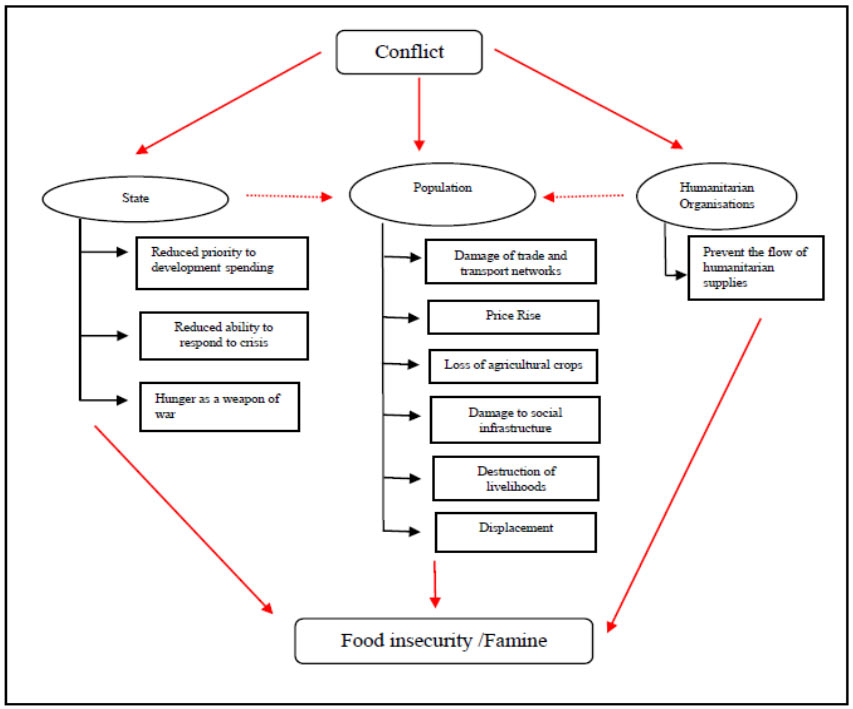
Conflict is one of the main drivers of food insecurity in Africa. Nearly 82 percent of the 149 million Africans facing acute food insecurity are in conflict-affected countries.[30] The relationship between conflict and food insecurity (including extreme food insecurity situations like famines) is well established; economist Amartya Sen (2000) has argued that wars and conflicts lead to entitlement failures, which in turn cause famines.[31] Figure 2 describes the causal links between conflict and food insecurity through their impact on households, governments, and even international agencies undertaking humanitarian work.
Conflict adversely affects the food security situation of underlying populations in several ways: damaged trade and transport networks, rise in the prices of essential food items, poor livelihood opportunities, loss of crops, internal displacement, and damaged social infrastructure. The state is often incapable of protecting food entitlement through development spending when military spending increases and its administrative capabilities erodes. Moreover, it is often repressive in conflict-affected states, using hunger as a weapon of war to starve certain sections of the population.[32] For instance, the Sudanese government downplayed the hunger crisis when the country was going through its worst famine in 2021, and Ethiopian and Eritrean armies blocked convoys of food and medicines and prevented farmers from tilling their land during the conflict with the Tigray People’s Liberation Front (TPLF).[33] Conflict also prevents the state and humanitarian agencies from providing relief to affected populations. According to the Integrated Food Security Phase Classification (IPC), nearly 21.2 million in Sudan are currently facing high levels of acute food insecurity (IPC Phase 3 or above), including 6.3 million in IPC Phase 4 (Emergency), and 375,000 people in IPC Phase 5 (Catastrophe).[34] Lack of data has prevented IPC classification of the besieged towns of El Fasher, Kadguli, and Dilling, and sending humanitarian aid to them.
Figure 2: Causal Link Between Conflict and Food Insecurity/Famine
Source: Author’s Own
Swedish hydrologist Malin Falkenmark’s seminal 1989 paper argued that endemic water scarcity is a serious issue in Africa and would emerge as a critical barrier to its development in the medium term.[35] She estimated that by the year 2000, African countries such as Morocco, Algeria, Tunisia, Libya, Egypt, Somalia, Kenya, Rwanda, Burundi, Malawi, and Zimbabwe will be water-stressed, and by 2025, another 10 countries, viz., The Gambia, Benin, Togo, Nigeria, Burkina Faso, Ethiopia, Uganda, Tanzania, Mozambique, and Lesotho will experience extreme water stress. Falkenmark’s water-scarcity assessments, though valuable, were solely based on demand variables, population growth, and food self-sufficiency requirement. She did not incorporate climate change, which is an important variable in Africa’s current water scenario.
High temperatures and changing precipitation patterns have had severe impact on Africa’s water resources. The IPCC’s sixth assessment report suggests that Africa has warmed more rapidly than the world average and is likely to experience unprecedented higher temperatures in the coming decades, much more than the high-income northern countries.[36] Climate change has also caused extreme variability in rainfall and river discharge in recent years. Thus, hydrological extremes are another serious concern for Africa. The frequency and intensity of droughts and extreme rainfall events are very high under all climate scenarios.[37]
A rapidly changing climate is a formidable obstacle to the eradication of hunger in Africa. The most severe impact of climate change is on food production through increasing temperatures, extreme weather events, changing precipitation patterns, desertification, and land degradation. The continent is witnessing significant negative impact on crop yields as nearly 97 percent of Africa’s agriculture is rain-fed, farmers lack adaptive capacities, and large parts of East and West Africa are facing extreme water scarcity and recurrent droughts along with spells of intense rains. As per the IPCC, agricultural productivity growth in Africa has declined by about 34 percent since 1961, more than any other region in the world. Yields of staple crops such as maize, wheat, and sorghum; several fruits such as mangoes and olives; and cash crops like coffee and tea are declining across the continent.[38] Extreme drought conditions have also led to a decline in agricultural production and higher undernutrition rates in the Sahel region of Cameroon.[39] The changing climate has also led to an increase in pests, which in turn has led to significant crop losses. Climate change also affects livestock production and fisheries. Rangeland net primary productivity[i] (NPP) is expected to decline by 42 percent in West Africa by 2050, along with vector-borne livestock diseases at 2°C global warming.[40]
Climate-change impact is not limited to food production alone. Other dimensions of food security—food access, utilisation, and stability—are also affected. Declining farm productivity has a negative impact on farm incomes and undermines food accessibility of net food buyers. Gebre and Rahut have constructed a Household Food Insecurity Access Scale (HFIAS) for three East African countries, Ethiopia, Kenya, and Tanzania, and found that exposure to climate extremes and crop losses have significant impacts on household-level food access.[41] The impact on women and girls, and matriarchal households in Africa, are higher, as agriculture is central to the livelihoods of women. Pastoral livelihoods are also threatened by climate change due to lower pastures and animal productivity, damaged reproductive function, and loss of biodiversity.[42]
Climate change also impacts food utilisation through reduced nutrition levels. For instance, elevated atmospheric carbon-dioxide levels decrease the protein content in many crops.[43] Reduced fish harvest due to climate change could leave 1.2–70 million people in Africa vulnerable to iron deficiencies, up to 188 million to vitamin A deficiencies, and 285 million to vitamin B12 and Omega-3 fatty acids deficiencies by mid-century.[44] Extreme events, like floods, also have a severe impact on food stability as the food supply chains break due to disrupted trade and transport systems.
In addition to the chronic development challenges, which operate in a nexus, Africa is also constrained by a world order deeply rooted in colonial legacies that undermines African interests while providing more advantages to western countries. The global financial order is heavily stacked against developing countries and plays a big part in perpetuating the conflict–climate-change–water-stress–food-insecurity nexus in Africa. Global financial institutions like the World Bank and the IMF serve the interests of the Global North, which are their primary shareholders, while the least developed countries (LDCs) in Africa are locked in structural inequalities and dependencies.
Much of the African continent is currently reeling under intense debt distress and lacks the fiscal space to undertake development spending on key areas like agriculture, health, education, and adaptation. A series of shocks, starting with the commodity price crash in 2015 followed by the Covid-19 pandemic and the Russia–Ukraine war, jolted African economies. But the global financial system based on structural inequalities did not help them absorb the shocks either, which affected their developmental trajectory. For instance, while the high-income countries were able to provide adequate support to their economies through fiscal stimulus packages of nearly 20 percent of their GDP, stimulus packages in African countries were inadequate at about 1 percent of their GDP.[45] IMF’s special drawing rights (SDR) allocations also favoured high-income countries that received the bulk of the SDRs whereas African countries together received only 3 percent worth $650 billion.[46] International banking rules also constrain development in African countries. For instance, capital adequacy requirements and prudential norms under Basel III[j] are stricter for African countries, which limits lending and has also led to the exit of several international banks.[47]
Despite the enormity of its needs, development aid to Africa has shrunk in recent years. Major donors such as the United States, United Kingdom, European Union, Norway, and Sweden have cut their aid budgets. Most European donors are diverting resources towards Ukrainian refugees after the Russian invasion. Annual official aid in Africa peaked at about US$40 billion in 2015, much before the pandemic, and has consistently declined thereafter.[48] Official development assistance to Sub-Saharan Africa declined by 7.8 percent in 2021.[49] Despite overall ODA numbers hitting record levels in 2022, total development assistance committee (DAC) commitments were 0.37 percent of the countries’ gross national income (GNI), much lower than the official target of 0.7 percent[k] first promised in 1970.[50] Africa experienced a 4.1 percent decline in aid flows as the increase in ODA was largely driven by greater spending on refugees and asylum seekers in the donor countries.[51] The level of development assistance for the world’s poorest countries is less than 0.1 percent, again, much below the UN’s goal of 0.15 percent of GNI. Within the ODA, the share of grants has fallen consistently, while that of concessional loans has increased, which has contributed to the debt burden of Africa’s low-income countries. Between 2012 and 2022, Africa witnessed an 8 percent increase in the share of ODA loans, from 21 percent to 29 percent.[52]
Africa has also not received its fair share in adaptation finance, as political commitments have not led to concrete actions. The climate finance target of US$100 billion made by the developed world at the Copenhagen Summit in 2009 has not been met. Between 2016 and 2019, Africa received only US$18.3 billion a year for climate adaptation.[53] European governments and entities, one of the largest donors, cut nearly €4.8 billion (about US$5.4 billion) in long-term development and climate funding to Africa in January and February 2024.[54] Current climate flows to Africa will not be able to finance the Nationally Determined Contributions (NDCs), which require between US$118.2 billion to US$145.5 billion per year till 2030.[55]
Despite being the most vulnerable region, Africa has received much lower per capita climate finance inflows as compared to more resilient and less vulnerable regions in Asia.[56] Significant differences also exist between Africa’s subregions. While East and West Africa experienced an increase in adaptation finance commitments between 2014 and 2018, Central Africa witnessed a decline.[57] Savvidou et al. (2020) have found that adaptation finance is not targeted according to vulnerability or needs.[58] As a result, some of the most vulnerable LDCs, which are also conflict-affected, like Somalia, Niger, Chad, Sudan, the DRC, Eritrea, Central African Republic, Ethiopia, Liberia, and Sierra Leone, have received adaptation commitments of less than US$5 per capita per year, whereas Gabon, which is much less vulnerable and not an LDC, has received over US$15 per capita per year between 2014–18.[59]
Further, nearly two-thirds of all climate finance channelled to Africa comprised loans, out of which about two-fifths were on non-concessional terms.[60] Disbursement rates in adaptation commitments in Africa are also much lower. During 2014–18, only 46 percent of commitments targeting adaptation in Africa were actually disbursed, suggesting capacity constraints in implementing adaptation projects.[61] Here, too, there are significant subregional variations, with the worst disbursement ratios observed in North Africa (15 percent), West Africa (33 percent), and Central Africa (33 percent). Capacity constraints in African countries also inhibit the use of direct-access modality of the Adaptation Fund[l] and Green Climate Fund[m] (GCF), as African institutions fail to get accreditation, the process is complex and lengthy, and fiduciary and institutions standards are tougher for them.[62]
As discussed in the first section, Africa’s core development challenges continually reinforce each other, perpetuating a vicious cycle of underdevelopment in the continent. An unfair international financial architecture also works against its interests. Moreover, the continent is currently battling a debt crisis, severe fiscal constraints, lacklustre growth prospects, and a shrinking global economy. This section discusses the way forward.
Conflicts are causing human and socioeconomic devastation in Africa. They are deeply intertwined with Africa’s development problems and become significant stumbling blocks for a food-secure and prosperous continent. Therefore, the first step towards breaking the vicious nexus is to prioritise peace building. Analyst Rabah Arezki (2026) argues that given the huge costs of conflict and long setbacks to development, the aid industry should resort to a ‘peace first’ approach.[63] Further, diplomacy, mediation, and preventive security have high long-term returns, so the aid industry and other multilateral and development institutions should employ these tools.
Given the complexity in Africa’s conflicts, durable peace often seems a distant dream. However, with global attention concentrated in Gaza, Ukraine, and Venezuela, the humanitarian crisis in Africa is not receiving the media, financial, and political attention it deserves. Foreign interventions have historically played a controversial role in African conflicts, as external actors often pursue their own economic and strategic interests. The path to peace in Africa lies in looking for ‘African solutions to African problems.’ The African Union and regional organisations must play a more active role in conflict resolution. It is imperative that African leaders work towards finding internal solutions rather than fully relying on external actors.
The global humanitarian system witnessed a massive funding collapse, with a 30 percent decline in funding in 2025, mainly due to withdrawal of US support.[64] At about 45 percent of global humanitarian needs,[n] Africa has been hit hard.[65] The humanitarian finance gap in the continent has widened in recent years. For instance, South Sudan, which is grappling with one of the world’s most severe humanitarian crises, has witnessed a rapid decline in funding from 2020 onwards.[66] In 2025, only 32 percent of the United Nations High Commissioner for Refugees’ (UNHCR) appeal of US$409.7 million for the Sahel region was met, forcing massive cuts in most programmes.[67] Similarly, only 19 percent of the US$2.1 billion humanitarian appeal for Mali, Niger, and Burkina Faso was funded.[68] Most humanitarian organisations in Africa are forced to curtail or even completely shut down their programmes, leaving millions in dire situations. Therefore, a stable Africa requires an urgent reversal of current trends and greater international commitment towards humanitarian action.
In addition to addressing the massive funding gap, the humanitarian sector also needs fundamental changes in design and operation to address Africa’s specific needs. The vicious nexus in Africa calls for a new approach to humanitarian action. Humanitarian finance must be tailored to the setting as flexible approaches work better than applying the same model everywhere.[69] In most FCAS African countries, people are facing protracted conflicts and the adverse consequences of climate change, rather than short-term crises. Humanitarian needs have grown rapidly in recent years due to the perpetual nature of crises. As climate crises become more intense and climate-related disasters become more frequent, humanitarian needs also multiply. According to a recent Oxfam report, climate injustice is at the heart of the humanitarian crisis, as the poorest African countries with the least emissions are suffering the most. UN humanitarian appeals linked to extreme weather are currently eight times higher than 20 years ago.[70]
In the African context, the humanitarian system must work towards breaking the nexus of multiple long-term mutually reinforcing crises, as opposed to focusing on just providing immediate relief. This requires greater coordination between climate and humanitarian finance, which is difficult as there are several differences between these sectors, which make collaboration difficult. For instance, humanitarian aid is typically designed to operate independent of state actors, as the states in conflict zones lack capacity and may even be party to the conflict. On the other hand, climate finance is mostly routed through state actors. Humanitarian aid rarely reaches local- and national-level actors; only 1.2 percent of humanitarian assistance reached them in 2021.[71] However, it is vital for these sectors to overcome their differences as there are significant gains associated with collaboration, as shown by the examples of humanitarian pooled funds,[o] which are more applicable in fragile African countries. There are several examples like the Central Emergency Response Fund (CERF), Country-Based Pooled Funds (CBPF), and the Nexus Response Mechanism. Several scholars also stress the benefits of anticipatory action[p] in proactive operation and expedited humanitarian action, along with building long-term local capacity.[72] Therefore, the climate and humanitarian actors must work together to design a coordinated approach to address the needs of the worst-affected communities, while ensuring that they support local and national actors, reduce emergency response speeds, and build long-term local capacities through anticipatory action.
While experts like Indermit Gill (2018) have prognosticated an end of aid before extreme poverty is eradicated, developing countries in Africa are experiencing a storm of challenges and need ODA grants more than ever before.[73] It might be reasonable to argue that middle-income countries should take care of their populations living in poverty, but much of Africa is currently under a severe debt crisis and several countries are spending more on debt servicing than on development. In 2024, Africa’s debt-servicing burden stood at about US$163 billion.[74] Sub-Saharan Africa was heavily dependent on aid and the Trump administration’s decision for dissolution of the USAID, which was a lifeline to millions of Africans, created havoc in the region. Countries like Ethiopia, Somalia, the DRC, Nigeria, Kenya, South Sudan, Uganda, and Mozambique, which were traditionally large recipients of USAID, will be the most affected.[75] According to analyst Jackie Cilliers, due to the aid cuts, 5.7 million would fall into extreme poverty within one year.[76] Several modelling studies also indicate that drastic aid cuts will intensify poverty and hunger in the continent. According to a recent estimate, by 2030, more than 19 million Africans are at risk of being destitute due to drastic cuts in aid budgets.[77]
Critical initiatives of the World Food Programme in fragile countries like Somalia, South Sudan, Sudan, and the DRC have been jeopardized, which may push nearly 14 million people into severe hunger.[78] Reduction in aid allocation to LDCs mired in or recovering from conflict could push them into a trajectory of renewed violence, political instability, and underdevelopment. Justino and Saavedra-Lux (2023) assert that marginalised populations are not only the most affected by armed conflict but also the most vulnerable to be re-mobilised into fighting.[79] Without massive international support, African countries mired in the conflict–climate change–water stress–food insecurity nexus will be pushed further into a vicious cycle of instability and underdevelopment. An unstable Africa will, in turn, push up humanitarian needs and increase the humanitarian budgets of donors. Therefore, there needs to be an urgent reversal of declining ODA trends and fresh injection of development aid to African countries. In other words, the important question is not whether aid works in conflict settings but how to design effective aid projects and manage the delivery process.
Despite the enormity of its development challenge, its vast vulnerable population, and its marginal contribution to global emissions, Africa has received scant adaptation finance. But the developed world can’t look the other way as its unsustainable consumption is responsible for Africa’s climate distress. It must deliver on its promised US$300 billion a year under the New Collective Quantified Goal agreed at the Conference of Parties (CoP) 29 in Baku, Azerbaijan. So far, only seven countries, viz., Sweden, Norway, France, Japan, Germany, the Netherlands, and Denmark, have mobilised a fair share of adaptation finance.[80] Within these, France and Japan stand out for the poor quality of their climate finance, as a significant share of their resources are bilateral loans and the share of adaptation finance is relatively small.[81] Developed countries like the US, Canada, and Australia fall significantly short on climate finance.
Most multilateral development institutions and development financial institutions—which favour mitigation projects because of a higher economic rate of return, whereas adaptation projects are characterised by imperceptible short-term economic returns on investment—often ignore the costs of underfunding adaptation in Africa. First, the bulk of Africa’s vulnerable population is completely bereft of adaptive resilience. Without adequate adaptation finance, it will endure extreme detrimental climate effects on ecosystems, biodiversity, food systems, water resources, and livelihoods. In other words, adaptation spending has much higher long-term social returns in Africa. Second, most models suggest that Africa’s adaptation costs will rise rapidly in the coming decades as global warming increases, reaching tens of billions of dollars every year.[82] Thirdly, as discussed in the first section, the pernicious impacts of climate change will push more Africans into hunger and fuel more conflicts, which will in turn create pressure on the humanitarian budgets of donor countries. Thus, channelling more funds for adaptation in Africa, particularly the vulnerable LDCs, may contribute towards building a stable, resilient, and peaceful continent. Moreover, climate finance should not add to the debt burden of African countries as the ones with the highest vulnerability to climate change are also countries at high risk of debt distress. Therefore, climate action should primarily be funded through equity investments and grants rather than loans.
Breaking the cycle of crises in Africa not only requires a massive redirection of funds towards its conflict and climate hotspots, but also a dramatic change in the way international development cooperation operates. While it is amply clear that Africa, home to 33 LDCs, continues to need aid, it is important not to repeat the mistakes of the past. Development aid has often been associated with increasing Africa’s dependence on external actors and perpetuating poverty and underdevelopment. Western experts are often not fully aware of Africa’s local conditions. Many external consultants have narrow specialisations and their recommendations do not capture the complexity of the nexus. Moreover, delivering aid, particularly in conflict-affected zones, is also not devoid of problems.
Development aid has a complicated relationship with conflict in Africa, and scholars are divided over the impacts of aid on conflict. Several experts have argued that aid often prolongs conflict by helping one or more parties. Frequent looting of aid in conflict zones can contribute to the war economy and prevent allocation to those most in need. For instance, Nunn and Qian (2014) find that US food aid prolongs the duration of small-scale civil conflicts, which cause between 25 to 999 combat deaths.[83] Dreher, Pan, and Schneider find that in countries with weak governance and upcoming elections, aid increases the chances of violence, particularly targeted violence against politicians. Similarly, Bluhm et al. (2020) say that bilateral aid often raises the chances of smaller conflicts escalating to armed conflicts.[84] Zürcher (2017) also finds that aid is more likely to lead to further conflict.[85] However, the link between development aid and conflict is not direct, as none of the studies find that aid sparks violence in truly peaceful societies.
On the other hand, Gehring et al. (2019) use georeferenced data on development projects by the World Bank and China, two of the largest donors with starkly difference approaches to development, and discover that aid from both the donors reduces rather than fuels lethal conflict.[86] Aid-funded infrastructure often contributes to state capacity to control rebel groups, tribal groups, and foreign-backed militia. The strongest conflict-reducing effects were found in the transport and finance sectors. They also find that the threat of losing aid leads to a reduction in violence by governments against civilians.[87] Moscona explores the relationship between management of development aid and violent conflict in Africa and says that better project management reduces conflict, increases local well-being and builds support for the government across sub-national aid- receiving regions while poorly managed projects increase conflict and could lead to local looting and appropriation.
Given that Africa’s fragile states are beset by multiple challenges and the difficulties associated with implementing development and humanitarian programmes, a holistic approach to international assistance is the only way forward. Conflict and climate change intersect in complex ways to disrupt lives and displace people in fragile African nations. For instance, in South Sudan, a large part of the population has been displaced due to a combination of flooding and conflict.[88] Pech and Chan (2024) observe that pastoralists in South Sudan have been forced to change their migration routes due to changing climatic conditions, which have in turn led to tensions with other pastoral groups in the Kapoeta region.[89] Therefore, international assistance must operate at the intersection of conflict, climate change, and displacement rather than conducting peacebuilding initiatives, development projects, humanitarian assistance, and climate adaptation projects in silos. International interventions must be so designed that addressing one problem does not aggravate another. For instance, climate adaptation strategies related to natural resource management can cause heightened insecurity about land rights, intensify environmental degradation, and marginalise certain communities, creating or escalating rifts in these countries.[90] Similarly, natural resources like water, and adverse climate impact including disasters, can’t be ignored in humanitarian interventions. Actions to promote peace in African countries must be implemented with an understanding of the local environment and climate impacts. Joireman and Haddad (2023) insist that the baseline environmental assessment of resources like water, land, and fuelwood is essential before the commencement of any relief project and on continuous monitoring of environmental and climate data throughout the project.[91] Any project which ignores conflict or works in isolation is likely to fail in fragile settings. Therefore, a conflict-sensitive approach, also known as the ‘do no harm’ approach, must form the bedrock of all international interventions. This approach emphasises a deeper understanding of the local context and helps undertake steps to prevent the potential negative impacts of development or humanitarian actions. Makosso (2025) stresses the role of local leadership and gender analysis and social inclusion (GESI) to ensure that climate adaptation projects are sustainable and sensitive to local dynamics.[92] The most common principles of conflict sensitivity are better planning, a flexible approach, and prioritisation of local leadership, and greater connection between multiple objectives: development, climate adaption, and peacebuilding. Extensive consultations should be held with local communities to ensure that every project is led by the locals and meets their needs. Further, greater emphasis should be laid on capacity building and developing indigenous expertise and knowledge, rather than simple transfer of know-how.
In a nutshell, donors and international agencies must not only reverse the current trend of funding cuts but ensure that aid does not escalate conflict or create new dependencies. A flexible and integrated approach to the development of Africa’s conflict and climate-affected regions, which recognises the interplay between climate and conflict, will be more appropriate.
In addition to a reversal in current declining ODA trends, Africa also needs a change in ODA composition. It needs more ODA in its agriculture, a sector that has been ignored by the donor community. Over the years, the share of agriculture in overall official aid has stagnated at about 4 percent.[93] Figure 2 traces the ODA commitments of DAC donors and multilateral donors to agriculture from 2000 to 2022 and shows that they stagnated from the mid-2000s.
Africa has about 60 percent of the world’s cultivable agricultural land, and yet spends nearly US$78 billion each year on food imports.[94] Although the agricultural sector accounts for 35 percent of its GDP and is the greatest source of employment, it suffers from low productivity levels.[95] Almost 80 percent of the food is grown by small-scale farmers, who continue to practise subsistence agriculture.[96] The Agenda 2063[q] identified the need for modern agriculture and high growth and productivity levels through greater investments in small-scale agriculture, rural infrastructure, and productivity improvements through better technology, but these objectives were not matched by actual investments.[97] The average government expenditure on agriculture stands at a mere 4.1 percent, much below the target of 10 percent.[98]
While most African countries experience high rates of undernutrition and rapid population growth, small-scale farmers are struggling with outdated technology in a rapidly changing climate. The continent desperately needs greater investments in agriculture to feed its growing population and make domestic food supply chains more reliable, reducing dependence on imports. A shift in priority to a wide range of food staples like maize and sorghum, rather than export crops like cocoa and coffee, is also needed. Financing is the biggest impediment to investment in agriculture. Africa’s current financing shortfall in agriculture is estimated between US$27 million–US$65 billion.[99] Given its damaged fiscal health, countries will not be able to draw up revenue resources to make greater investments in agriculture. International support is necessary to help adapt its agriculture to the changing climate. Therefore, more resources should be directed towards agriculture to address food insecurity, reduce imports, and make it less reliant on food aid.
Increasing temperatures and changing precipitation patterns due to climate change will make water stress worse. While the importance of reliable water resources for food security, agricultural and industrial progress, and sustainable development is well known, in the African context, water is also a source of conflict. Therefore, equitable and sustainable use of water through effective water governance will be an essential ingredient of its development roadmap.
African leaders need to recognise that water scarcity is a serious barrier to development, and invest in water infrastructure and better water management, particularly in rural areas, to help smallholder farmers and pastoralists. Its agriculture sector particularly needs significant investments to improve irrigation facilities and better water management to increase food production for the growing population. Access to clean drinking water is another major challenge for millions of Africans, exposing them to deadly water-borne diseases like cholera. The DRC, which is home to over 50 percent of Africa’s freshwater resources, also suffers from a massive clean water crisis.
While the bulk of Africa’s adaptation commitments are directed at the water sector, given the diminutiveness of actual adaptation funds directed towards water-scarce African regions like the Horn of Africa and the Sahel, there is a need to step up funds in building adequate water infrastructure and better water management. African nations must prioritise forging partnerships with international bodies, governments, and research institutions for water security. They must aim to glean lessons in water management and water technologies from global leaders like the Netherlands, Denmark, Singapore, and Israel.
Low-income African countries often face significant governance barriers to development and climate adaptation, due to weak or complete absence of sub-national institutions, ineffective bureaucracy, lack of coordination between different government departments, and poor leadership mandates. As observed in the second section, capacity constraints in African countries often prevent them from accessing the limited adaptation finance that is available. Therefore, addressing this should be an important part of international cooperation. Here, Africa’s development partners from the Global South, like India, can play an important role. Capacity building is an important pillar of India’s approach to development cooperation. The Ten Guiding Principles of India–Africa Engagement, outlined by Indian Prime Minister Narendra Modi in his address to the Ugandan Parliament in 2018, stressed India’s commitment to building African capacity.[100] India’s development cooperation (and other countries’ too) in the next decade should focus on developing African capacity to prepare and implement adaptation and development plans, build and strengthen African institutions, and help smaller African countries in drafting proposals, preparing feasibility reports, and accessing global adaptation funds.
Africa often presents itself as a developmental puzzle. Poverty and hunger remain high, and most countries are not on track to achieve the SDGs. The continent is home to the highest number of conflicts, is highly water stressed and food insecure. Despite its minuscule contribution to global greenhouse gas emissions, it has experienced widespread losses and damages due to adverse climate impacts. Africa also faces discrimination from an inequitable global order, which prevents it from accessing resources on fair terms to address its core development challenges. The developed world is also cutting back on aid budgets as the continent is going through its toughest times. This paper calls for immediate international action to prevent Africa from slipping further into the vicious cycle of conflict and underdevelopment, through peacebuilding, humanitarian action, development finance, and adaptation support. The diversion of aid from Africa needs to be corrected, and developed countries must enhance their support. It also calls for support for Africa’s food self-sufficiency, capacity-building, and better water management and governance.
Malancha Chakrabarty is Senior Fellow and Deputy Director (Research) at the Observer Research Foundation.
The author would like to thank Dr Nilanjan Ghosh and the anonymous reviewers for their comments on the first draft.
All views expressed in this publication are solely those of the author, and do not represent the Observer Research Foundation, either in its entirety or its officials and personnel.
[a] According to the Uppsala Conflict Data Program (UCDP), a state-based conflict is one between two or more armed groups, at least one of which is a state, which causes at least 25 deaths due to fighting within a year.
[b] The Malabo Declaration was adopted by the heads of states and the Government of the African Union in June 2014 in Malabo, Equatorial Guinea. It set the goal of ending hunger in Africa by 2025 and reducing child stunting to less than 10 percent.
[c] When pastoralists follow their traditional migration routes, they adhere to customary agreements with local populations. Following new routes often lead to conflicts due to the lack of such agreements.
[d] The act of stealing live cattle in large numbers. Cattle raids are a big problem in many parts of Africa, notably East Africa and South Sudan. This practice is rooted in both traditional culture and modern conflicts. It is getting increasingly violent due to availability to arms and has a high human cost in the affected communities.
[e] Countries affected by violent conflict and high levels of institutional and social fragility. The World Bank Group lists FCAS situations annually to inform its strategic and operational decision-making.
[f] The FDLR (English: Democratic Forces for the Liberation of Rwanda) is an armed rebel group operating in the DRC.
[g] The Mouvement Du 23 Mars (M23) is an armed group operating in the DRC.
[h] REDD+ (Reducing Emissions from Deforestation and Forest Degradation) is a climate change mitigation solution developed by Parties to the United Nations Framework Convention on Climate Change (UNFCCC). It encourages developing countries to conserve forests, manage them sustainably, and enhance carbon stocks. It combats climate change by reducing emissions from deforestation, which contributes up to 11 percent of global carbon emissions, while fostering sustainable development and supporting local communities.
[i] The rate at which rangeland plants convert sunlight into energy (biomass) that is available to herbivores and other consumers. It is an indicator of rangeland ecosystem health, function, and its ability to support livestock. NPP can be measured using remote sensing or by weighing and drying plant samples. Factors such as rainfall, temperature, and soil conditions influence it, and it varies significantly across different types of rangelands.
[j] An internationally agreed set of measures developed by the Basel Committee on Banking Supervision in response to the financial crisis of 2007–09. It aims to strengthen the regulation, supervision, and risk management of banks.
[k] The 0.7 percent GNI target was formally adopted by the UN in 1970, which stated that developed countries would provide at least 0.7 percent of their GNI as foreign aid to developing countries. Most developed countries have consistently failed to meet this target.
[l] The Adaptation Fund was established in 2001 to finance concrete adaptation projects and programmes in developing country parties to the Kyoto Protocol that are particularly vulnerable to the adverse effects of climate change.
[m] A key element of the historic Paris Agreement, the GCF is the world’s largest climate fund, mandated to support developing countries raise and realise their Nationally Determined Contributions (NDC) ambitions towards low-emission, climate-resilient pathways.
[n] Out of a total of 300 million people, nearly 134 million African require humanitarian assistance.
[o] Humanitarian pooled funds combine donor contributions into single, unearmarked or loosely earmarked funds, enabling rapid and flexible strategic financing for crises.
[p] A branch of climate and disaster risk management that emphasises the use of climate services and risk analyses to predict crises and enable action to prevent/mitigate impacts before disasters occur.
[q] The African Union’s 50-year strategic framework (2013–63) to transform the continent into a global powerhouse, focusing on sustainable development, integration, and peace.
[1] Siri Aas Rustad, Conflict Trends: A Global Overview, 1946–2023, (Oslo: Peace Research Institute Oslo, 2024), https://cdn.cloud.prio.org/files/92a7aad5-3572-4886-9e9c-8aa155f1d0f4/Conflict_Trends-2024_DIGITAL.pdf.
[2] “African Conflicts Displace Over 40 Million People,” Africa Center for Strategic Studies, Washington DC, August 22, 2023, https://africacenter.org/spotlight/african-conflicts-displace-over-40-million-people/.
[3] Bastian Herre, “Millions Have Died in Conflicts Since the Cold War; Most of Them in Africa and Intrastate Conflicts,” Our World in Data, July 15, 2024, https://ourworldindata.org/conflict-deaths-breakdown.
[4] “African Conflicts Displace Over 40 Million People.”
[5] Anna Marie Obermeier and Siri Aas Rustad, Conflict Trends: A Global Overview, 1946–2022, (Oslo: Peace Research Institute Oslo, 2023), https://cdn.cloud.prio.org/files/dc754702-b1ec-4787-97bb-7a41f187036a/Obermeier_Rustad_Conflict_Trends_1946-2022_PRIO_Paper_2023.pdf.
[6] Kevin C. Urama, Adamon Mukasa, and Anthony Simpasa, “Turning Political Ambitions into Concrete Climate Financing Actions for Africa,” in Foresight Africa 2023, ed. Aloysius Uche Ordu and Nicole Ntungire (Washington DC: Brookings Institution, 2023), 130–134, https://www.brookings.edu/wp-content/uploads/2023/01/foresightafrica2023_fullreport.pdf.
[7] “Focus on Africa,” African Development Bank Group, https://www.afdb.org/en/cop28/focus-africa.
[8] Charlotte MacAlister et al., Global Water Security 2023 Assessment, (United Nations University Institute for Water, Environment, and Health, 2023), https://collections.unu.edu/eserv/UNU:9107/n23-116_UNU_Water_Security_WEB_Final_updated.pdf.
[9] MacAlister et al., Global Water Security 2023 Assessment.
[10] “Human-Induced Climate Change Increased Drought Severity in Horn of Africa,” World Weather Attribution, April 27, 2023, https://www.worldweatherattribution.org/human-induced-climate-change-increased-drought-severity-in-southern-horn-of-africa/.
[11] Food and Agriculture Organization, African Union Council, Economic Commission for Africa, and World Food Programme, Africa Regional Overview of Food Security and Nutrition 2023: Statistics and Trends (Accra: FAO, 2023), https://openknowledge.fao.org/server/api/core/bitstreams/c6c81d5f-e337-4b3e-8330-555c9ed0e741/content.
[12] “Conflict and Migration,” Global Center on Adaptation, 2021, https://gca.org/wp-content/uploads/2022/07/03_WTW_14855_GCA_2021_Sect3_CONFLICT_MIGRATION_v5.pdf.
[13] Kyungmee Kim and Tània Ferré Garcia, “Climate Change and Violent Conflict in the Middle East and North Africa,” International Studies Review 25 (2023): 1.
[14] “The Central Sahel: How Conflict and Climate Change Drive Crisis,” International Rescue Committee, August 17, 2023, https://www.rescue.org/article/central-sahel-how-conflict-and-climate-change-drive-crisis.
[15] Younes Abouyoub, “Climate: The Forgotten Culprit. The Ecological Dimension of the Darfur Conflict,” Race, Gender & Class 19 (2012): 150.
[16] Abdul Karim Issifu, Francis Diawuo Darko, and Sebastian Angzoorokuu Paalo, “Climate Change, Migration and Farmer–Herder Conflict in Ghana,” Conflict Resolution Quarterly 39 (2022): 421.
[17] Malin Mobjörk, “Exploring the Climate–Conflict Link: The Case of East Africa,” in SIPRI Yearbook 2017: Armaments, Disarmaments and International Security, ed. Dan Smith (Oxford: Oxford University Press, 2017), 287.
[18] Mobjörk, “Exploring the Climate–Conflict Link.”
[19] Mandlenkosi Makhayeni Moyo, “Pastoralist Conflict in Ethiopia from 2015 to 2022: Climate Change and Food Insecurity as Exacerbating Factors,” University of Pretoria, https://repository.up.ac.za/items/4c6c1134-dc28-47b0-8c57-717eb7792c0b; “Communal Conflicts in the Karamoja Cluster (Uganda),” Climate Diplomacy, https://climate-diplomacy.org/case-studies/communal-conflicts-karamoja-cluster-uganda.
[20] Kim and Garcia, “Climate Change and Violent Conflict in the Middle East and North Africa.”
[21] Laura Jaramillo et al., “Climate Challenges in Fragile and Conflict-Affected States,” (IMF Staff Climate Note, 2023), https://www.imf.org/en/Publications/staff-climate-notes/Issues/2023/08/24/Climate-Challenges-in-Fragile-and-Conflict-Affected-States-537797.
[22] Olivia Nater, “The Disappearing ‘Lungs of Africa’: Deforestation in the Congo Basin,” Population Connection, June 12, 2023, https://populationconnection.org/article/the-disappearing-lungs-of-africa-deforestation-in-the-congo-basin/.
[23] Nater, “The Disappearing ‘Lungs of Africa’”; Mongabay, “Poor Governance Fuels ‘Horrible Dynamic’ of Deforestation in DRC”, Earth.org, December 25, 2020, https://earth.org/deforestation-in-drc/
[24] Olivia Nater, “The Disappearing ‘Lungs of Africa’.”
[25] Elodie Toto, “DRC’s Reliance on Charcoal Threatens Forests and Fuels Armed Conflict,” Mongabay, December 5, 2024, https://news.mongabay.com/2024/12/drcs-reliance-on-charcoal-threatens-forests-and-fuels-armed-conflict/.
[26] Toto, “DRC’s Reliance on Charcoal Threatens Forests and Fuels Armed Conflict.”
[27] Halvard Buhaug, “Armed Conflict and Climate Change: How These Two Threats Play Out in Africa,” ReliefWeb, November 9, 2022, https://reliefweb.int/report/world/armed-conflict-and-climate-change-how-these-two-threats-play-out-africa.
[28] International Organization for Migration, “Conflict Drives Displacement Amidst Rising Climate Shocks: New Africa Migration Report,” March 26, 2024, https://www.iom.int/news/conflict-drives-displacement-amidst-rising-climate-shocks-new-africa-migration-report.
[29] International Organization for Migration, “Conflict Drives Displacement Amidst Rising Climate Shocks.”
[30] Africa Center for Strategic Studies, “Unresolved Conflicts Continue to Drive Africa’s Food Crisis,” October 16, 2023, https://africacenter.org/spotlight/unresolved-conflicts-continue-to-drive-africas-food-crisis/.
[31] Amartya Sen, “Wars and Famines: On Divisions and Incentives,” Peace Science and Public Policy 6, no. 2 (Spring 2000): 10.
[32] Jenny Edkins, “Mass Starvations and the Limitations of Famine Theorising,” IDS Bulletin 33, no. 4 (2002): 12; Alex de Waal, “The Nazis Used It, We Use It: On the Return of Famine as a Weapon of War,” London Review of Books 39, no. 12 (2017).
[33] Malancha Chakrabarty, “The Enduring Link Between Conflict and Hunger in the 21st Century,” ORF Issue Brief No. 500, Observer Research Foundation, https://www.orfonline.org/research/the-enduring-link-between-conflict-and-hunger-in-the-21st-century.
[34] “Sudan: Acute Food Insecurity Situation for September 2025 and Projections for October 2025–January 2026 and for February–May 2026,” Integrated Food Security Phase Classification, https://www.ipcinfo.org/ipc-country-analysis/details-map/en/c/1159787/.
[35] Malin Falkenmark, “The Massive Water Scarcity Now Threatening Africa—Why Isn’t It Being Addressed?” Ambio 18 (1989): 112.
[36] Christopher H. Trisos et al., “Africa,” in Climate Change 2022: Impacts, Adaptation and Vulnerability, Working Group II Contribution to the Sixth Assessment Report of the Intergovernmental Panel on Climate Change (Cambridge: Cambridge University Press, 2022), 1285–1455.
[37] Trisos et al., “Africa,” 1285.
[38] Patrick Ketiem et al., “Integration of Climate Change Information into Drylands Crop Production Practices for Enhanced Food Security: A Case Study of the Lower Tana Basin in Kenya,” African Journal of Agricultural Research 12 (2017): 1763–1771.
[39] Nkwetta Elvis Chabejong, “A Review on the Impact of Climate Change on Food Security and Malnutrition in the Sahel Region of Cameroon,” in Climate Change and Health: Improving Resilience and Reducing Risks, eds. Walter Leal Filho et al. (Germany: Springer, 2016), 133–148.
[40] Trisos et al., “Africa,” 1285.
[41] Girma Gezimu Gebre and Dil Bahadur Rahut, “Prevalence of Household Food Insecurity in East Africa: Linking Food Access with Climate Vulnerability,” Climate Risk Management 33 (2021).
[42] Cheikh Mbow et al., “Food Security,” in Climate Change and Land: An IPCC Special Report, eds. P. R. Shukla et al. (Cambridge: Cambridge University Press, 2022), 437–550.
[43] Mbow et al., “Food Security,” 437.
[44] Trisos et al., “Africa,” 1285.
[45] “How to Optimise Africa’s Economic Response to the Coronavirus Pandemic,” AfriCatalyst, https://africatalyst.com/how-to-optimize-africas-economic-response-to-the-coronavirus-pandemic/; Brahima Sangafowa Coulibaly, “Rebooting Global Cooperation Is Imperative to Successfully Navigate the Multitude of Shocks Facing the Global Economy,” Brookings, September 16, 2022, https://www.brookings.edu/articles/rebooting-global-cooperation-is-imperative-to-successfully-navigate-the-multitude-of-shocks-facing-the-global-economy/.
[46] Coulibaly, “Rebooting Global Cooperation Is Imperative to Successfully Navigate the Multitude of Shocks Facing the Global Economy.”
[47] Soumya Bhowmick and Nilanjan Ghosh, “Africa’s High Cost of Financial Flows and Economic Marginalisation,” in Cape Town Chronicles, Observer Research Foundation and Thabo Mbeki Foundation, eds. Malancha Chakrabarty and Lukhanyo Neer (New Delhi: Observer Research Foundation, 2023), 23–34.
[48] Indermit Gill, “The End of Aid,” Brookings, January 19, 2018, https://www.brookings.edu/articles/the-end-of-aid/.
[49] Patricia Justino and Laura Saavedra‑Lux, “Development Aid Cuts Will Hit Fragile Countries Hard, Could Fuel Violent Conflict,” United Nations University, December 1, 2023, https://unu.edu/article/development-aid-cuts-will-hit-fragile-countries-hard-could-fuel-violent-conflict.
[50] Rebeca Grynspan et al., “Aid Under Pressure: 3 Accelerating Shifts in Official Development Assistance,” United Nations Global Crisis Response Group, April 2024, https://unctad.org/system/files/official-document/un-gcrg-oda-report_en.pdf.
[51] Grynspan et al., “Aid Under Pressure.”
[52] Grynspan et al., “Aid Under Pressure:”
[53] Urama et al., “Turning Political Ambitions into Concrete Climate Financing Actions for Africa,” 130.
[54] Mimi Alemayehou and David McNair, “False Economy: Why Europeans Should Stop Slashing Development Aid to Africa,” European Council on Foreign Relations, February 28, 2024, https://ecfr.eu/article/false-economy-why-europeans-should-stop-slashing-development-aid-to-africa/.
[55] Urama et al., “Turning Political Ambitions into Concrete Climate Financing Actions for Africa,” 130.
[56] Urama et al., “Turning Political Ambitions into Concrete Climate Financing Actions for Africa,” 130.
[57] Trisos et al., “Africa,” 1285.
[58] Georgia Savvidou, Aaron Atteridge, Kulthoum Omari-Motsumi and Christopher H. Trisos, “Quantifying International Public Finance for Climate Change Adaptation in Africa,” Climate Policy 21 (2020): 1020–1036.
[59] Savvidou et al., “Quantifying International Public Finance for Climate Change Adaptation in Africa.”
[60] Urama, Mukasa, and Simpasa, “Turning Political Ambitions into Concrete Climate Financing Actions for Africa,” 130.
[61] Savvidou et al., “Quantifying International Public Finance for Climate Change Adaptation in Africa.”
[62] Kulthoum Omari‑Motsumi et al., Broken Connections and Systemic Barriers: Overcoming the Challenge of the ‘Missing Middle’ in Adaptation Finance, Global Commission on Adaptation, 2019, https://gca.org/wp-content/uploads/2020/12/Missing_Middle_Adaptation_Finance_Background_Paper.pdf.
[63] Rabah Arezki, “The Aid Industry Needs to Refocus on Building Peace,” Nature 650, February 12, 2026, https://www.nature.com/articles/d41586-026-00384-4.
[64] “A Generational Collapse: Tracking the Toll of Trump’s Humanitarian Aid Cuts,” Refugees International, February 5, 2026, https://www.refugeesinternational.org/reports-briefs/a-generational-collapse-tracking-the-toll-of-trumps-humanitarian-aid-cuts/.
[65] “Africa Humanitarian Review Mid‑Year Update – As of June 2025,” United Nations Office for the Coordination of Humanitarian Affairs, https://www.unocha.org/publications/report/world/africa-humanitarian-overview-mid-year-update-june-2025.
[66] “Conflict and Aid Cuts Drive Crisis in South Sudan,” Oxfam, February 4, 2026, https://www.oxfamamerica.org/explore/emergencies/east-africa-hunger-crisis/conflict-and-aid-cuts-drive-crisis-in-south-sudan/.
[67] Vibhu Mishra, “In Africa’s Sahel, Conflict and Climate Change Force Millions from Their Homes,” United Nations, October 10, 2025, https://news.un.org/en/story/2025/10/1166076.
[68] Mishra, “In Africa’s Sahel, Conflict and Climate Change Force Millions from Their Homes.”
[69] Vanina Farber, “Aid as We Know It Is Changing—It’s Time to Innovate Humanitarian Finance,” World Economic Forum, July 21, 2025, https://www.weforum.org/stories/2025/07/aid-as-we-know-it-is-changing-it-s-time-to-innovate-humanitarian-finance/.
[70] Mathew Truscott and Erica Mason, “Leaving No One Behind: A Green Bargain for People and Planet,” Oxfam International, September 2023.
[71] Truscott and Mason, “Leaving No One Behind.”
[72] Arielle Tozier de la Poterie et al., “Anticipatory Action to Manage Climate Risks: Lessons from the Red Cross Red Crescent in Southern Africa, Bangladesh, and Beyond,” Climate Risk Management 39 (2023).
[73] Gill, “The End of Aid.”
[74] “Annual Meetings 2024: Old Debt Resolution for African Countries – The Cornerstone of Reforming the Global Financial Architecture,” African Development Bank Group, May 15, 2024, https://www.afdb.org/en/news-and-events/annual-meetings-2024-old-debt-resolution-african-countries-cornerstone-reforming-global-financial-architecture-70791.
[75] Spencer Lynn, “The Devastating Impacts of the USAID Pullout on Africa,” Michigan Journal of Economics, May 13, 2025, https://sites.lsa.umich.edu/mje/2025/05/13/op-ed-the-devastating-impacts-of-the-usaid-pullout-on-africa/.
[76] Jakkie Cilliers, “Data Modelling Reveals the Heavy Toll of USAID Cuts on Africa,” Institute for Security Studies, February 28, 2025, https://issafrica.org/iss-today/data-modelling-reveals-the-heavy-toll-of-usaid-cuts-on-africa.
[77] Cilliers, “Data Modelling Reveals the Heavy Toll of USAID Cuts on Africa.”
[78] “Humanitarian Funding Cuts Pushing Millions into Hunger: WFP,” United Nations, October 15, 2025, https://news.un.org/en/story/2025/10/1166112.
[79] Justino and Saavedra‑Lux, “Development Aid Cuts Will Hit Fragile Countries Hard, Could Fuel Violent Conflict.”
[80] Sarah Colenbrander, Laetitia Pettinotti, and Yue Cao, “A Fair Share of Climate Finance? An Appraisal of Past Performance, Future Pledges and Prospective Contributors,” ODI Working Paper, June 2022, https://odi.org/en/publications/a-fair-share-of-climate-finance-an-appraisal-of-past-performance-future-pledges-and-prospective-contributors/.
[81] Colenbrander et al., “A Fair Share of Climate Finance?”
[82] Savvidou et al., “Quantifying International Public Finance for Climate Change Adaptation in Africa.”
[83] Nathan Nunn and Nancy Qian, “US Food Aid and Civil Conflict,” American Economic Review, June 2014.
[84] Richard Bluhm et al., “Fueling Conflict? (De)escalation and Bilateral Aid,” Journal of Applied Econometrics (2020).
[85] Christoph Zürcher, “What Do We (Not) Know About Development Aid and Violence? A Systematic Review,” World Development 98 (October 2017): 506–522.
[86] Kai Gehring, Lennart Kaplan, and Melvin H. L. Wong, “Aid and Conflict at the Sub-National Level: Evidence from World Bank and Chinese Development Projects in Africa,” AidData Working Paper No. 70, March 2019.
[87] Gehring e al., “Aid and Conflict at the Sub-National Level.”
[88] Kuach Pech and Natalia Chan, “Conflict-Sensitive Aid at the Intersection of Climate Change, Conflict and Vulnerability in South Sudan,” Humanitarian Practice Network, Issue 84, March 13, 2024, https://odihpn.org/en/publication/conflict-sensitive-aid-at-the-intersection-of-climate-change-conflict-and-vulnerability-in-south-sudan/.
[89] Pech and Chan, “Conflict-Sensitive Aid at the Intersection of Climate Change, Conflict and Vulnerability in South Sudan.”
[90] Amanda Makosso, “Conflict Sensitivity: A Key Approach for Climate Adaptation,” Policy Report, Issue 29, Network for Strategic Analysis, March 2025, https://ras-nsa.ca/conflict-sensitivity-a-key-approach-for-climate-adaptation/.
[91] Sandra F. Joireman and Fidaa Haddad, “The Humanitarian–Development–Peace Nexus in Practice: Building Climate and Conflict Sensitivity into Humanitarian Projects,” Current Opinion in Environmental Sustainability 62 (June 2023).
[92] Makosso, “Conflict Sensitivity.”
[93] “OECD Data Explorer,” OECD, https://data-explorer.oecd.org/vis?fs[0]=Topic%2C1%7CDevelopment%23DEV%23%7COfficial%20Development%20Assistance%20%28ODA%29%23DEV_ODA%23&pg=0&fc=Topic&bp=true&snb=10&df[ds]=dsDisseminateFinalDMZ&df[id]=DSD_DAC1%40DF_DAC5&df[ag]=OECD.DCD.FSD&df[vs]=1.0&pd=%2C&dq=DAC.528....Q.311&to[TIME_PERIOD]=false&ly[rw]=SECTOR&ly[cl]=TIME_PERIOD.
[94] Gareth Hodder and Brenda Migwalla, Africa’s Agricultural Revolution: From Self‑Sufficiency to Global Food Powerhouse, White & Case, July 12, 2023, https://www.whitecase.com/insight-our-thinking/africa-focus-summer-2023-africas-agricultural-revolution.
[95] Chido Munyati and Landry Signé, “How Africa’s New Free Trade Area Will Turbocharge the Continent’s Agriculture Industry,” World Economic Forum, March 14, 2023, https://www.weforum.org/agenda/2023/03/how-africa-s-free-trade-area-will-turbocharge-the-continent-s-agriculture-industry/.
[96] “The Role of Smallholder Farmers in Food Security, Agricultural Sustainability and Global Food Supply Chains,” Zero Carbon Analytics, September 2023, https://zerocarbon-analytics.org/wp-content/uploads/2023/11/2023-09-Smallscale-farmers.pdf.
[97] “Goals and Priority Areas of Agenda 2063,” African Union, https://au.int/agenda2063/goals.
[98] Hodder and Migwalla, “Africa’s Agricultural Revolution.”
[99] Hodder and Migwalla, “Africa’s Agricultural Revolution.”
[100] Prime Minister’s Office, Government of India, https://pib.gov.in/PressReleasePage.aspx?PRID=1540025.
The views expressed above belong to the author(s). ORF research and analyses now available on Telegram! Click here to access our curated content — blogs, longforms and interviews.

Dr Malancha Chakrabarty is Senior Fellow and Deputy Director (Research) at the Observer Research Foundation where she coordinates the research centre Centre for New Economic ...
Read More +


 PREV
PREV