As India operationalises its labour codes, the central question is whether establishment-based regulation can meaningfully improve conditions in a labour market dominated by informality

Days after Labour Day, the Union government published over 30 gazette notifications on 8 and 9 May, fully operationalising the four labour codes — on Wages; Industrial Relations; Social Security; and Occupational Safety, Health and Working Conditions. The codes themselves came into force on November 21, 2025. The six-month gap between commencement and the rules (the codes have been technically in force since November but lacked the implementing machinery until May) itself signals the practical weight of these notifications. These rules complete a process that has consolidated 29 central labour laws into a single framework. Whether this represents reform or repackaging depends on a question often crowded out by procedural debate: how well the codes fit the labour market they are designed to govern.
The operational details are crucial because the May notifications are not merely procedural. The Code on Wages Rules translate the statutory wage definition into registers, wage slips, and claims machinery; the Industrial Relations Rules specify recognition, standing orders, lay-off and retrenchment processes; the Social Security Rules lay the architecture for contributions, records, and portability; and the Occupational Safety, Health and Working Conditions (OSH) Rules set the compliance frame for safety, health, welfare facilities, contract labour, and inter-state migrant workers. The substantive question is no longer when the codes take effect, but how their machinery will land on the labour market they now govern.
India's employment challenge is now concerned with whether work is secure, remunerative, and capable of moving workers into higher-productivity activity.
The latest annual Periodic Labour Force Survey (PLFS) does not describe an economy unable to absorb workers.[1] Headline labour-force participation has improved, women's workforce participation has substantially risen over the past decade, and measured unemployment is low. Yet the same market relies heavily on farms, family enterprises, self-employment, unpaid work, and tiny establishments. India's employment challenge is now concerned with whether work is secure, remunerative, and capable of moving workers into higher-productivity activity.
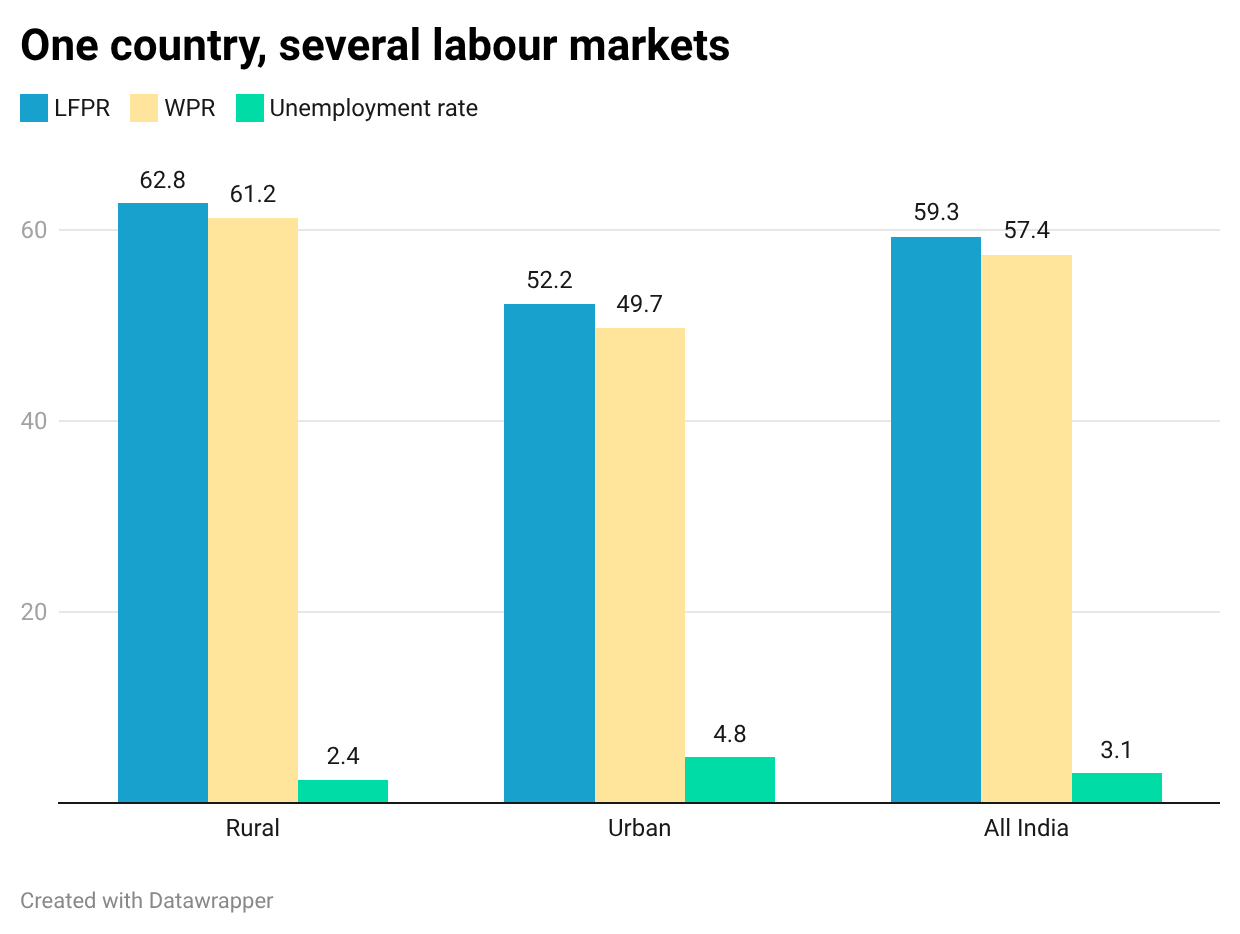
This distinction is especially important after operationalisation. Codes written around employers, establishments, and registers work best when workers are attached to identifiable units. PLFS shows a large share of workers instead remaining in self-employment, agriculture, unpaid family work, and very small enterprises.
Figure 1: LFPR and WPR
Source: PLFS
The composition in Figure 1 complicates how we read aggregates. Rural unemployment is low partly because agriculture and household enterprises function as shock absorbers. Urban unemployment is higher because the search for work is tied to education, mobility, and the availability of suitable wage employment. A young, educated urban woman and an unpaid family worker in a village can appear in the same statistic,[2] even though their economic realities are very different.
Labour-market inequality begins not at the wage level, but at the type of job itself. It should be noted that regular wage employment is not a clean proxy for formality.
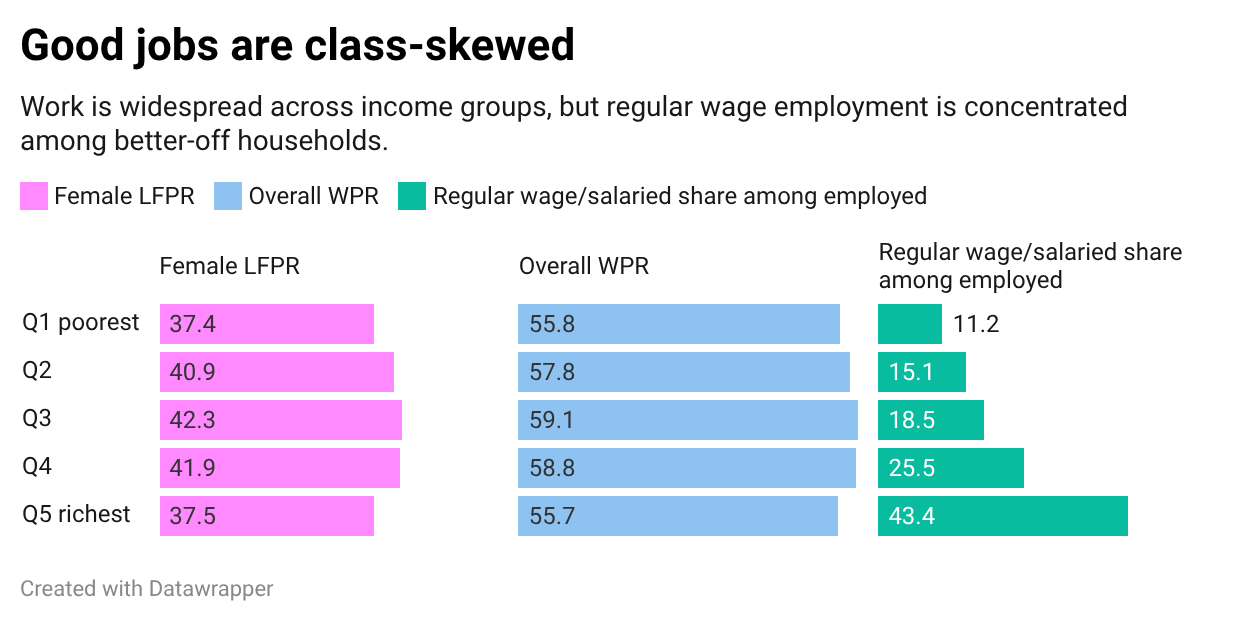
Quality work, thus, becomes the pivot. Regular wage work is the closest approximation to a "good job" for most households, yet access to it is class-skewed. Better-off households are far more likely to have members in salaried employment; poorer households remain dependent on casual labour, self-employment, and survival work. Labour-market inequality begins not at the wage level, but at the type of job itself. It should be noted that regular wage employment is not a clean proxy for formality.
Figure 2: Distribution of Work across Income Classes
Source: PLFS
Women's employment compounds the labour market pangs. Female workers are over-represented in unpaid family work, while men dominate the regular-wage segment and also account for a larger share of own-account work. Rural India absorbs labour more visibly, but much of that absorption is into low-productivity work. Urban India offers a larger share of regular wage employment but presents sharper barriers to women and the young.
Figure 3: Categorisation of Work by Sex

Source: PLFS
In the PLFS unit-level estimates used here, 57.8 percent of regular wage/salaried workers had no written job contract, 47.5 percent were not eligible for paid leave, and 51.4 percent reported no specified social-security benefit. This is exactly where the codes can matter: appointment letters, common wage records and portability can turn “regular” jobs into quality jobs. Based on the above labour market dimensions, the codes are directionally correct in places.
The Code on Social Security extends pension, health, and accident cover to gig and platform workers for the first time, with aggregators required to contribute 1–2 percent of annual turnover, subject to a ceiling of 5 percent of the amount payable to gig and platform workers. A standardised wage definition, a statutory national floor wage, mandatory appointment letters, and gratuity for fixed-term employees after one year, rather than five, should narrow the distance between formal and partial-formal jobs. Aadhaar-linked Universal Account Numbers and e-Shram registration address a long-standing failure of Indian labour policy, where benefits did not move with workers.
Yet much of the informal economy sits outside this lift. The 300-worker threshold below which firms may retrench without government approval, retained in the Industrial Relations Code, continues to incentivise small size. The Occupational Safety Code's threshold of 10 workers leaves swathes of household and micro-enterprise employment substantively uncovered. The standardised wage base — basic plus dearness allowance, with a 50 percent cap on excluded allowances — is meant to harmonise contributions, but its actual impact on EPF and ESI bases will vary by firm. Enforcement, meanwhile, relies on web-based inspections and self-certification, which limit monitoring where workers are least able to assert their statutory rights.
If implementation remains centred on registered establishments alone, the codes will improve the upper layer of the labour market while leaving the modal worker dependent on schemes, portability, and state capacity rather than enforceable employer obligations.
The fit problem is sharpened by enterprise size. Unit-level PLFS estimates suggest that about 74.5 percent of principal-status workers with enterprise information are in units with fewer than six workers, and another 9.1 percent are in units with six to nine workers. This means the bulk of the labour market is below, or just around, the thresholds where establishment-based regulation becomes practical. If implementation remains centred on registered establishments alone, the codes will improve the upper layer of the labour market while leaving the modal worker dependent on schemes, portability, and state capacity rather than enforceable employer obligations.
With the implementation of the codes, the regulatory philosophy has shifted from protectionism to conditional equality. For instance, while women were initially prohibited from working at night or in hazardous workplaces, now the onus is on the employer to ensure safe working conditions. The Code on Wages goes beyond older laws like the Equal Remuneration Act by prohibiting gender discrimination not just in pay but also in recruitment and general conditions of employment for similar work. The Social Security Code preserves the 26 weeks of paid maternity leave. It adds statutory provisions for working from home post-maternity where feasible, expands the mandate for crèche (daycare) facilities, and expands the definition of "family" to allow female workers to include their parents-in-law as dependents for insurance coverage. However, the caveat is that these Codes will apply to only a minimal fraction of women employed in the formal sector.
India's next labour-market transition must be judged less by whether people are counted as working, and more by whether work allows them to earn, move, save, and build security. The codes can carry that transition, but only if implementation reaches the informal majority they claim to serve.
The constructive question is how to make the codes work for the market they purport to govern. First, measurement: the new digital architecture should be used to track job quality — contracts, paid leave, social security, hours, enterprise size, alongside participation and unemployment. Second, calibration: rules should reach below, not just around, the formal threshold. Here, portable social security for the bottom half of enterprises is the binding constraint. Third, the women-specific frictions like childcare, safe transport, rental housing, care services, and non-farm work should be treated as labour-market policies and not packaged into peripheral welfare schemes. Fourth, apprenticeships and the Industrial Relations Code's Re-skilling Fund must become credible pathways rather than fragmented schemes. Finally, since "labour" is a Concurrent List subject, state-level implementation will decide whether the codes amount to coordinated reform or a patchwork. This highlights the need for interoperable labour laws and structural cooperation between states to safeguard the welfare and legal rights of India’s massive interstate migrant workforce.
The data does not justify pessimism, but scrutiny is essential. Work is widespread, while good work is scarce. India's next labour-market transition must be judged less by whether people are counted as working, and more by whether work allows them to earn, move, save, and build security. The codes can carry that transition, but only if implementation reaches the informal majority they claim to serve.
Arya Roy Bardhan is a Junior Fellow with the Centre for New Economic Diplomacy at the Observer Research Foundation.
[1] Unless otherwise stated, PLFS figures used here draw on the 2025 Annual Report and the unit-level first-visit files analysed for this article; the 2025 redesign makes the survey more useful for current labour-market monitoring, but also requires caution when comparing with earlier PLFS rounds.
[2] Unpaid family workers are individuals who work without explicit monetary compensation in a market-oriented business, farm, or enterprise operated by a relative living in the same household. While they contribute directly to economic activity, they frequently lack employment contracts, social protection, and recognized worker representation.
The views expressed above belong to the author(s). ORF research and analyses now available on Telegram! Click here to access our curated content — blogs, longforms and interviews.

Arya Roy Bardhan is a Junior Fellow at the Centre for New Economic Diplomacy, Observer Research Foundation. His research interests lie in the fields of ...
Read More +


 PREV
PREV

