When water challenges defy quick fixes, hydrocracies must shift—embracing collaboration, local knowledge, and smarter governance.
.jpg)
Image Source: Quang Nguyen Vinh / Pexels
This article is a part of the essay series: World Water Week 2025
A remarkable development occurred in the water community during the autumn of 2022. For the very first time, the United States Geological Survey (USGS), the ex-cathedra authority of Earth-system interactions, decided to revise its classical diagram of the water cycle to explicitly include human activities such as urban runoff, agricultural water use, reservoir storage, and others. This was more than a move towards a more accurate representation; it was also a marker of the way the wind had been blowing. Generations had grown up learning that this cycle was a ‘natural’ and a ‘neutral’ scientific concept, originally formulated by the American hydrologist Robert Horton in 1931. However, this change also brought to the forefront the deeply political and socially constructed nature of the water cycle and the field of hydrology.

Source: United States Geological Survey
This older version of the water cycle went beyond just representing nature. It delineated the mandate of the then-emerging field of hydrology and established its purpose—to trace and explain the dynamic processes of the water cycle. By doing so, the hydrologic cycle legitimised a specialised community of reductionist knowledge producers—hydrologists and engineers—positioning them as the gatekeepers with the sole knowledge authority on water and, consequently, the ones entrusted with the power to engineer and shape it.
From these dynamics arose the hydrocracy: an empowered nexus of decision-making elites composed of bureaucrats, technocrats, and engineers.
Yet, as vital as this community of knowledge producers was, it was only after a mutually advantageous relationship emerged between the hydro-technocrats and the politico-administrative wing of the state that large-scale transformations could unfold. These transformations were achieved by harnessing freshwater in the river basins and valleys of the world and putting it to ‘beneficial use’. In this relationship, the state embraced these scientific and technical methods, fusing them with the renewed imperative of the hydraulic mission: to harness rivers, secure water supplies, mitigate floods and droughts, and, through these processes, propel modernisation and nation-building. Furthermore, such large-scale infrastructure inherently involves substantial money flows, part of which can be siphoned through corrupt practices for private gain. Hence, promoters of these projects continue to have a perverse incentive to underestimate costs and overestimate benefits. The hydro-technocrats that emerged, in turn, gained the finance, authority and legitimacy to strengthen their episteme and prestige, deepening their mutually beneficial bond with the state and creating path dependencies.
From these dynamics arose the hydrocracy: an empowered nexus of decision-making elites composed of bureaucrats, technocrats, and engineers. The pre-colonial global history is rich with evidence of hydraulic societies—from Ancient Egypt, Mesopotamia, Imperial China, and others, all with centralised, authoritarian rule to manage large irrigation systems—what the German American Historian Karl Wittfogel referred to as “oriental despotism”. However, it would take a colonial push of domination over nature through large-scale hydraulic works for these institutional structures to take hold. Ironically, though, these colonial institutional structures, designed to ‘harness’ nature to fill the coffer of the colonial state exchequer, have persisted, despite the wave of anti-colonial movement and the emergence of newly independent states following World War II.
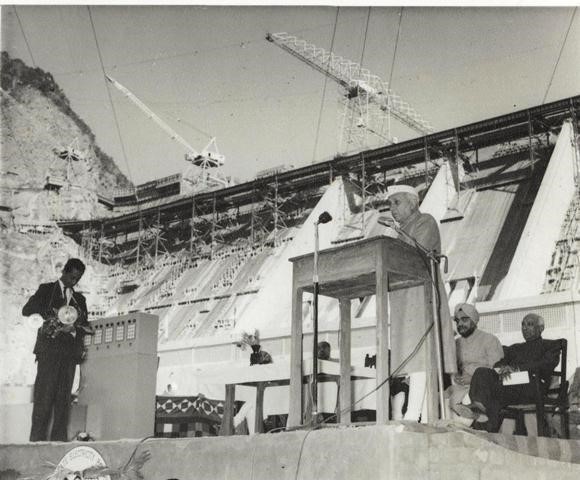
Figure 1: India’s first Prime Minister, Jawaharlal Nehru, at the Bhakra Dam in 1953.
Source: Wikimedia Commons
In 1947, following India’s independence, the Constitution of India espoused participatory democracy. Yet public involvement has remained conspicuously low in both the framing of water-related problems and in identifying solutions. Instead, the hydrocracy has been unilaterally deciding how and for whom water flows. Ironically, the rise of democracy in India after it gained its independence only strengthened the hydrocracy, achieved at a scale commensurate with the demands of a steadfast hydraulic mission in the post-independence context.
Emboldened by former Prime Minister (PM) Jawaharlal Nehru’s call for temples of modern India and the newly imported style of multipurpose river valley development projects in the decolonising world from the Global North, the hydraulic mission got intertwined with the twin objective of creating a welfare state and a modernist state. The welfare state aimed to mitigate the risk of periodic droughts, famine, and food crises through large water control infrastructure. The modernist state believed in large public sector projects to create a ‘modern’ India that breaks itself from the (rich pre-colonial) past. The intertwining created a continuity for the colonial hydrocracy in the post-colonial period and served to strengthen its legitimacy as an important actor in ‘nation building’.
Even when public participation in water resource projects is required by law, such as during environmental impact assessments, genuine engagement remains rare.
As the hydrocracy strengthened, there was hardly any room for negotiation or meaningful dialogue with the diverse constituency. Ramaswamy Iyer, an eminent figure within India’s state apparatus, an architect of the first National Water Policy, and also a critic of the hydrocracy in his later years, described this post-independent phase as one of “innocent ignorance.” The centralisation and a narrow disciplinary focus of the episteme continue. Even when public participation in water resource projects is required by law, such as during environmental impact assessments, genuine engagement remains rare. Public consultations often serve only a symbolic purpose, aimed at securing consent while minimising dissent.
Yet, beyond these top-down processes, communities across generations of lived experiences have developed an intrinsic, locally adapted understanding of how water flows in a cyclical pattern, and how to cope with its surpluses and scarcities. The daily engagement of society with water—across space, time, and generations—results in a nuanced understanding of water and possible development and management ways. Borrowing from feminist theorist Donna Haraway, this understanding of society regarding water could be termed as situated knowledge. Since India’s independence, the engineering-dominated paradigm of hydrocracy has been regularly pitted against the situated knowledge paradigm that embraces a more intuitive and heuristic civil engineering perspective. Nonetheless, the latter has represented far less discursive power and often loses out in policy and decision-making spaces.
With time, the social existence of water has been laid bare as water problems have gotten increasingly more ‘wicked’ – a term that highlights their distinctive complexity. They are unstructured, with no clear cause-and-effect relationships; crosscutting through multiple, overlapping, and interconnected subsets of problems; and are often relentless.
It is now evident that the only way to deal with such complex problems is to engage with a wide array of stakeholders, along with experts representing multiple disciplines, to work collaboratively and consensually.
Consider any persistent problem, such as river pollution, flooding, groundwater depletion and deterioration, and low utilisation of canal irrigation within command areas, which would all exhibit these traits. It is now evident that the only way to deal with such complex problems is to engage with a wide array of stakeholders, along with experts representing multiple disciplines, to work collaboratively and consensually. This inherently calls for institutionalised power-sharing mechanisms. However, such mechanisms would hardly emerge organically within the traditionally hierarchical and centralised governance systems dictated by the hydrocracy. Decentralisation of authority and devolution of power are resisted. At best, responsibility for managing these infrastructures is handed over to local communities and local non‑state actors. However, the inherent path dependency of these infrastructures and services, as explained before, still works to preserve the existing power structure.
As hydroclimatic regimes are left irreversibly altered due to climate change, the need of the hour is to be nimble and adaptive in responding to these challenges. The solution must move beyond replicating universal remedies—an approach most compatible with the Hydrocracy—and instead be reflexive to past and present actions, while responding in ways that are contextually consistent, locally grounded, and technically ‘smart’.
Considering both the reach of government agencies and their financial capacity—especially in the context of the Global South—the purpose of addressing wicked water problems would be better served if a more collaborative and adaptive approach were adopted. For this to happen, polycentricity—or the recognition of multiple, independent centres of decision-making authority that interact in complicated ways—must be explicitly recognised in water policy and praxis. The Lewinian Model of Change, with its emphasis on unfreezing existing mindsets and refreezing new behaviour, is perhaps nowhere more important than within the hydro-bureaucracy. So, too, is a better understanding of how intentional learning practices can be built into water governance practices.
The solution must move beyond replicating universal remedies—an approach most compatible with the Hydrocracy—and instead be reflexive to past and present actions, while responding in ways that are contextually consistent, locally grounded, and technically ‘smart’.
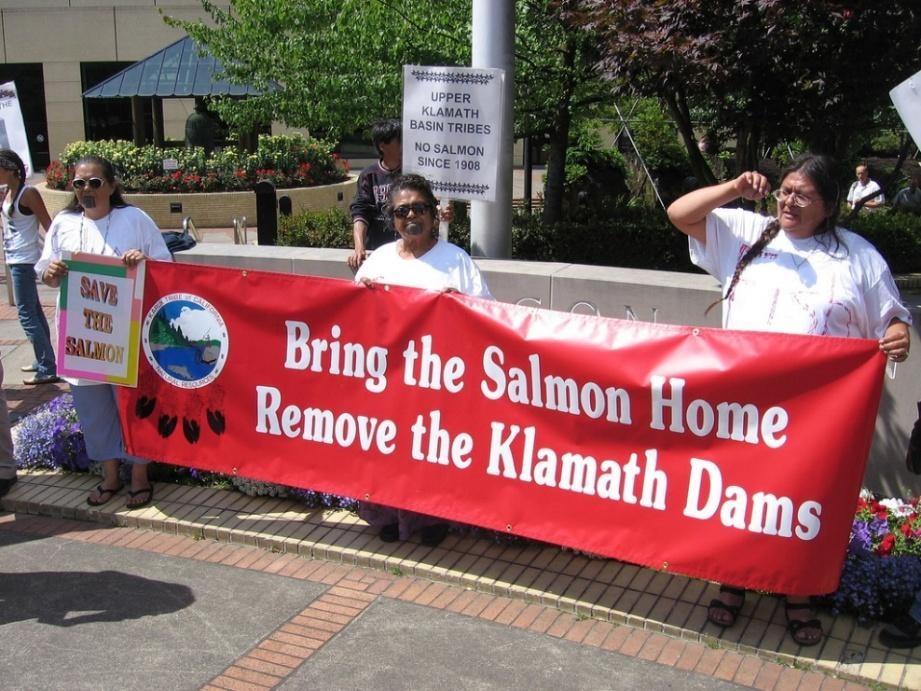
Figure 2: Demonstrators from the Karuk tribe calling for the removal of dams in 2006 on the Klamath River in the USA. All dams were removed by 2024.
Source: Wikimedia Commons
The question remains: what would happen if hydrocracy had to become more collaborative? Cases from around the world demonstrate the potential and the necessity for power-sharing, stakeholder engagement, learning, and adaptive governance in managing complex water systems. For instance, in the Colorado River Basin, numerous collaborative venues have been established over the past several decades to address emerging issues, especially in the context of dwindling water availability. These collaborative venues focus on issues ranging from salinity control to endangered fish recovery, binational cooperation for the delta and more.
Furthermore, deepened binational cooperation between the US and Mexico has recently led to environmental water releases through Minute 319, reviving riparian vegetation, and showcasing how state actors, NGOs, and local communities can co-manage water beyond hydraulic control. Similarly, in Australia’s Murray-Darling Basin, reforms have instituted more structured power-sharing through the allocation of water entitlements and environmental flows. These arrangements involve federal, state, and local actors and attempt to balance ecological imperatives with agricultural demands, though tensions between these objectives persist.
Thus, this is not to suggest that these systems are flawless or without challenges. Rather, they mark a beginning—and an urgently needed one
Sayanangshu Modak is a doctoral candidate in the School of Geography, Development and Environment at the University of Arizona.
Nirmalya Choudhury is an Associate Professor with the Jamsetji Tata School of Disaster Studies, Tata Institute of Social Sciences, Mumbai.
Andrea K. Gerlak is a Professor at the University of Arizona, School of Geography, Development & Environment and Director of the Udall Centre for Studies in Public Policy.
The views expressed above belong to the author(s). ORF research and analyses now available on Telegram! Click here to access our curated content — blogs, longforms and interviews.

Sayanangshu Modak is a doctoral candidate in the School of Geography, Development and Environment at the University of Arizona. ...
Read More +
Nirmalya Choudhury is an Associate Professor with the Jamsetji Tata School of Disaster Studies, Tata Institute of Social Sciences, Mumbai. ...
Read More +
Andrea K. Gerlak is a Professor at the University of Arizona, School of Geography, Development & Environment and Director of the Udall Centre for Studies ...
Read More +


 PREV
PREV